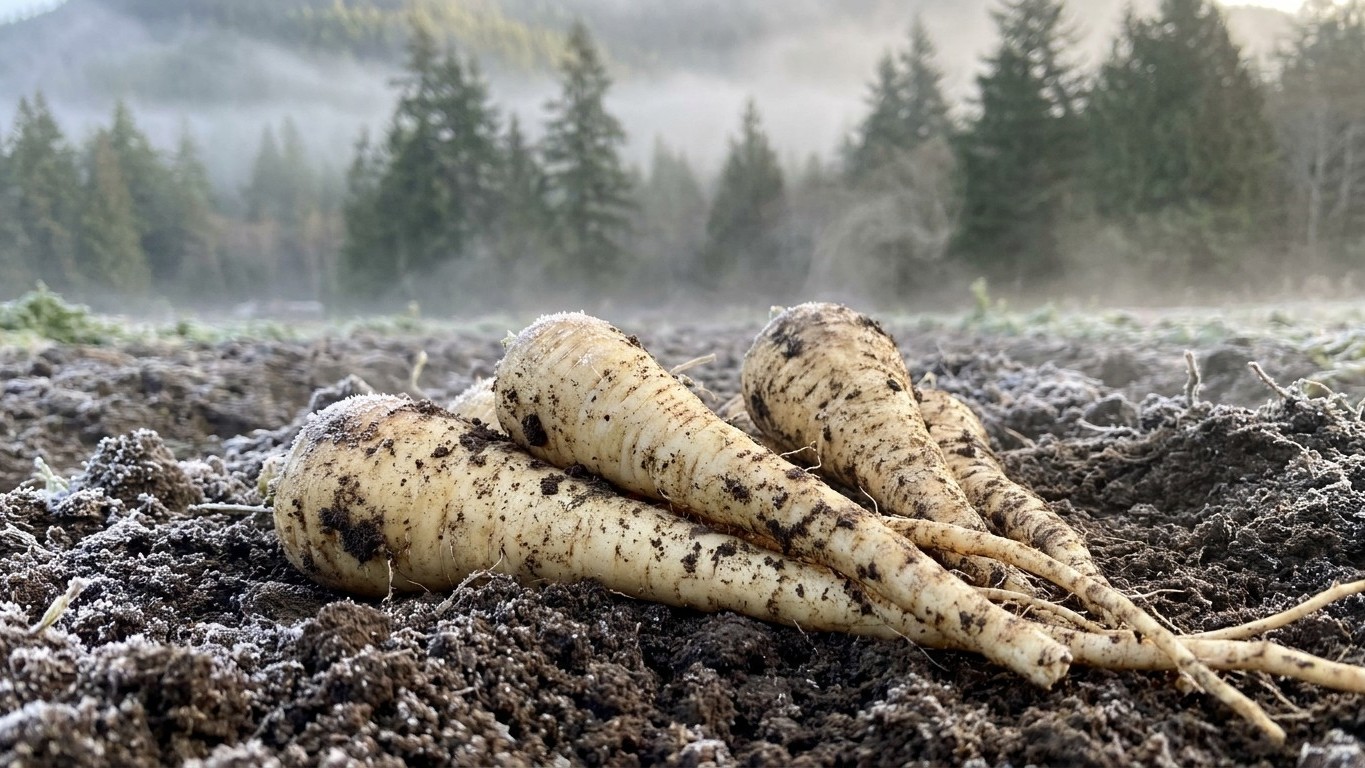

Lift parsnips in the Northwest Territories after several weeks of frost. Cold is never the problem here. The coldest month averages a daily minimum of -29.5 °C. What decides the crop is whether a 100 to 120 day vegetable finishes in a short summer, and how it is stored afterward. Kept cold, humid and away from fruit, roots hold for four to six months.
The short answer
Does this territory deliver several frosty weeks? Without question. The mean daily minimum of the coldest month at Yellowknife is -29.5 °C, and the first fall frost arrives on average September 18. A parsnip grown here will sweeten, not merely grow, because weeks of cold turn stored starch into sugar. The risk runs the other way: winter can arrive before you have lifted the row. The full growing picture is in Growing Parsnips in Northwest Territories, and the chemistry behind the flavor is in Will Parsnips Sweeten in Northwest Territories?
When should you lift parsnips here?
Wait for several weeks of cool, frosty weather after the first hard frost. Counting from a mean first frost of September 18, that lands in early to mid October. Treat the date as the midpoint of a window. In one year out of two the first frost comes earlier, and the station at Yellowknife A does not speak for every community. Districts farther north or on higher ground run weeks apart from it, so a local growers’ group will know your own timing better than any average.
The other limit is the soil. Once the top layer sets hard, digging gets slow and the roots get nicked. Lift while a garden fork still goes in cleanly. If you want to hold some roots in the ground a little longer, a thick mulch over the row keeps the soil workable for more weeks.
How long do parsnips keep once lifted?
Start with what spoils them, because it is not the cold. A parsnip is not chilling sensitive, so a root can sit near freezing without harm. What ruins it is ethylene, the ripening gas that apples and other fruit give off. Even a low level in cold storage makes parsnips turn bitter, so keep them in a separate space from any fruit.
The storage reference from the USDA (Agricultural Handbook 66) puts the keeping time at four to six months. That assumes 0 to 1 °C (32 to 34 °F) with 98% humidity, held steady. Almost no house does that. A cold cellar, an unheated porch that stays above freezing, or a spare refrigerator comes closest. Packing roots in a container of damp sand or sawdust helps hold the humidity. Expect less than the full six months in a warmer, drier spot.
Top the roots after lifting, but do not trim into the crown. Cutting the crown opens the root to rot.
Does the season fit?
It fits, but tightly. Parsnips are sown in place, and the 100 to 120 days run from seeding. The usual advice is to sow two to three weeks before the last spring frost. The steps below show how that plays out against the frost window at Yellowknife.
- The mean last spring frost is May 25. Half of all years the last frost falls later than that, so it marks the middle of the window and is no safe date. Sowing two to three weeks ahead means roughly May 4 to May 11.
- The reference station has about 116 frost-free days between the mean last spring frost of May 25 and the mean first fall frost of September 18.
- Add 100 to 120 days to an early May sowing and the roots finish between mid-August and the second week of September, ahead of the average first frost.
- Northern soil often stays cold and wet through early May, and a seed that sits in it germinates slowly. Sowing as soon as the ground can be worked is the practical target, even if that falls a little after the textbook window.
- A sowing in the last days of May still finishes in September, right around the first frost. That is acceptable for this crop, because roots keep sizing up in cool weather and the cold that follows is what sweetens them.
- A sowing much past the first week of June leaves the roots short of full size when the ground freezes. Small roots still taste good, but the harvest shrinks.
Remember that the seed is slow. Digging it up and re-sowing is the most common mistake, and in a short season it costs the whole crop.
What goes wrong here
Winter is far from too mild to sweeten roots in this territory, so the failures come from soil, water and timing. The pests that can add to them are covered in What Eats Parsnip in Northwest Territories, and When.
- Forked roots from heavy or stony ground. Parsnips want deep, sandy soil, and heavy soil needs double digging, according to Utah State University Extension. Where the soil is thin over rock or full of stones, the tap root splits around every obstacle. The remedy is to loosen the bed deeply and pull out stones, or build a raised bed deep enough for a full-length root and fill it with loose, sandy loam.
- Forked roots from overwatering. This is a separate cause with the same symptom. Constant wet soil makes the root branch and also invites rot. Keep the row evenly moist while the seed germinates, then water deeply only when the top few inches dry out and let the roots chase moisture downward.
- A season that runs out. A late sowing, or a cold spring that holds germination back, leaves small roots when freeze-up arrives. Sow as soon as the soil can be worked, resist the urge to re-sow during the 14 to 21 day wait, and lift small roots anyway rather than leave them to be locked in frozen ground.
- Frozen ground before you lift. A hard freeze can seal the row for months, and the roots cannot be dug until the thaw. Lift by mid October, or mulch the row thickly and open it up in short stretches as you need roots.
Common questions
Can parsnips stay in the ground all winter in the Northwest Territories?
The roots tolerate frozen soil, but the ground here stays hard for months, so digging them in midwinter is impractical. Lifting in the fall and storing the roots cold is the dependable route. Roots left in over winter can also attract pests, which is another reason to lift before the ground locks up.
How do I know the parsnips are sweet enough to lift?
Taste one. Pull a root, rinse it and bite a thin raw slice. Sweetness arrives after several weeks of cool, frosty weather, and a root that still tastes starchy needs more time in the cold. Check again a week later rather than guessing from the calendar.
Can I store parsnips next to apples?
No. Apples and other ripening fruit release ethylene, and even a small amount in cold storage turns parsnips bitter. Give the roots their own box or their own shelf in a separate room, with the stored fruit well away.
Why has my parsnip row not come up?
Parsnip seed is slow to germinate, and cold northern soil sits at the slow end of that. Keep the row lightly and evenly moist and wait the full three weeks before concluding the seed failed.