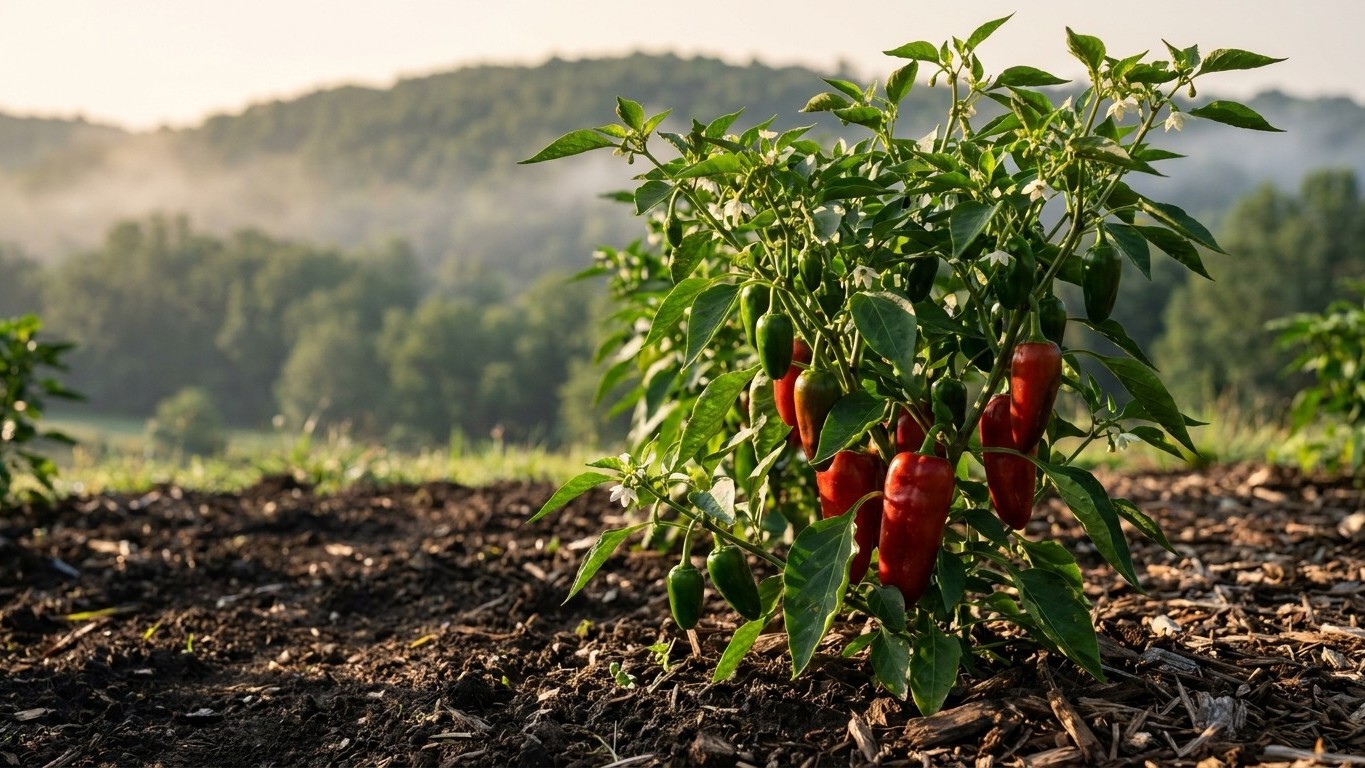

Pick peppers once the fruit is full size, firm and glossy, which Clemson Cooperative Extension puts at about 70 to 85 days after transplanting. Then keep them out of the refrigerator. Fresh peppers store best at 45 to 50 °F (roughly 7 to 10 °C), and a fridge runs colder than that. Below about 45 °F the skin pits and the flesh softens, a problem called chilling injury. It is the mistake nearly everyone makes with a fresh harvest.
Keeping them, and for how long
Why does the fridge damage peppers?
Peppers are a warm-season crop, and cold hurts their tissue even when nothing freezes. A fridge is normally kept at 40 °F (about 4 °C) or below, at least five degrees under the bottom of the range peppers tolerate. Time in that cold shows up as small sunken pits, soft patches and water-soaked spots on the skin. Rot follows quickly, because damaged tissue gives mold an easy way in. The damage often appears only after the pepper has come back to room temperature, so a pepper that looked fine going in can be mushy two days later.
Clemson Cooperative Extension’s pepper fact sheet gives the storage conditions plainly: temperatures of 45 to 50 °F and 80- to 90-percent relative humidity, for two to three weeks. Both numbers matter. At that temperature, dry air still pulls moisture out through the skin, and the fruit wrinkles. A fridge crisper drawer adds humidity but cannot fix the temperature, so it solves only half the problem.
How long do picked peppers last?
Two to three weeks is a ceiling. It describes sound, undamaged fruit held at both the right temperature and the right humidity at the same time. Most kitchens and basements miss one or both of those marks, so plan on less. Fruit with cracks, sunscald patches or insect damage will not reach the ceiling, and neither will fruit that spent a cold night on the plant before picking.
A few habits stretch the time you do get:
- Cut each pepper with pruners and leave a short stub of stem, because pulling tears the fruit and the branch.
- Keep the fruit dry. Skip washing until you are ready to eat it.
- Store peppers loosely in a perforated bag or a ventilated container, which holds humidity without trapping water against the skin.
- Check the batch every few days and use the soft ones first, since one rotting pepper spreads to its neighbors.
Once a pepper is cut open, it belongs in the fridge, because the chilling problem applies to whole, intact fruit. Anything you cannot use within the storage window can be sliced and frozen, dried or pickled. A good rule is to freeze the surplus in the first week, while the fruit is still crisp, rather than waiting for the last-minute rescue.
Where in the house that actually is
The numbers sound simple until you go looking for 45 to 50 °F in an ordinary house. Most rooms miss it in one direction or the other.
Heated living space is too warm. A kitchen counter or a pantry shelf near a furnace duct sits well above that range, and heated indoor air is dry. Peppers left there lose firmness and shrivel within days instead of weeks. The refrigerator is the opposite problem: too cold, and cold enough to injure the fruit.
An attached or detached garage looks promising because it is cool, but it follows the weather. On a mild fall afternoon it may sit near the right range, and by the next morning it can be close to freezing. A freeze ruins peppers just as surely as the fridge does, only faster. A garage can work for a few days in a steady stretch of weather, but it is a poor place to count on for two weeks.
The room that comes closest in most Yukon homes is a cool, unheated interior space. Think of a basement corner away from the furnace and water heater, a cold room, or a pantry against an outside wall that gets little heat. Basements are the usual best bet because the ground keeps their temperature steadier than the air outside. Even so, one basement can read 48 °F and the next 60 °F, depending on insulation, ductwork and how the house is built.
That is why a guess is not good enough. Set a min-max thermometer in the spot for two or three days before the harvest comes in, and read both the low and the high. If the space stays between 45 and 50 °F, you have found your storage spot. If it runs warmer, peppers will still keep better there than in the fridge, but expect the shorter end of the window and check them more often. If it dips under 45 °F, the same chilling injury applies, so move the crate to a warmer spot. Skipping this step is how a good harvest ends up as a tray of pitted, soft peppers.
A small hygrometer is cheap and tells you whether the 80 to 90 percent humidity is within reach. If the air is dry, the perforated bag does most of the work. Everything you learn about your house also carries over to next year, so write the readings on the box.
Common questions
When should I pick peppers in Yukon?
Start from planting. Transplants need 8 to 10 weeks indoors and go out when the soil reaches 60 °F (about 16 °C), after frost, according to Utah State University Extension. At the Whitehorse A reference station, Environment and Climate Change Canada’s climate normals put the mean last spring frost on June 5. That is the midpoint of a window. In one year out of two the last frost falls later, and northern or upland districts run weeks behind that station. Clemson’s 70 to 85 days after transplanting then gives a rough range: a plant set out on June 5 would reach the early end around mid-August. Later planting or a cool summer pushes everything later, so treat the range as a floor.
Pick when the fruit has reached full size and feels firm and glossy. When frost is forecast, bring in every pepper that has reached full size, because a frozen plant is finished. For the full season picture, see Growing Peppers in Yukon.
Can I leave peppers on the plant until they turn red?
Yes, but it is a gamble in a short season. Full-size green peppers are mature enough to eat, and picking them also encourages the plant to keep producing. Color takes extra time, and fruit left hanging longer is exposed to frost and to whatever feeds on it. A pepper that has already started to color will often finish indoors. A sensible split is to pick most of the crop at full size and leave a few fruits to color while the weather holds. What Eats Pepper in Yukon, and When covers what to watch for on fruit that stays out late.
Do heat and cold affect peppers before I even pick them?
They do, and mostly through fruit set. Pepper fruit set fails at both ends: nights below 55 °F (about 13 °C) or days above 90 °F (about 32 °C). The hot end is rare at the Whitehorse A station, which averages 0.28 days a year reaching 32 °C and 0.92 days a year above 30 °C. That count covers extreme days only and says nothing about whether the season is long enough, so it is no reason to write off peppers here. The cool end depends on your own location, so watch your own nights through flowering. A cold stretch then can mean fewer peppers to pick later, a problem covered in Why Peppers Fail to Set Fruit in Yukon.
Is it ever fine to put whole peppers in the fridge?
As a last resort, for a short stretch. Chilling injury builds the longer fruit sits below about 45 °F, so a day or two does less harm than a week. The pits and soft spots tend to show up after the pepper warms, so use those fruits first and plan to eat them soon. For anything you want to keep longer, the cool basement spot is better, and freezing is better than leaving whole peppers in the cold to slowly spoil.