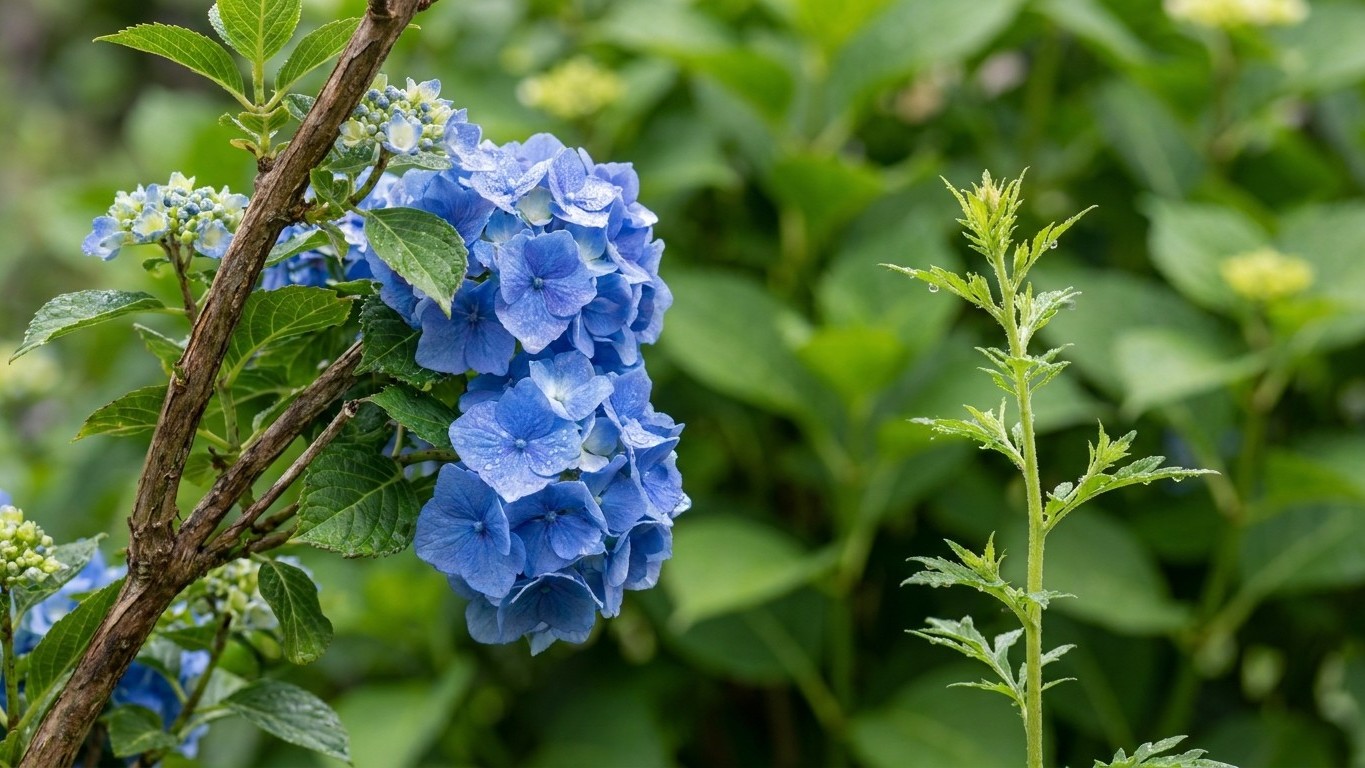

Hydrangea flowers turn pink when the soil holds little available aluminum, and in Massachusetts that happens more often than the region’s acidic reputation suggests. Lime leaching from concrete foundations, lawn lime, alkaline public water and limestone bedrock in parts of the Berkshires all push soil pH up. To get blue, bring the pH down to roughly 5.2 to 5.5 and keep aluminum available. This works only on bigleaf types, and it usually takes a full growing season or more.
What this comes down to in Massachusetts

A bigleaf hydrangea in Massachusetts turns blue only if the soil is acidic enough, and its growing season runs from the last spring frost (April 1 to April 8 at Boston’s Logan Airport, per NOAA NCEI 1991-2020 Climate Normals) to the first fall frost (November 3 to November 14 at the same station). Logan is a waterfront station and milder than most inland sites, so inland suburbs and the Berkshires generally start later and finish earlier.
What makes hydrangea flowers pink or blue?
One pigment produces both colors. When aluminum is available, the plant pulls it up through its roots and the pigment binds to it, giving blue. Without aluminum, the same pigment shows as pink or red. Most New England soils contain plenty of aluminum. The question is whether it dissolves, and that depends almost entirely on pH.
| Soil pH (approximate) | Aluminum in the soil | Typical bigleaf flower color |
|---|---|---|
| Below about 5.5 | Dissolved and available | Blue |
| About 5.5 to 6.5 | Partly available | Purple, or a mix of blue and pink on one plant |
| Above about 6.5 | Locked up | Pink to red |
Phosphorus adds a second lever. It ties up aluminum inside the plant, which is why a high-phosphorus “bloom booster” fertilizer tends to nudge flowers toward pink even in soil that is acidic enough.
Why do so many Massachusetts hydrangeas end up pink?
Glacial sand and till across eastern Massachusetts are naturally acidic, and the blue hydrangeas of Cape Cod and the islands show it. But gardens are rarely left in their natural state. Concrete and mortar foundations release lime into the bed beside them for decades. Lawn care in this region routinely calls for lime, and spreaders throw it into neighboring beds. Some public water systems are treated to run mildly alkaline, so watering with a hose can raise pH slowly. Your water utility can tell you how yours is treated.
Parts of the Berkshires also sit on limestone and marble bedrock, which pushes soil pH up on its own. And some cultivars lean pink by breeding, so they resist blue even when conditions are right. Check the plant tag, and ask the nursery whether the cultivar was selected for pink or red.
Working it out for your own garden
The method is the same everywhere in the state: measure, set a target, adjust, then wait one season for the buds to respond. A test result beats guessing from the flower color, because a plant can look pink one year and purple the next with no change in what you did.
How do you find out your soil pH?
Send a sample to a lab. The soil testing service at UMass Amherst Extension reports pH and nutrient levels, including phosphorus. Take the sample from the root zone, a few inches down and a foot or so from the stem, and avoid the strip right against a foundation unless that is where the plant grows. Home pH probes and drugstore kits give a rough read, but a lab number is steadier.
Suppose the result is 6.4 with high phosphorus. That points to a pink or purple plant. To reach blue, the pH needs to drop by about one point, to the 5.2 to 5.5 range, and the phosphorus should stop climbing. Sandy soil shifts quickly. Heavy clay and soil rich in organic matter resist change and need more product and more patience.
When and how do you lower the pH?
Two products do the work. Aluminum sulfate acts quickly and supplies aluminum directly, but it can burn roots if overapplied, so follow the label rate and water it in to moist soil. Elemental sulfur works slowly, because soil microbes have to convert it, and it needs warm soil and a few months to take effect. Many gardeners use sulfur for the long job and aluminum sulfate for a quicker nudge.
Use the frost window as your calendar. At Logan the last frost falls April 1 to April 8, so work can begin in early April once the ground thaws and the shrub is leafing out. Inland the start shifts later. Spread the applications through spring and early summer, following the product label, and stop well before the first fall frost window of November 3 to 14. Flower buds form on the plant through the growing season, and the color they carry reflects what the roots took up while they developed. Expect partial change in the first summer and a clearer result the next.
For a plant against a concrete foundation that keeps leaching lime, a large container with acidic potting mix is often the simpler route to blue. A container also lets you control phosphorus and pH from the start.
What changes across the state
A state with Cape Cod at one end and the Berkshires at the other does not run on one calendar. Logan’s dates describe a mild waterfront. Towns on the Cape and islands get a longer season moderated by the ocean, while inland suburbs frost sooner in fall and later in spring. The Berkshires frost noticeably earlier and later still. That shrinks the window in which aluminum applications can do their work, so inland gardeners should start when their own soil thaws and leaves open, not when the Boston calendar says so.
Soil shifts with the map as well. Sandy coastal soils are acidic and respond quickly to amendments. Glacial till inland is usually acidic but varies stone by stone and lot by lot. In the western valleys with limestone or marble beneath, pH can sit high and keep creeping back up after you lower it, so retest every year or two rather than treating it as a one-time fix.
Cold matters for color too, in a way people overlook. The USDA Plant Hardiness Zone Map rates average annual extreme minimum temperature, and it spans roughly zones 5 to 7 across Massachusetts. In the colder zones, bigleaf hydrangeas often lose flower buds to winter, since they bloom on old wood. A plant that does not flower cannot show blue, however perfect the chemistry. Our guide to Protecting Hydrangeas Through a Massachusetts Winter covers that side, and When to Prune Hydrangeas in Massachusetts explains why a spring haircut can remove the very buds you are trying to color.
The mistakes this state punishes

Using a bloom booster is a common one. Fertilizers sold for flowers are high in phosphorus, and in a bed that is otherwise heading toward blue they undo the work. Choose a formula low in phosphorus and higher in potassium.
Lawn lime is next. Because so much of the region’s soil is acidic, spring lawn liming is routine, and drift from a spreader or runoff from a limed slope can raise pH in the hydrangea bed next to it. Keep lime off the beds, and test that soil before blaming the plant.
Applying product too early is a third. A warm March spell can tempt you to start, but a late frost can still nip new growth in April, and amendments on a stressed shrub in cold, wet soil do little. Wait until the ground has thawed and the leaves have opened. Dry soil is a mistake as well, since aluminum sulfate on a dry root zone can burn. Water the bed first and again after.
Impatience costs gardeners too. Buds are already set by late summer, so a treatment started in August rarely changes that year’s flowers. Plan on the next summer for the real result.
Finally, trying to recolor the wrong plant wastes a season. Panicle hydrangeas, smooth hydrangeas such as Annabelle types, oakleaf hydrangeas and white bigleaf types do not respond to soil chemistry. Only blue-to-pink bigleaf and some mountain hydrangeas do. If you are unsure what you have, our guide to growing hydrangeas in Massachusetts helps identify the type.
Checking this against your county
The dates and ranges above are starting points. A garden in the Berkshires, one in Worcester County and one on the Cape sit in different conditions, and your own soil can differ from your neighbor’s across a fence. UMass Extension can tell you how local soils and water behave and when your area typically frosts. The UMass Amherst Extension site also carries soil testing instructions and its own hydrangea guidance for the state.
Common questions
How long does it take to turn a pink hydrangea blue?
Expect some bluing or purple tones in the first summer and a clearer blue the following year. Buds form on the plant through the growing season, so what you apply now shows mostly in later blooms. In heavy clay or high-pH soil it can take two seasons.
Do coffee grounds or rusty nails turn hydrangeas blue?
Rusty nails supply iron, and the color change depends on aluminum, so they do nothing useful. Used coffee grounds are only a mild soil amendment and will not move pH enough on their own. A soil test and sulfur or aluminum sulfate are more reliable.
Will every hydrangea change color?
No. Bigleaf hydrangeas and some mountain hydrangeas change. Panicle, smooth, oakleaf and white-flowered types do not, because their color does not respond to aluminum in the soil.
Can I turn a blue hydrangea back to pink?
Yes. Raise the soil pH to about 6.5 or a little above with garden lime, based on a soil test, and use a fertilizer higher in phosphorus. The change is gradual and takes a season or more. Keep in mind that acidic Massachusetts soil will tend to drift back toward blue.