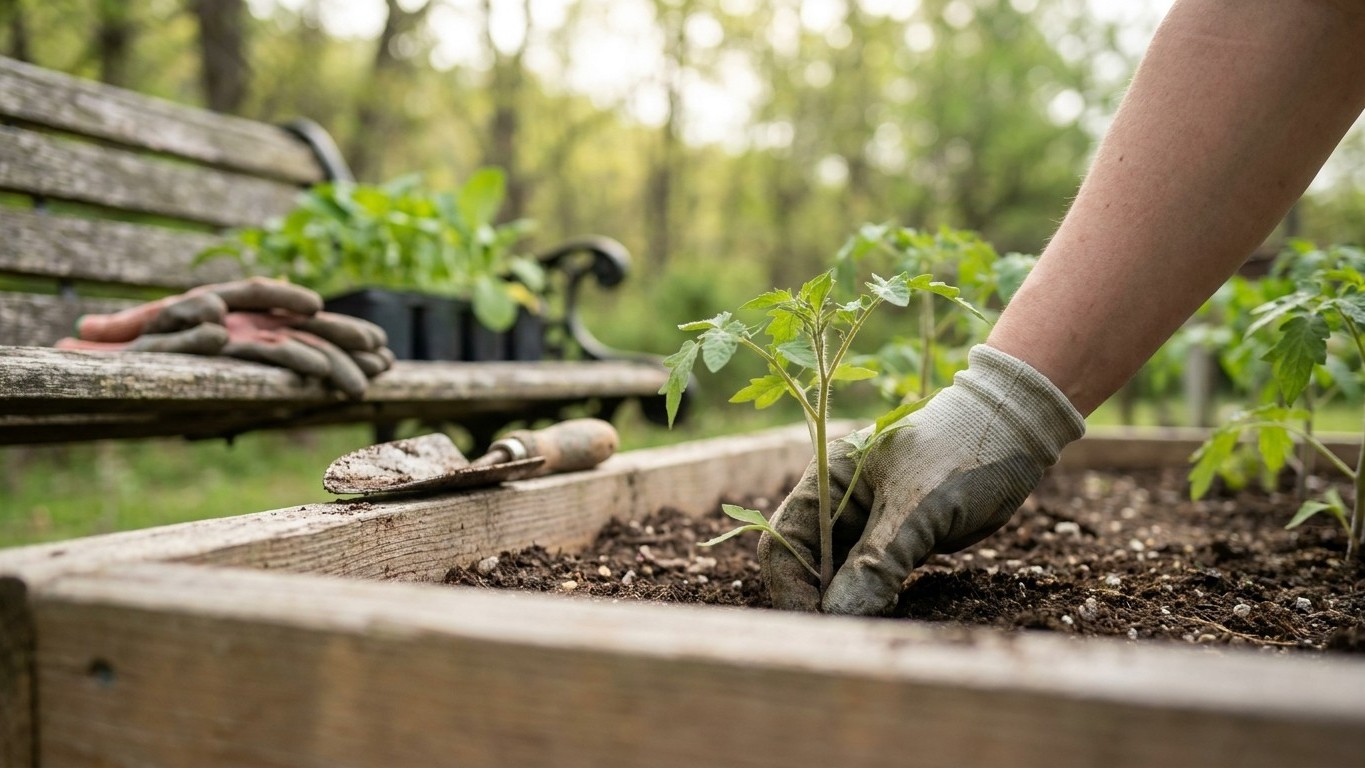

In West Virginia, Tomato Planting Dates follow the last spring frost window, and NOAA’s NCEI 1991-2020 climate normals put that window at April 9 to April 23 for the Charleston area. Start seed indoors roughly six to eight weeks before that window opens, then hold off transplanting until the risk of frost has genuinely passed where you garden, not where the calendar says it should have. Check your own county’s frost history against Charleston’s before you lock in a date.
What this comes down to in West Virginia

Charleston’s river valley gets a head start most of West Virginia doesn’t share. April 9-April 23 is a real frost window, but it belongs to that valley floor, not to a ridge twenty miles off or a hollow that traps cold air well into spring. The state runs from zone 5a to 7a on the current hardiness map, which means two gardeners can both call themselves West Virginians and still be weeks apart on when it’s safe to set tomatoes outside. Your own last frost, not the valley’s, is the number that counts.
Charleston sits in a river valley, and NOAA’s own station notes flag that fact directly: valley floors like this one warm up earlier in spring and hold heat longer into fall than the ridges and hollows around them. So the April 9-April 23 window is not a date you can circle on a calendar; it’s a range, measured at one specific location. If you garden in the Kanawha Valley itself, it applies fairly directly. Anywhere with more elevation or a colder local pocket, treat it as a starting point and expect your own last frost to run later, not earlier.
The USDA Plant Hardiness Zone Map, built from the same 1991-2020 climate normals, places the state across zones 5a to 7a, and that spread alone tells you the state doesn’t share one planting date. A gardener at the cold end of that range works with a shorter frost-free season than one at the warm end, even though both are technically the same state. What matters for your own transplant date isn’t the zone number so much as your own local frost history, which a county extension agent can usually pin down more precisely than any statewide average.
The practical answer: don’t transplant tomatoes outdoors until you’re past the local equivalent of that April window, and don’t assume a date pulled from a seed packet or a neighboring county carries over unchanged to your garden.
Working it out for your own garden
The frost window only tells you when it’s safe to set plants outside. To get an indoor sowing date, you count backward from it using the timing most seed catalogs recommend, typically six to eight weeks before the transplant date. Do the arithmetic on the range, not on a single day pulled out of it.
The spring end of the calculation
Take Charleston’s April 9-April 23 last-frost window. Subtract roughly eight weeks from the early end and six weeks from the late end, and you land on a sowing window that runs from about mid-February to mid-March. That’s a range built from a range – it is not more precise than the frost data it started from, and picking one day out of it would be inventing precision that isn’t there.
| Timing | Task | Approximate window at Charleston |
|---|---|---|
| 6 to 8 weeks before transplant | Sow seed indoors | mid-February to mid-March |
| 1 to 2 weeks before transplant | Harden off seedlings outdoors | late March to mid-April |
| Frost window | Transplant into the garden | April 9 to April 23 |
The fall end of the calculation
The other end of the season matters just as much. NOAA’s normals put Charleston’s first fall frost between October 18 and November 1, which means a transplant set out in the April window has, roughly, a six-month run before frost closes things down again. A cultivar’s days-to-maturity number, printed on the seed packet, counts from transplant, not from seed – the sibling page on Tomato Varieties That Ripen in Time in West Virginia lists real cultivars with real day counts, and the arithmetic here works the same no matter which one you pick.
Say a packet lists 75 days to maturity. Transplanted anywhere in the April 9-23 window, that fruit ripens somewhere from late June into mid-July, weeks before Charleston’s fall frost window even opens. A slower 90-day cultivar set out at the same time still finishes with a month or more to spare. Around Charleston, the season is long enough that days-to-maturity rarely decides the outcome on its own – a late transplant date or a cold snap right after transplanting is far more likely to be what actually costs you the harvest.
What changes across the state
Charleston’s numbers are a reference point, not a forecast for the whole state. West Virginia’s terrain is what makes that true: the state runs from river valleys to ridgelines and plateaus well above them, and elevation is the single biggest thing moving these dates around.
Higher ground freezes earlier in fall and thaws later in spring than a valley floor like Charleston’s. NOAA’s own station data flags this pattern directly for the Charleston site: a river valley warms up sooner in spring and holds its heat longer into fall than the hills around it. A garden in the Eastern Panhandle’s higher elevations, or in one of the state’s mountain counties, should expect both ends of the frost-free season to close in – later in spring and earlier in fall – compared to what the Charleston figures show.
Cold air also pools, physically, in low ground. Frost settles into hollows and bottomland even at modest elevation, so two gardens a few miles apart, one on a slope and one in a low spot, can have noticeably different frost histories even inside the same county and the same USDA zone. The USDA hardiness map’s 5a to 7a spread across the state is shorthand for exactly this kind of variation. It is not one number, and no single planting date derived from Charleston’s station fits every one of those zones equally well.
None of that makes the Charleston window useless elsewhere. It’s a reasonable starting estimate for the Kanawha Valley and similar low-elevation river corridors, and a useful baseline to adjust from everywhere else. The adjustment itself holds statewide even when the exact number of days doesn’t.
The mistakes this state punishes

A few errors show up again and again in West Virginia gardens, and they’re tied directly to this state’s swingy spring weather.
The first is trusting a warm stretch instead of the frost data. This state can throw a run of warm days in late March or early April, right inside the period when NOAA’s normals still show a real chance of freezing weather through April 23 at the Charleston station. Tomatoes set out during that warm spell can be knocked back hard, or killed outright, by the freeze that follows. Wait for the window to close, not for the air to feel like it already has.
The second is planting into cold soil. Air warms faster than soil, especially after a wet spring, and tomato roots stall in cold ground even when the plant above looks fine. A transplant that sits without growing for a couple of weeks loses most of the head start it was supposed to give you. Check the soil, not just the sky, before you commit a flat of seedlings to the garden.
The third is choosing a cultivar against the season on the seed packet’s photo instead of the season you actually have. The page on Tomato Varieties That Ripen in Time in West Virginia walks through matching days-to-maturity to this frost window in detail, and it’s worth doing that arithmetic before you buy seed, not after you’ve already got seedlings on a windowsill.
The fourth is missing early pest pressure because the calendar says it’s too soon. Some of the insects covered on the Tomato Pests in West Virginia: Which Ones Actually Show Up Here page work on a schedule of their own that has nothing to do with the frost calendar, and a transplant stressed by a late cold snap is an easier target for them. Keep a close eye on new transplants especially in the first couple of weeks after the frost window closes.
Checking this against your county
Everything above starts from one NOAA station near Charleston, and that’s a useful anchor, not a verdict on your own backyard. Your county’s frost history can run days or weeks off that range depending on elevation and local terrain, and the only way to know for sure is to check locally.
Start with WVU Extension, the state’s land-grant extension service, at extension.wvu.edu, and look for the office nearest you. Agents there track local frost patterns county by county and can tell you how your ground compares to the Charleston figures used here, often in a five-minute phone call that can save you a flat of seedlings.
Some gardeners also time this by the Moon: when to plant tomatoes by the moon, as almanac tradition rather than fact.
Common questions
Can I plant tomatoes in West Virginia in early April?
Only if you’re already past your local last frost, and at Charleston that’s uncertain before April 9 at the earliest, per NOAA’s 1991-2020 normals. Transplanting on the early edge of that window is a gamble almost anywhere in the state, and many gardeners wait until later in the range, especially away from a low river valley.
How late can I transplant and still get a harvest?
That depends on the cultivar’s days-to-maturity and how much frost-free season is left once you transplant. Count forward from your transplant date to your area’s expected first fall frost, compare that number of days to the cultivar’s rating, and leave some cushion for a cool stretch or an early freeze at higher elevation.
Do I need to worry about soil temperature separately from frost date?
Yes. A date past the last frost doesn’t guarantee warm soil, and tomato roots sit and sulk in cold ground even when the air feels mild. It’s worth checking the soil itself, not just watching the forecast, before you transplant.
What if I live somewhere colder than Charleston?
Then push your dates later on both ends: expect your last spring frost to land after Charleston’s window and your first fall frost to arrive before it. Your county extension office is the best source for how much later, since that gap depends on your specific elevation and terrain.