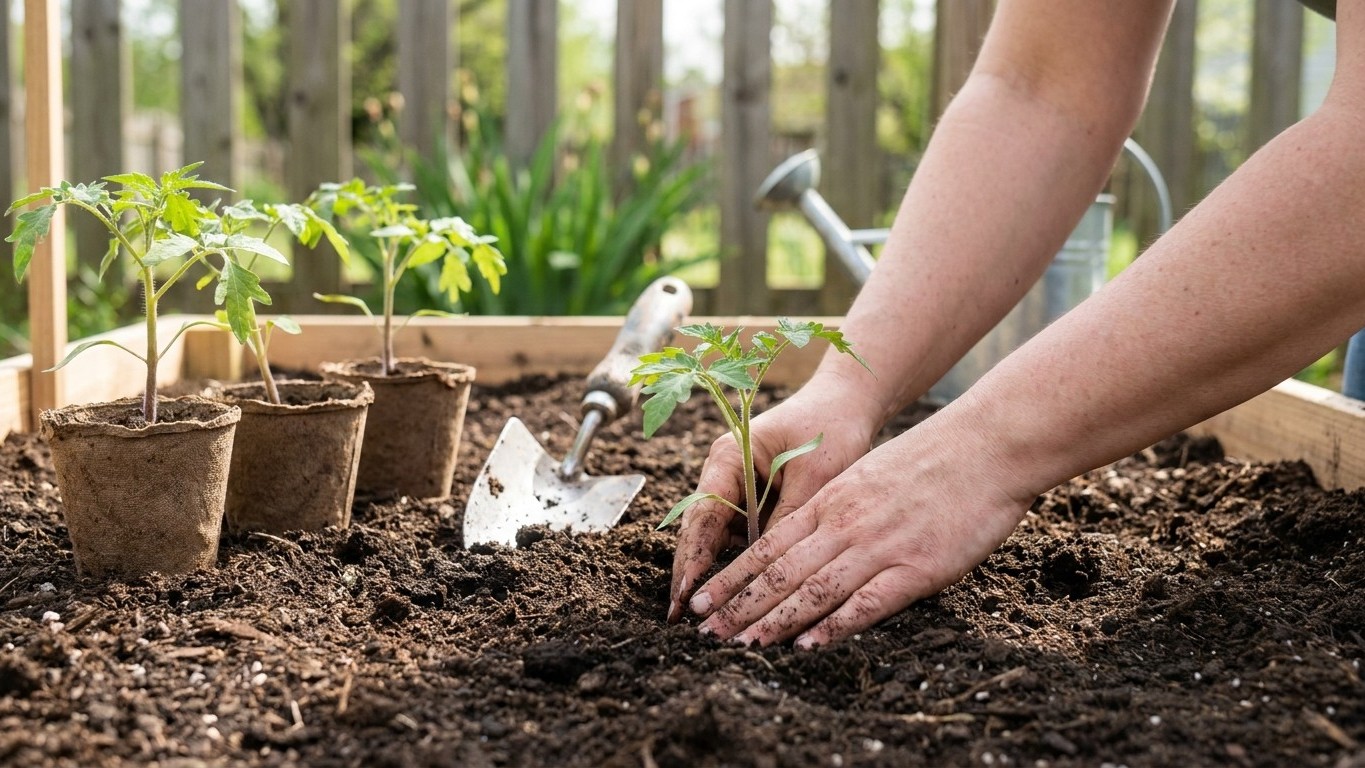

Virginia’s tomato transplant window opens once the last spring freeze has passed, and NOAA’s 1991-2020 climate normals put that freeze, for the Virginia Beach area (station NAS Oceana), between March 20 and April 3. That’s a two-week range, not a single day, because freeze risk fades gradually rather than switching off overnight. The action to take: pick your transplant date inside or just after that range for your own location, and keep frost cloth ready for the two weeks on either side of it, since warm air over still-cold soil is common here and catches people out.
What this comes down to in Virginia

A tomato transplant set out three days too early doesn’t just sulk—it can die outright, or limp along stunted for weeks after the warmth finally arrives, so the whole head start is wasted. That’s the trap of Virginia’s last-frost range: it looks like a suggestion, but it behaves like a deadline. Miss it on the early side and cold soil stalls roots even after the air turns mild. Wait too long and you hand back two weeks of season you didn’t need to lose.
The core decision is simple to state and easy to get wrong: tomato transplants go into the ground after the local last-frost range has passed, not on a date copied off a seed packet or a neighbor’s habit. A transplant set out during that freeze window, even under light row cover, can be killed outright or stunted badly enough that it never really recovers, even once warm weather returns. Waiting until the range has fully closed costs a couple of weeks of season. Planting right at the start of the range and covering on cold nights can buy those weeks back, but it means watching the forecast closely for about two weeks straight.
Soil temperature matters here almost as much as air temperature. A run of warm days in March can make garden soil feel ready for planting while the ground a few inches down is still cold enough to stall root growth, even after the freeze risk on the calendar has passed. That mismatch between warm air and cold soil shows up often on Virginia’s Coastal Plain, and it’s the main reason a transplant date is better treated as a range tied to the frost window than as one fixed day.
None of this settles which tomato to plant. Whether a given cultivar’s days-to-maturity actually fits inside this state’s frost-free season is a separate question, covered in Tomato Varieties That Ripen in Time in Virginia.
Working it out for your own garden
The method matters more than any single date, because it still works if you move across the state or get an unusual year. Start from the two frost ranges NOAA’s climate normals give for the Virginia Beach reference station, and count in both directions from them.
Counting backward: when to start seed
Tomato seed is typically started indoors six to eight weeks before the transplant date. Subtract that from the last-frost range rather than from a single day: eight weeks back from March 20 lands in late January, and six weeks back from April 3 lands in late February. So the indoor seed-starting window for the Virginia Beach area runs roughly late January to late February, a range built from a range, not a day picked out of it. Anyone gardening in a colder part of the state should slide this whole calculation later once they know their own last-frost range.
Counting forward: when fruit should ripen
The same logic works after transplanting. ‘Early Girl‘, a catalog-listed 50-day tomato, gives a rough idea: transplanted anytime inside the March 20 to April 3 window, first ripe fruit should arrive roughly 50 days later, putting harvest in the mid-to-late-May stretch. That lands comfortably ahead of the first fall freeze range of November 10 to November 24, which is the real check a days-to-maturity number needs to pass.
| Step | Timing (Virginia Beach reference) |
|---|---|
| Start seed indoors | Roughly 6 to 8 weeks before the last-frost window: late January to late February |
| Harden off transplants | 7 to 10 days before moving them outside, once nights are reliably milder |
| Set transplants outside | On or just after the last-frost window (March 20 to April 3), row cover ready for two weeks after |
| First ripe fruit, ‘Early Girl’ (~50 days) | Roughly 50 days after transplant: mid to late May |
Run this same arithmetic with whatever cultivar you’re actually growing, using the days-to-maturity printed on the packet, and check the result against the fall-frost range rather than a guess. That check is what tells you whether a long-season slicer is realistic before you commit a whole raised bed to it, a question the variety guide works through in more detail.
What changes across the state
Virginia spans USDA hardiness zones 5a to 8b, according to the USDA’s Plant Hardiness Zone Map, and that six-zone spread across one state tells you how much the frost calendar shifts between the coast and the mountains. The Virginia Beach figures used above sit at the mild end of that range. They are not a stand-in for the whole state.
Elevation is the biggest single driver. Gain enough elevation heading into the Blue Ridge or the far southwest, and both frost dates move against you: the last spring freeze arrives weeks later than it does at the coast, and the first fall freeze arrives weeks earlier, squeezing the growing season from both ends. Distance from the Atlantic and from the Chesapeake Bay works the other way. Large bodies of water moderate temperature swings, so places close to the coast tend to see their last spring freeze earlier and their first fall freeze later than inland spots at a similar latitude.
Latitude plays a smaller role than elevation in Virginia, since the state is wider east to west than it is tall, but the general pattern still holds: southern counties trend slightly milder than northern ones at similar elevation and distance from water. The right response to a six-zone state is not to guess at a mountain frost date, it’s to find the frost data specific to your own county, which the next section covers.
Microclimate matters at a much smaller scale too. A south-facing slope, a spot against a brick wall that holds heat, or a low pocket where cold air pools on clear nights can each shift the effective frost date on a single property by a week or more, regardless of what the regional numbers say.
The mistakes this state punishes

The most common one is trusting a warm spell instead of the calendar range. A week of 70°F days in mid-March feels like permission to plant, but the last-frost window for the Virginia Beach area runs all the way to April 3, and a cold night that returns after transplants are already out can undo weeks of head start in a single evening. Treat a stretch of warm weather inside the frost window as a chance to harden off plants outdoors during the day, not as a green light to leave them out overnight unprotected.
The second is picking a variety on flavor or size alone without running the days-to-maturity math against the fall-frost range. A tomato that needs a long, hot stretch to finish can still ripen at the coast, where the season runs long, and still fall short in a shorter, cooler part of the state. Do the arithmetic described above before choosing, not after the plants are already in the ground; the variety guide lays out which cultivars fit a shorter window.
The third is skipping the hardening-off step because the transplant date has already arrived and there’s a rush to get plants in. A tomato seedling raised indoors or under lights has soft tissue that scalds in direct sun and bruises in wind; moving it straight from a sheltered spot to the open garden on transplant day, rather than over the better part of a week, sets it back nearly as much as a light frost would.
A fourth is ignoring pest timing while focused entirely on frost. Some of the insects that damage Virginia tomato crops arrive on a fairly predictable schedule of their own, independent of the frost calendar, and missing that window costs a harvest just as surely as a late freeze does. That’s covered separately in Tomato Pests in Virginia: Which Ones Actually Show Up Here.
Checking this against your county
Before you lock in a transplant date, check the frost data for a weather station closer to your own county, and confirm current guidance through Virginia Cooperative Extension at ext.vt.edu, which can point you to your local extension office and its own tomato planting recommendations. A five-minute call to that office, especially if you garden anywhere near the Blue Ridge or in southwest Virginia, is worth more than any statewide range.
Common questions
Can I plant tomatoes early if I cover them at night?
Row cover or a cold frame buys some protection, usually a few degrees, but it does not turn a hard freeze into a safe night. Using cover to push a transplant date a little earlier inside the last-frost range is reasonable; relying on it to plant weeks ahead of that range is a gamble most gardeners lose at least once.
What if I miss the whole spring transplant window?
Tomatoes transplanted later than the ideal window can still produce a full crop in Virginia, since the frost-free season runs well into fall. Run the days-to-maturity math for your chosen cultivar against the first fall freeze range for your area before assuming a late start will work out.
Is soil temperature or air temperature the better guide?
Both matter, but soil temperature is the one people skip. A patch of ground can look and feel ready on a warm afternoon while staying cold a few inches down, which is exactly the condition that stalls a young transplant even without a frost.
Does the same planting date apply everywhere in Virginia?
No. The frost ranges here come from a single coastal reference station near Virginia Beach, and inland and mountain areas run on a noticeably different schedule. Use the method, and get your local numbers from your county extension office before you commit to a date.
If you follow the almanac, here is when to plant tomatoes by the moon. It is a tradition, not a proven method.