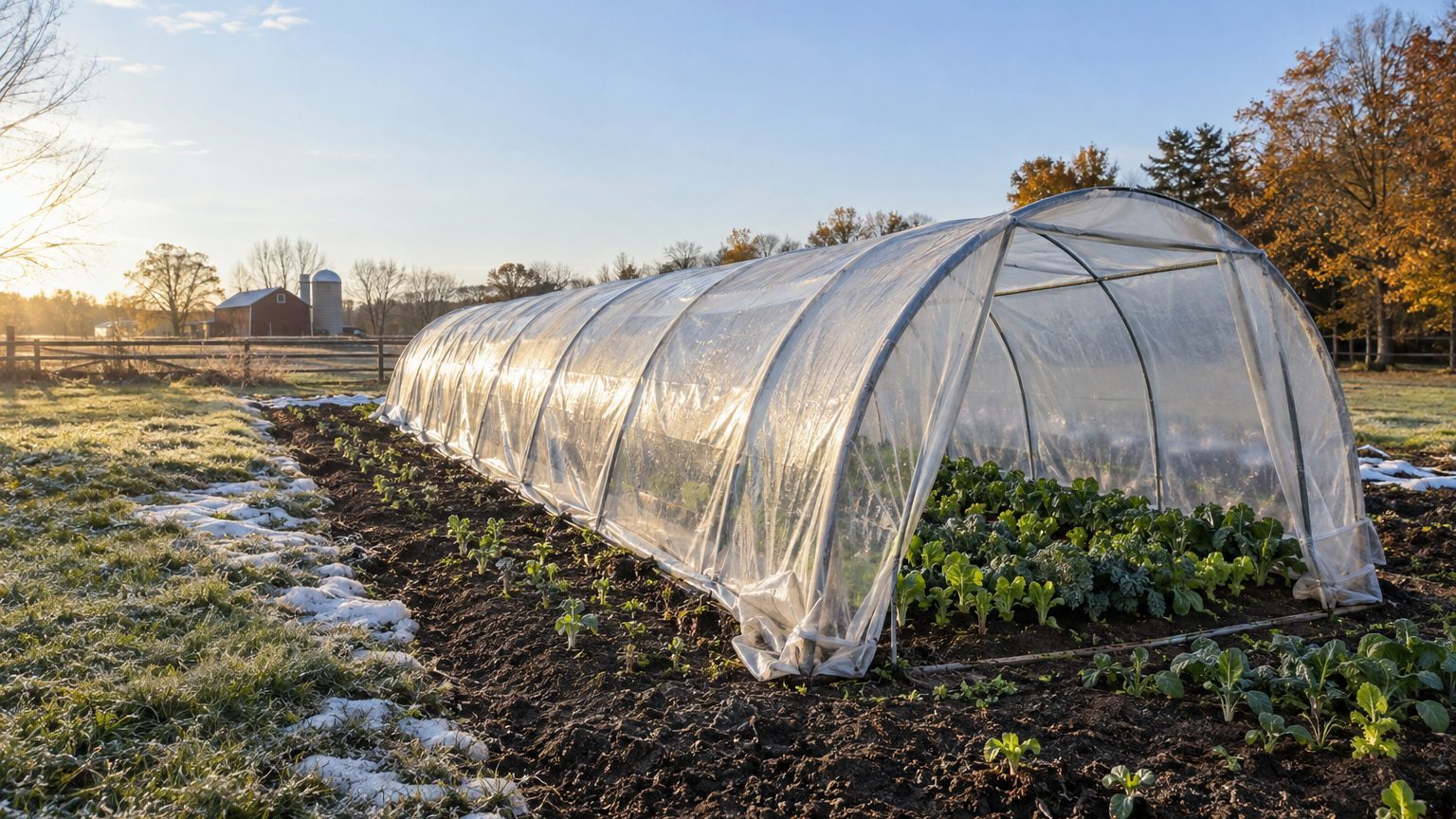

A walk-in tunnel is a hoop frame covered in plastic, tall enough to stand in. It can add weeks at both ends of the growing season and lets you harvest in winter weather. It also behaves like a small building. Wind pushes on it, snow loads it, and sun can overheat it in an hour. It shifts the frost limit for a crop but never removes it.
What is actually going on
A tunnel works because of volume. A low cover over a row traps a thin layer of air that cools quickly once the sun is down. A tunnel you can walk through encloses a much bigger body of air, and that air sits on a much bigger patch of soil. The soil does most of the work. It soaks up sun all day, then releases that heat slowly through the night into the still air under the plastic. The more soil and air the structure holds, the slower the whole system cools.
The gain is real, but it varies from night to night. It depends on the covering material, how much heat the ground stored beforehand, and how hard the wind blows around the structure. A clear, calm, dry night loses heat fastest, because the plastic does little to stop warmth escaping upward. Wet, well-watered soil holds more heat than dry, fluffy soil. A tunnel after a string of sunny days starts the night in better shape than one after a week of gray.
Why does a bigger cover hold heat better than a small one?
Small covers are all surface and little contents. Heat leaves through the surface, so a small cover loses it fast relative to what it holds. A tunnel has proportionally less surface for the soil and air it contains. That is why a tunnel often buffers temperature swings better than the same crop under an individual cover. For the smaller end of the scale, see Cloches and Individual Covers.
A second layer multiplies the effect. Lightweight fabric draped over the crop inside the tunnel, or a small low hoop inside the big one, traps another pocket of still air. Two thin layers with air between them usually insulate better than one thicker layer. This is a passive trick. No heater, lamp or flame belongs inside a covered structure, because fire and carbon monoxide risks in an enclosed space are serious.
Why do wind and snow matter so much on a tunnel?
A cover over a bed is light. A tunnel is a large, curved surface that catches wind like a sail, and wind can lift the whole frame if the base is not anchored. Snow adds a different load. Wet snow is heavy, and it piles on a shallow curve that cannot shed it. A tall, steep arch sheds snow better than a flat one. Either way, a tunnel that holds heat also tends to hold the weight on its roof unless someone clears it.
That is the point where a cover becomes a building. You now have to think about foundations, loads and maintenance, and about ventilation, which is a matter of keeping the crop alive. A closed tunnel in spring sun overheats fast, and a closed space full of leaves and damp soil turns humid enough to invite fungal disease. A tunnel that is never opened will cook its crop sooner or later. Cold does less damage than that.
In the garden
Four things change when you scale up from a cover to a structure: anchoring, ventilation, snow handling and access. Each one has a right answer and a typical way of failing. The table puts them side by side.
| What changes | What to do | What happens when it goes wrong |
|---|---|---|
| Anchoring | Sink the frame into the ground or onto a firm base, and tension the plastic so it cannot flap. | Wind gets under a loose edge, the plastic tears, and a light frame can lift or fold. Flapping plastic wears through at every contact point. |
| Ventilation | Open both ends or roll up the sides on every sunny day, including cold ones. | The air heats far past what leaves tolerate, and a sealed tunnel can scorch a crop in about an hour. Stuffy, wet air also breeds mold and leaf disease. |
| Snow and heavy rain | Choose a steep arch, brace the frame, and knock off snow as it builds. | Weight accumulates on the roof, bows the hoops, and collapses the structure onto the plants. |
| Winter access | Keep a clear path to the door and room to open it against drifts. | A door frozen shut means you cannot vent on a sunny afternoon. The crop overheats while you shovel. |
| Watering | Water the soil by hand or drip, and do it in the morning. | Plastic sheds rain to the outside, so the bed inside dries out. Evening watering leaves foliage damp through a cold night. |
What does a walk-in tunnel actually buy you?
It buys time at both ends of the year and a place to work when the weather is miserable. In spring the soil under plastic warms sooner, so transplants and direct-sown hardy crops can go in earlier. In fall, crops keep growing and stay sheltered from frost for longer after the open garden has been cut down. For the spring side of that, Using Covers to Start Earlier in Spring covers the timing in more detail.
In winter the main gain is protection from wind and wet, and a gentler temperature curve. Hardy greens and roots held in a tunnel stay in better condition than those left out, and you can pick them without standing in a snowstorm. Growth slows sharply in the short days of deep winter, so a tunnel keeps a crop alive and harvestable more than it makes it grow. A hard freeze after a clear night can still get in. A layer of fabric over the crop gives extra margin, though none of it makes the bed frost-proof.
What it depends on where you are
Some of this is true everywhere. Heat held by soil, the need to anchor against wind, and the need to vent on sunny days apply in every state. The principles carry across the country because the physics does not change.
The rest is local, and it decides whether a tunnel pays for itself. Season length, summer heat and summer rainfall change the answer most. Where the growing season is short, a tunnel can add a meaningful share of extra weeks. Where winters are mild, the same structure may add little in winter and mostly serve to protect against rain. Where summers are hot, a tunnel can become an oven for months, and it needs open sides, shade cloth or removal of the covering from late spring on. Where summers are wet, the roof keeps rain off tomatoes and similar crops, which cuts some disease pressure but leaves you responsible for every drop of water.
Snow and wind loads also vary widely. A frame that suits a calm valley can be wrong for an exposed ridge, and a gentle curve that sheds a light dusting will fail under heavy wet snow. Some counties also treat larger structures differently from small ones, so a quick call to the local building or planning office before putting in permanent footings is cheap insurance.
For dates, hardiness and what has worked nearby, start with the state pages on this site, then check with your county extension office. Extension staff know the local frost pattern, the wind and snow habits of your area, and which crops carry through winter under cover in your region. For a wider view of what covers can and cannot do anywhere, read Extending the Season: What a Cover Buys, and What It Cannot.
The mistake that costs the most
The costliest error is leaving the tunnel closed on a sunny day. It happens on cold mornings, when the air is sharp and the tunnel looks like it needs every bit of warmth it has. The sun comes out by mid-morning, nobody is home, and the air inside climbs fast. A closed tunnel can overheat a crop in about an hour. Leaves scorch, flowers drop, seedlings collapse, and a bed that survived a hard night dies in a single afternoon.
Cold gets the blame for lost crops, but heat from a closed tunnel often does more damage. The frame looks fine and the plastic is intact, so the failure comes as a surprise.
The fix is a habit. Open the tunnel every sunny day, even when the air outside is cold. Open both ends, or roll the sides up, so air moves through rather than sitting. Do it in the morning before you leave, because a tunnel is easier to cool than to rescue. Close it again in the late afternoon while the soil is still warm, so the stored heat is trapped for the night. If you are away all day, set the openings partly ajar from the start, and use doors that hold in place against wind.
Venting also helps the crop in a second way. Moving air dries the leaves, which lowers the risk of mold and rot in the damp conditions a closed tunnel produces. Think of the openings as part of the structure. A tunnel with no easy way to open is a poorly designed one.
Common questions
Do I need a permit for a walk-in tunnel?
It depends on the county and on the size. Many places treat small temporary structures differently from large or permanent ones, and some set rules on footings or distance from property lines. Call the local building or planning office before you pour or drive anything permanent. Your county extension office can often tell you what neighbors have done.
Can I heat a tunnel to keep crops from freezing?
No. Heaters, lamps and open flames inside a plastic-covered structure create fire and carbon monoxide risks. Stay with passive methods: soil that has stored daytime heat, still air, and a second layer of fabric over the crop. These shift the limit but do not remove it, so choose crops hardy enough for your winters.
How much longer will my season be?
It varies with your climate, the weather of the year, and how well you manage the structure. Most gardeners gain some weeks in spring and fall, and the gain in deep winter is smaller. A tunnel that is anchored, vented every sunny day, and fitted with an inner layer will do better than one that is neglected.
Should I put row cover inside the tunnel?
Yes, on cold nights. A light fabric over the plants or on low hoops adds a second pocket of still air that makes a noticeable difference on clear nights. Remove or pull back the fabric on sunny days, and keep the tunnel ends open so heat can escape.