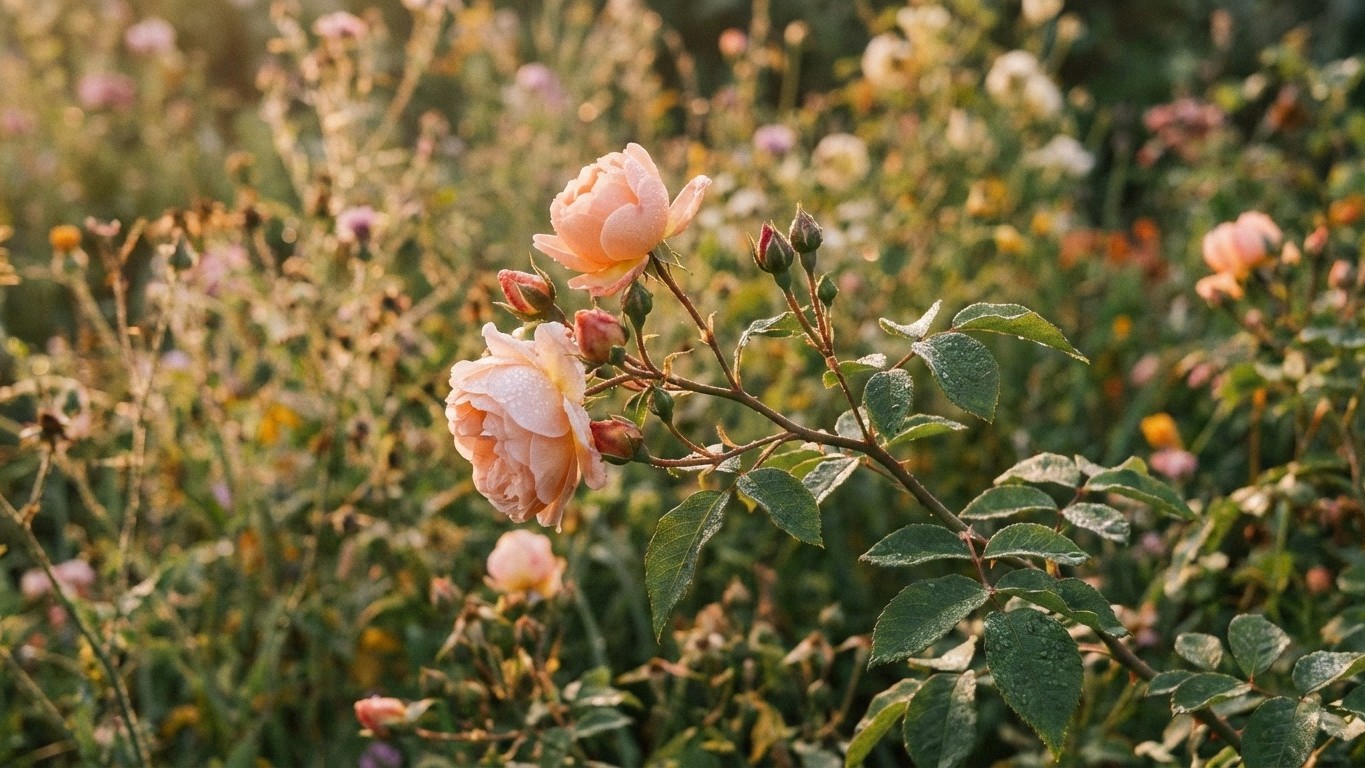

Three common diseases of roses in New Hampshire are black spot, powdery mildew and downy mildew. Each one follows a different kind of weather, and the state’s mix of humid summers, cool nights and wet shoulder seasons gives all three a turn. A fourth problem, rose rosette, is a virus with no cure. For the wider basics, see growing roses in New Hampshire. What follows covers what goes wrong, and when.
Which rose diseases New Hampshire’s climate brings
Each of these diseases has a weather recipe, and New Hampshire serves all of them in one year. Warm, muggy stretches in July and August favor one. Clear days followed by chilly nights favor another. Cold, drizzly weeks in May and October favor the third. Knowing the recipe tells you which disease to expect, and which to rule out when a leaf looks wrong.
What causes black spot on roses?
Black spot is one of the most common rose diseases in the eastern United States, and it thrives on warm, wet summers. The fungus needs water sitting on the leaf before it can infect. Rain, heavy dew and overhead sprinklers all do the job, and splashing drops carry spores up from infected debris on the ground. You see round black spots with feathery edges, often ringed in yellow. Leaves then drop, starting at the bottom of the plant. A rose that loses most of its foliage by August goes into winter weak, and the cold in zones 3b to 6b punishes weak plants. The fungus overwinters on fallen leaves and on canes, so rake up and bag every fallen leaf in autumn. Skipping that step leaves a fresh supply of spores for the next wet spring.
Why does powdery mildew show up on roses here?
Powdery mildew likes warm days and cool nights, the pattern that dominates late summer and early fall in much of the state. It differs from the other two in one important way: it does not need wet leaves. Humid air and a crowded, shaded plant are enough. The first sign is a white or gray dusting on young leaves, shoot tips and flower buds, followed by puckered, curled, reddish new growth. It rarely kills a rose, but it stunts growth and ruins blooms.
What is downy mildew on roses?
Downy mildew is often the least familiar of the three and is easy to misdiagnose. It favors cool, wet weather, so it strikes in spring and again in fall, and a rainy, chilly stretch can set it off at any point. Look for purplish-red to brown, irregular blotches on the upper leaf surface, bordered by leaf veins. A faint gray fuzz may appear underneath. Leaves yellow and fall quickly, sometimes within days, which makes it look like a sudden collapse. Gardeners often mistake it for black spot or for spray damage.
Cane cankers and gray mold on buds also turn up in cool, damp weather, especially on canes hurt by winter. The fix for cankers is pruning back into healthy wood, where the center of the cane is white rather than brown.
When each one shows up here
The calendar starts with frost. At the Concord reference station, the last spring 32°F freeze typically falls between April 27 and May 22 (median about May 8), and the first fall freeze between September 21 and October 16 (median about October 3), based on NOAA’s U.S. Climate Normals for 32°F freeze probabilities. Those are ranges for one airport, not a promise for your yard. Suburban and rural gardens, especially in cold-air pockets or at higher elevation, can get the last spring frost later and the first fall frost earlier. The USDA Plant Hardiness Zone Map runs from 3b to 6b across the state, so a garden near the White Mountains lives on a noticeably shorter clock than one near the coast.
What shows up in spring and early summer?
Downy mildew and the first black spot infections come early. Once leaves open, usually in May, cool rainy spells can bring the purple-brown blotches of downy mildew within a week or two. Black spot spores are already waiting on last year’s canes and leaf litter. The first spots usually appear in June, on the lowest leaves, where splashing water reaches them first. Many gardeners spot them a few weeks after the first long stretch of rain.
What shows up from August to frost?
July and August are black spot’s peak, as humid heat and thunderstorms keep leaves wet. By August the lower half of a neglected rose can be nearly bare. Powdery mildew builds as nights cool, so the white coating tends to appear on late-summer growth and fall blooms. Downy mildew returns when the weather turns cold and damp. Around the first fall frost, September 21 to October 16 at the reference station, new infections slow down. That is the signal to start cleanup. The spores that survive on leaf litter are the ones that will start next year’s outbreak.
What this changes about spacing and watering
Air movement and dry foliage are a big part of the defense, and they work in two ways. Black spot and downy mildew need water standing on the leaf, so anything that dries leaves faster cuts their chances. Powdery mildew needs only humid air around the plant, so it is the one that rewards open spacing even when you never wet a leaf. Both fixes cost nothing once the roses are in the ground, and neither involves a sprayer.
How far apart should roses be to prevent disease?
Give hybrid teas, floribundas and grandifloras room between plants, and larger shrub roses even more. Keep every rose off a wall, fence or hedge, since a solid surface behind the plant traps still, humid air. East-facing and south-facing beds help because morning sun dries the dew early. A rose in dense shade will stay damp all day, and no fungicide fully compensates for that. In spring, pruning the center open lets air pass through the plant, and thinning crossing canes helps the same way.
What time of day should you water roses?
Water in the early morning. Leaves that get wet at dawn dry by midmorning, while leaves wet in the evening stay damp all night, which is the long wetness black spot needs. Aim the water at the base of the plant with a soaker hose or drip line, not at the foliage. A hand-held wand works if you keep it low. Wetting the leaves should be the exception, not the routine. A layer of mulch over the root zone keeps rain from splashing soil and spores up onto the lowest leaves, but keep it back from the canes so it doesn’t hold moisture against the bark.
Rainy weeks are beyond your control. In a wet June, spacing and morning watering will not stop black spot entirely, but they shorten the time leaves stay wet and slow the spread. Fungicides labeled for roses protect healthy leaves from new infection and do not cure leaves that already have spots. Your county extension office can tell you which products are currently labeled.
Rose rosette: the one that means digging the plant up
Rose rosette is a virus carried by a tiny eriophyid mite that rides the wind from plant to plant. No spray, pruning cut or fertilizer treatment cures it. An infected rose declines and typically dies within a few years, and it can serve as a source of infection for nearby roses. The disease is established across much of the eastern United States and has been moving north, so New Hampshire gardeners should treat it as a real possibility rather than a distant problem. Wild multiflora rose along roadsides and field edges can harbor it. Whether it has been confirmed near you is a question for your county extension office.
How do you recognize rose rosette?
The signs show up on new growth. Look for shoots that are unusually thick, covered in far more thorns than normal, and colored deep red or burgundy. Another warning sign is a tight cluster of distorted, bunched stems called a witches’ broom. Leaves may be crinkled, narrow or strangely shaped, and flowers may be deformed or fail to open. Herbicide drift and some other problems can look similar at first glance, so get a second opinion before acting. A rose with a single oddly red shoot is worth watching for a week or two. A rose with a full broom is not.
What do you do if you find it?
Remove the plant, and dig out the whole thing, roots included. Cutting off the affected shoots does not work, because the virus is already inside the plant and any root left behind can resprout infected. Bag the plant and put it in the trash rather than the compost pile or brush heap. Do this promptly, since the mites that spread the virus can move to neighboring roses once the plant declines.
Checking this against your own county
The frost dates here come from one weather station, and conditions in the North Country, the Lakes Region and the Seacoast differ from Concord’s. Your own garden will differ as well, depending on elevation, slope and how much air drains through it. The disease calendar shifts with those conditions, so treat these timings as a starting point and compare them with what your roses do.
For a local answer, contact University of New Hampshire Extension. Before you spray or pull anything, get the problem identified. A leaf sample or clear photos of the affected leaves and canes can separate black spot from downy mildew, and can confirm whether a strange red shoot is rose rosette.
Common questions
Can roses survive black spot?
Most do. Black spot weakens a rose more than it kills it. The danger comes when it strips leaves for several summers in a row, leaving the plant too weak for a hard winter. Clean up fallen leaves, water at the base in the morning, and replace a rose that defoliates every year with a more resistant one.
Is powdery mildew or downy mildew worse?
Downy mildew is usually faster and more damaging, since leaves can drop within days. Powdery mildew is slower and mainly disfigures new growth and buds. Both are easier to prevent than treat, and both are much worse on crowded plants in poor airflow.
Should I cut off leaves with black spot?
Yes, pick off spotted leaves and any that have fallen, and put them in the trash. Composting them at home usually does not heat the pile enough to kill the fungus. Removing leaves will not cure the plant, but it lowers the number of spores that can reinfect healthy foliage.
How do I know if it is rose rosette or just a fast-growing shoot?
A healthy vigorous shoot is red when young but has normal leaves and normal thorns, and it turns green as it matures. A rosette shoot stays abnormally red and thick, with excess thorns and distorted leaves, and often forms a cluster. If you are unsure, have UNH Extension look at it before you dig, and leave the plant in place until you hear back.