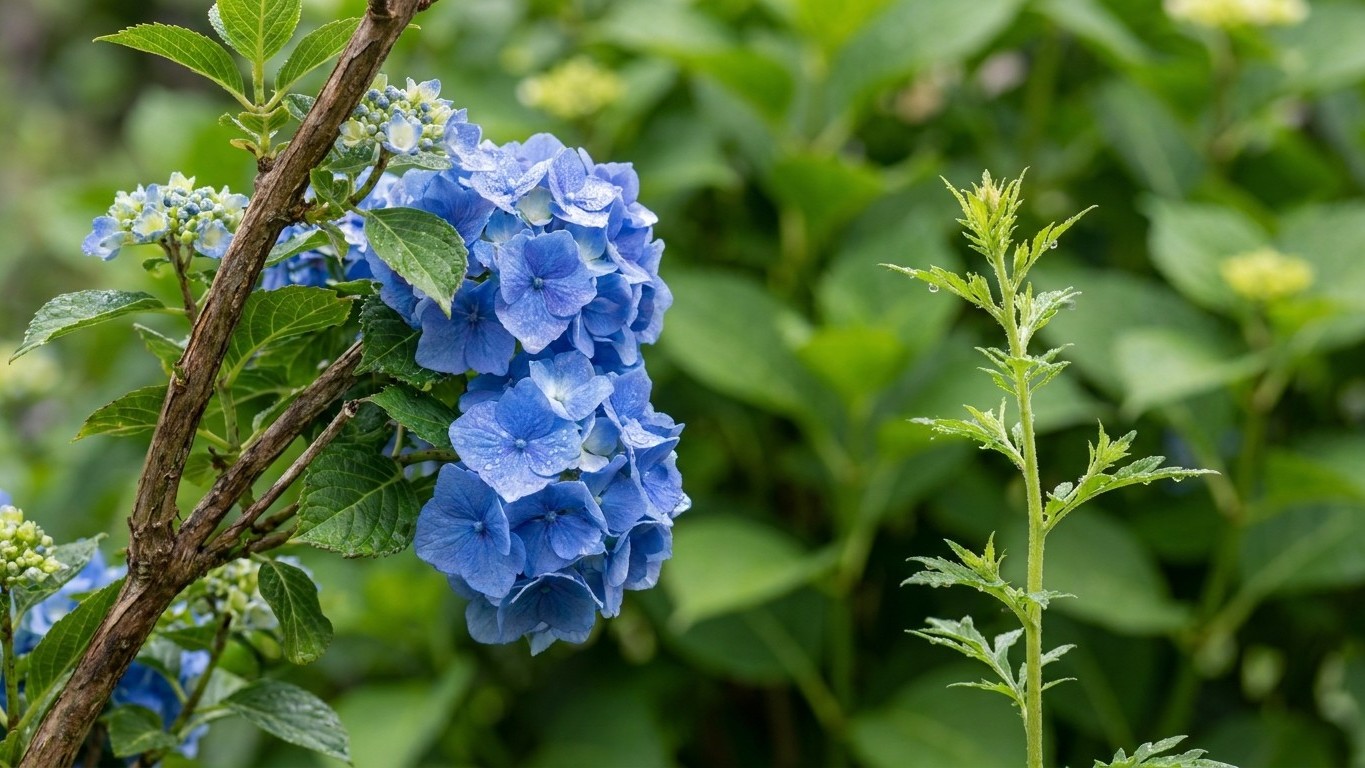

Hydrangeas come up pink across much of Ontario because the soil is neutral to alkaline, and in that chemistry the plant cannot take up aluminum. Blue flowers need acidic soil, where aluminum dissolves and moves into the shrub. Only bigleaf and mountain hydrangeas swing between pink and blue, and white ones never change. Moving a pink shrub toward blue takes a full growing season of soil work, sometimes two.
What this comes down to in Ontario

At Toronto Pearson, the reference station, the average last spring frost is April 30 and the average first fall frost is October 16, and a bigleaf hydrangea uses that whole stretch to grow, set buds and settle its color. Soil acidity decides whether those flowers open pink or blue, and across much of southern Ontario the soil leans alkaline, so pink is the default. Both dates are averages. In about one year out of two the last frost comes later than April 30, and in about one year out of two the first fall frost comes earlier than October 16. The reference station has a frost-free season between the two average dates.
Why are hydrangeas pink in Ontario soil?
Much of the southern part of the province sits on glacial till and clay built from limestone and other carbonate-rich rock. That material holds pH at neutral or above, often well above. In soil like that, aluminum has to be dissolved to color a bloom blue, and it is locked in solid form instead. The pigment in a bigleaf flower shows pink without aluminum and blue with it. More acidic soil gives blue, less acidic gives pink, and the range between produces purple or mixed heads on the same shrub.
Other things push pH up. Municipal and well water in limestone country is often hard, and each watering leaves a little more lime behind. Concrete foundations, sidewalks and mortar leach lime into the soil around them, which is why a hydrangea tucked against a house wall stays pink while the same plant farther out in the yard may lean purple. Phosphorus matters too. A high-phosphorus fertilizer ties up aluminum even when the pH is low enough.
Which hydrangeas can turn blue?
Only the bigleaf type (Hydrangea macrophylla) and, to a lesser degree, the mountain type (Hydrangea serrata) respond to soil chemistry. Panicle hydrangeas, smooth hydrangeas and oakleaf hydrangeas ignore it. The pink blush that creeps over a panicle bloom in fall comes from cool nights and flower age, and no amount of aluminum sulfate will touch it. If you are unsure which type you own, check the leaves: bigleaf and mountain types have glossy, thick, toothed leaves. The general care for all of them is covered in growing hydrangeas in Ontario.
Working it out for your own garden
How do you time a color change around the frost window?
Build the schedule backward from bud set, and treat every date as a range. Flower buds on a bigleaf hydrangea are set in late summer, ahead of the average first fall frost of October 16. That means the soil should already be acidic by midsummer, and a gardener needs to start treatment well before then for the roots to respond. Counting back, the first treatment goes on when leaves open, which is around the last-frost window near Toronto. Further doses follow at intervals through early summer.
Planting dates follow the same logic. Because April 30 is an average and half of all years bring a later frost, a new container shrub goes in after the window has clearly passed. Starting then leaves a long season for the roots to establish before the soil work can show.
Which hydrangeas will actually change color?
Take a reblooming bigleaf such as Endless Summer, which flowers on both old and new wood. Planted after the last-frost window and acidified through early summer, it makes new-wood buds that open in summer, comfortably ahead of the October 16 average first frost. The color shift can show in the first year.
A classic old-wood bloomer such as Nikko Blue works differently, because its buds were set the previous summer. Plant it after the last-frost window and the first flowers keep the nursery color. The blue shows the following summer. Plant that same shrub in autumn and the clock runs out: the roots barely settle before frost, and the change may take a long time. A panicle type like Limelight never enters this calendar, since its color does not respond to soil.
What changes across the province
Ontario is not one climate. The Golden Horseshoe and the Lake Erie and Niagara shores keep a longer frost-free season, because the big lakes soak up summer heat and release it in fall. Toronto Pearson sits in that lake-moderated belt, and its Canadian hardiness zone is 7a, an NRCan rating built on seven climate variables that does not convert to a USDA zone. Inland, higher ground and the districts north of Lake Simcoe, Muskoka, Ottawa and beyond run weeks behind the reference dates, with a later last frost in spring and an earlier first frost in fall. The color schedule shifts with them, so a gardener in cottage country starts treatments later and has less margin before bud set.
Soil changes just as much as weather. The limestone plains of the south, and the Niagara Escarpment, push pH up and make pink the natural outcome. The Canadian Shield to the north is granite and thin, acidic soil, where bigleaf hydrangeas can come up blue with no help at all. Sandy districts can also run acidic, but sand holds little buffering, so pH swings fast after fertilizer or watering.
Cold also decides whether color matters at all. Where winters are harsher than at the reference city, bigleaf buds on old wood can die back and there will be nothing to color. Shelter is what protects the flowers there, which is covered in winter protection for hydrangeas in Ontario.
The mistakes Ontario punishes
A common one is treating soil that is full of free lime as if it were ordinary garden dirt. Heavy clay with carbonates neutralizes aluminum sulfate quickly, so pH creeps back within weeks and the blue fades. Instead of one heavy dose, apply small amounts on a schedule, retest the pH in midsummer, and mulch with pine needles or composted bark to hold acidity. Aluminum sulfate also burns roots when overapplied, so follow the label, water it in, and never put it on dry soil.
Timing is the second trap. A warm spell in early April tempts people to treat early, but the dates above are averages, and a hard frost after the shrub has leafed out harms the plant long before any color arrives. Wait until buds are visibly swelling and the frost window has mostly passed. Treatments applied after midsummer reach buds that are already set, and the change turns up a year later.
Pruning in the wrong season is another quiet loss. Cutting a bigleaf in spring or fall removes buds that were already colored, so the flowers never open. The right timing is laid out in when to prune hydrangeas in Ontario.
Finally, plant location matters. Beside a concrete wall or walkway, lime keeps pulling pH up. Move the shrub farther out, or grow it in a large pot with acidic mix, where color is easiest to control.
Checking this against your county
The dates and zone above describe one reference city, and a county farther north or higher up will differ. Treat them as a starting point. For local frost timing and soil conditions, ask the nearest Master Gardeners chapter or your county or regional agricultural office, and look at the Government of Ontario agriculture and food pages for provincial guidance. You can also look up your municipality’s zone on Canada’s Plant Hardiness Site.
Common questions
Can I turn a white hydrangea blue?
No. White varieties lack the pigment that reacts to aluminum, so soil changes do nothing. Only bigleaf and mountain hydrangeas in pink, red, blue or purple will shift.
How long does it take for pink hydrangeas to turn blue?
Expect a full growing season, and sometimes two. Buds are colored when they form, so treatments only show on flowers that open after the soil has changed.
Does coffee grounds or vinegar work?
Neither is reliable. Coffee grounds barely change pH, and vinegar acidifies briefly and then washes out, sometimes stressing roots. Elemental sulfur or aluminum sulfate at label rates, plus acidic mulch, does the job.
Will my hydrangea turn back to pink?
Yes, if you stop. In alkaline soil or hard-water areas, pH drifts upward again, so blue plants need a light yearly top-up and a low-phosphorus fertilizer.