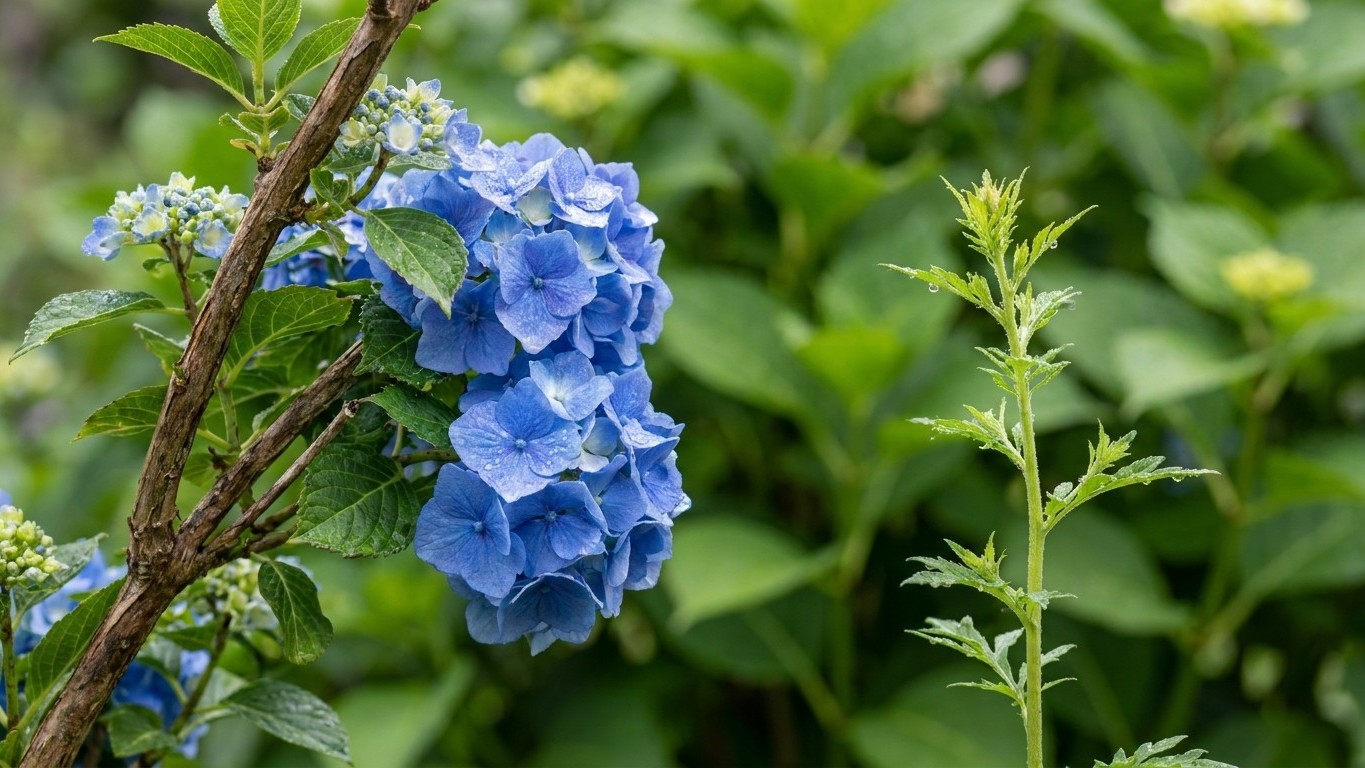

Prune hydrangeas by type, not by the calendar. Bigleaf and other old-wood types get a light trim within a few weeks after the flowers fade. Panicle and smooth types get cut in late winter, before leaves open. Around Montreal the average last spring frost is May 6, which is why bigleaf stems are judged late in spring and cut gently. Get the timing wrong and the shrub can look tidy all summer and bloom little or not at all.
What this comes down to in Quebec

At the Montreal/St-Hubert reference station, Environment and Climate Change Canada puts the average last spring frost on May 6 and the average first fall frost on October 5. Panicle and smooth hydrangeas are pruned in late winter, roughly late March into early April. Bigleaf types wait until the spring frost window has closed, then get light pruning, or are trimmed right after flowering.
Those two dates are midpoints. In one year out of two the last spring frost falls after May 6, and in one year out of two the first fall frost arrives before October 5. The reference station has about 150 frost-free days between them. Montreal is mapped at about Canadian hardiness zone 6a on Natural Resources Canada’s 2014 map (check the newer 1991–2020 update for your address). It is a rating built on seven climate variables that does not convert directly to a USDA zone. Districts farther north or higher up have a shorter, later window.
The frost window matters because it decides which buds are still alive when you pick up the pruners. Hydrangeas split into two groups, and each group gets its own schedule.
Which hydrangeas bloom on old wood?
Bigleaf (mophead and lacecap), mountain, oakleaf and climbing hydrangeas set next summer’s flower buds on stems grown the year before, and the buds are in place by late summer. Cut those stems in fall, winter or early spring and you cut the flowers with them. The safe moment is within a few weeks after the blooms fade. Remove spent flowerheads, dead stems and one or two of the oldest canes at ground level, and leave the rest.
Cold winters complicate this. The upper stems of bigleaf hydrangeas often die back, and the live buds may sit only on the lower few inches of wood. That is why spring work on these types is limited to dead wood, and why it is worth checking which hydrangea types survive your winters before you decide how much to cut.
When do panicle and smooth hydrangeas get pruned?
These two bloom on wood grown in the same season, so there are no buds to lose in winter. Cut them in late winter, before the buds swell. Taking off about a third of last year’s growth keeps the shrub compact and the flower stems sturdy. Smooth hydrangeas can be cut lower still, to a low framework. A frost-nipped shoot tip in May costs these shrubs little, since the flower-bearing growth has not formed yet.
Working it out for your own garden
A fixed date fails after a move or a cold spring. A method built on the frost window and on the plant itself keeps working. The first step is to count back from the frost window, treating May 6 as the middle of a spread of possible last-frost dates rather than a safe day.
For a new-wood hydrangea, aim to finish pruning well before that midpoint. Four weeks before May 6 lands around April 8, and six weeks lands in the last days of March. So the working range is late March to early April, with a cold spring pushing it later and a mild one pulling it earlier. In a district where the last frost runs weeks behind Montreal’s, the same subtraction moves the whole range into April.
For an old-wood hydrangea, count back from October 5 instead. Pruned stems push new shoots, and those shoots need time to firm up before the first fall frost. Two months before October 5 is early August, so finish by the end of July. A mophead that finishes blooming in mid-July and is trimmed that week has weeks to spare. The same shrub cut in late August sends up soft shoots that meet the first frost unprepared. It also loses the buds it was forming for next summer. The first plant blooms. The second does not.
That test replaces the calendar for bigleaf types. Wait until leaf buds open on the live wood. Then remove only what is clearly dead. A shrub that looks bare in April is often just slow.
What changes across the province
Quebec is not one climate. The Montreal figures describe the St. Lawrence lowlands, where the river and the built-up area take some of the edge off spring and fall. Elevation and latitude change the picture quickly from there.
In the upper Laurentians, the Saguenay and Lac-Saint-Jean, Abitibi and the Gaspé, spring arrives later and the first fall frost comes earlier than it does at the reference station. A shorter season pushes every pruning window later. Late-winter work on panicle hydrangeas may happen under snow in March in the lowlands but only in April farther north. The old-wood deadline slides earlier, because shoots need their two months before an earlier frost.
Snow is the other variable. A deep, steady snowpack insulates the lower stems, so bigleaf buds near the ground often survive in snowy districts even when the tops are killed. In a lowland spot where the snow melts in January thaws and refreezes, those same buds are more exposed. Two neighbors a few hundred feet apart can differ if one planting sits on a windswept rise and the other in a sheltered hollow.
The practical takeaway is to use the Montreal dates as a starting point, then watch your own shrub. The day leaf buds swell on a neighbor’s lilac or on your own hydrangea is a better local clock than any regional average. Let the plant’s own spring pace adjust the range, and treat the late-winter window for new-wood types as open until the buds begin to move.
The mistakes Quebec’s climate punishes
A common error is giving bigleaf hydrangeas a spring haircut. It feels right, because other shrubs get one then. On an old-wood hydrangea it removes the flower buds that survived the winter, and the shrub leafs out healthy and blooms little or not at all.
A second mistake is pruning during a March thaw. Mild days can wake a shrub, and a cut made then invites tender growth. With the average last frost not until early May, and some years later, a late cold snap can catch that growth. For new-wood types, wait for the thaw to end and prune while the buds are still tight.
Third, late-summer and fall pruning of old-wood types does double damage. It removes next year’s buds and it stimulates growth that cannot harden before the first fall frost, which on average arrives October 5 at the reference station and earlier in colder districts. Stop cutting by the end of July.
The fourth is cutting everything to the ground after a rough winter. Many bigleaf hydrangeas leaf out late from low buds. Do the scratch test, wait for leaves, and remove only what is dead. Instead of cutting, give a slow shrub more time. Faded flowerheads left on over winter may give the buds just below them some protection. If you leave them, remove them in spring.
Checking this against your area
A province-wide figure is a starting point. Quebec is organized into regional county municipalities, so a nearby agronomist or horticultural advisor can tell you how your district runs compared with Montreal. The Ministère de l’Agriculture, des Pêcheries et de l’Alimentation du Québec mainly serves commercial producers, but it is a starting point for agricultural advice in your region. For the rest of the growing picture, including siting, watering and feeding, see the guide to growing hydrangeas in Quebec.
Common questions
Can I prune hydrangeas in the fall in Quebec?
Only to remove dead or broken wood, and only lightly. Fall cutting on bigleaf and other old-wood types takes off next year’s flower buds. On any type, a heavy cut invites soft growth ahead of the first fall frost, which on average arrives October 5 at the Montreal reference station.
Should I cut my hydrangeas to the ground after a hard winter?
Panicle and smooth types can be cut low in late winter, since they flower on new growth. Bigleaf types should not be cut low unless the scratch test shows every stem is dead. Wait for leaves, which can take until late May, then remove only what has stayed brown.
What if I don’t know which kind of hydrangea I have?
Look at the flowers. Round or flat clusters of pink, blue or purple on a shrub with broad, glossy leaves point to bigleaf. Cone-shaped, white flower clusters that age to pink point to panicle, and large white globes point to smooth. When in doubt, do no pruning beyond removing dead wood in spring, and note whether the shrub blooms from old stems or new ones this summer.
Does pruning change the flower color?
No. Color on bigleaf hydrangeas depends on soil acidity and aluminum availability, covered in detail in soil pH and bloom color. Pruning affects how many flowers you get, not what shade they are.