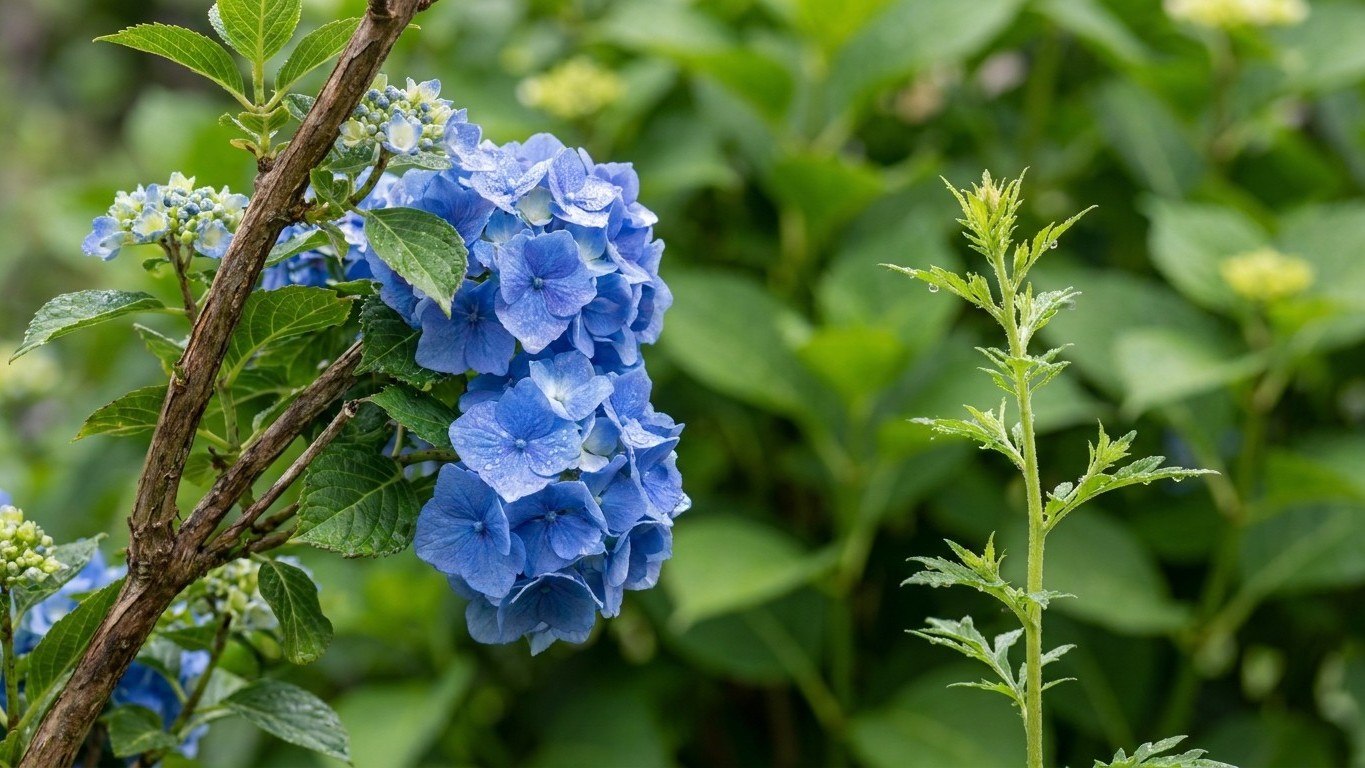

Bigleaf hydrangeas turn pink when the plant cannot take up aluminum, and Montreal’s soil is often near-neutral to alkaline, which locks that aluminum away. Blue flowers need acidic soil, roughly pH 5.5 or lower. A soil test tells you where you stand, and sulfur or aluminum sulfate can push the number down. Only some hydrangea species respond to any of this, so check yours first.
What this comes down to in Quebec

The window for turning hydrangeas blue opens when growth restarts after the last spring frost, which averages May 6 at the Montreal/St-Hubert station, the reference city for this guide. That date is the midpoint, so in one year out of two the last frost falls later, and the soil work should follow the plants rather than the calendar. The same station has a mean last spring frost of May 6 and a mean first fall frost of October 5. Color is settled inside that stretch, and the soil chemistry behind it is what decides pink or blue.
Why do hydrangeas turn pink in Quebec soil?
Bigleaf hydrangeas (Hydrangea macrophylla) carry a pigment that shifts color when it binds with aluminum. Aluminum is abundant in most soils, but it only dissolves at low pH. Above roughly 6.5, it stays locked in the soil and the flowers come out pink or red. Below roughly 5.5, the roots can absorb it and the flowers turn blue. In between, you get purple, or a mix of pink and blue on one shrub.
The St. Lawrence Lowlands around Montreal sit on clay and limestone-rich deposits, so the soil there often tests near-neutral or alkaline. A bigleaf planted in that ground turns pink on its own. Foundations, concrete walkways and lime-rich fill raise the pH further for the plants closest to the house. Hard water from limestone wells can do the same over time.
Which hydrangeas can actually turn blue?
Only some species respond to soil chemistry. Treating the wrong one wastes a season and a good deal of money.
| Type and example | Does soil pH change the color? | Blooms on |
|---|---|---|
| Bigleaf, such as Nikko Blue | Yes: pink, purple or blue | Old wood only |
| Reblooming bigleaf, such as Endless Summer | Yes: pink, purple or blue | Old and new wood |
| Panicle, such as Limelight | No: white or green, aging to pink with cool nights | New wood |
| Smooth, such as Annabelle | No: color is fixed by the cultivar | New wood |
A pink panicle or smooth hydrangea will not turn blue with any amount of aluminum sulfate. Its pink is built in or comes from the weather. For the broader picture of site and care, see growing hydrangeas in Quebec.
Working it out for your own garden
A method beats a recipe here, because soils vary from one yard to the next and spring arrives at different times from year to year. Three steps cover it: test, count back from bloom, and check what the flowers show you.
How do you test soil before changing hydrangea color?
Start with a pH reading, from a home kit or a lab, taken a few inches from the shrub at root depth. Anything above about 6.5 explains pink flowers. A reading near 6.0 usually gives purple. If the number is already below 5.5 and the flowers are still pink, the problem is probably phosphorus. High phosphorus in the soil ties up aluminum, so a high-phosphorus fertilizer can undo your work. A low-phosphorus, high-potassium fertilizer avoids that.
How long before bloom should you start treating?
Work backward from bloom. Aluminum has to be in the plant weeks before the flowers open and color up. Subtract several weeks and the treatment window opens in spring, around the time of the last frost. The mean last frost of May 6 sits near the start of that range. In a late spring, wait until the leaves have opened and the soil is no longer cold. A first application of aluminum sulfate diluted in water, repeated through the spring, is the usual home routine; follow the label rate. Follow the label, because overdoing it burns roots.
Elemental sulfur works more slowly. It needs warm, moist soil and time, so it suits a plan for next year better than a rescue this June.
Now the cultivar that does not get there. A classic old-wood bigleaf such as Nikko Blue sets its flower buds on the previous year’s stems. If a Quebec winter kills those buds, or a spring pruning removes them, the shrub grows leaves and no flowers. With nothing to color, the acidifying work is wasted. The first fall frost, averaging October 5 at the reference station and arriving earlier in one year out of two, also marks the end of the season for new growth. Reblooming types have a second chance on new wood, while old-wood-only types do not.
What do your flowers tell you?
Pink flowers on a bigleaf point to pH. Muddy purple on one side of the shrub points to uneven soil, often lime leaching from a foundation on that side. Green-white flowers that blush pink as autumn cools belong to a panicle hydrangea, and no soil treatment will change them.
What changes across the province
The Montreal reference point does not describe the whole province. Quebec runs from the lowlands along the St. Lawrence up to the Laurentians, the Eastern Townships and the districts north and east of Quebec City. Spring comes weeks later as you go north or up in elevation, so the treatment window slides later with it. The Canadian hardiness zone of 5b applies to the reference city only, and colder districts sit in lower zones. That is a Canadian zone, which does not convert to a USDA zone.
Soil changes as much as climate does. The Lowlands around Montreal tend toward clay with a lot of calcium from limestone, so pink comes naturally and blue takes steady effort. The Laurentians and parts of the Appalachian foothills lie on older, acidic bedrock, and the soil there is more likely to sit on the acid side without any help. A gardener in one of those districts may find hydrangeas turning blue or purple with no work at all.
Winter matters more than soil in the colder districts. A bigleaf that loses its buds every year gives you nothing to color. In those areas, a reblooming cultivar, a sheltered spot against a south wall, and a thick layer of mulch over the crown do more for flowers than any pH adjustment. Gardeners near the Montreal area and the river corridor, where winters are milder, can focus on color. Those further out should settle the bud-survival question first.
The mistakes Quebec’s climate punishes
The first mistake is treating cold soil. A warm spell in April tempts gardeners to apply aluminum sulfate early, but roots are barely active and the product sits in the ground. Frost can still return until well into May, and in one year out of two the last one falls later than May 6. Wait for new leaves.
The second is feeding the wrong shrub. Applying aluminum sulfate to a panicle or smooth hydrangea does nothing for the color, and strong doses can scorch roots. Check the species label before spending money.
Third, a one-time treatment. Alkaline soils and hard water, common around Montreal, pull the pH back up over time, so blue shrubs fade to purple and pink. Plan on retesting every spring and repeating the routine each year. Mulching with pine bark or shredded oak leaves helps keep the soil acidic around the shrub.
Fourth, acidifying late. Once the flowers have opened, the color is largely set for the season, so adding product in August only prepares the next year’s buds. Treat in spring for this year’s color.
Fifth, lime and ash. Wood ash, dolomite lime and many bagged composts raise pH. Keep them away from shrubs you want blue.
Last, pruning old-wood bigleafs in fall or early spring. This removes the buds that Quebec winters had left alive. Cut only dead stems after the leaves have emerged.
Checking this against your region
The May 6 and October 5 dates come from a single station near Montreal, and soil pH can differ from one side of a yard to the other. Treat both as a starting point. Quebec’s agriculture ministry, MAPAQ, publishes agricultural and soil information, though its services are aimed mainly at farm operators. For a garden soil test, use a home kit or a commercial lab. Pair that with our hydrangea guide for hardiness and winter protection.
Common questions
Can I turn pink hydrangeas blue in one season?
Often partly. A shrub in the ground usually shows purple tones at first and fuller blue later, as soil pH drops and aluminum builds up in the plant. Container plants change faster because the pot holds less soil.
Will coffee grounds or vinegar turn hydrangeas blue?
Neither does much. Coffee grounds have a small and short-lived effect on pH, and vinegar acidifies the soil briefly before the pH rebounds. Aluminum sulfate or elemental sulfur, applied with a soil test as a guide, is a more dependable route.
Why did my blue hydrangea turn pink the next year?
The pH drifted back up. Alkaline soil, hard water, nearby concrete and lime all push it that way. Retest in spring and repeat the treatment.
Do white hydrangeas change color with soil?
White varieties stay white regardless of pH. Panicle types may blush pink as the flowers age and nights cool, but that comes from the plant and the weather, and no soil change will bring it on or stop it.