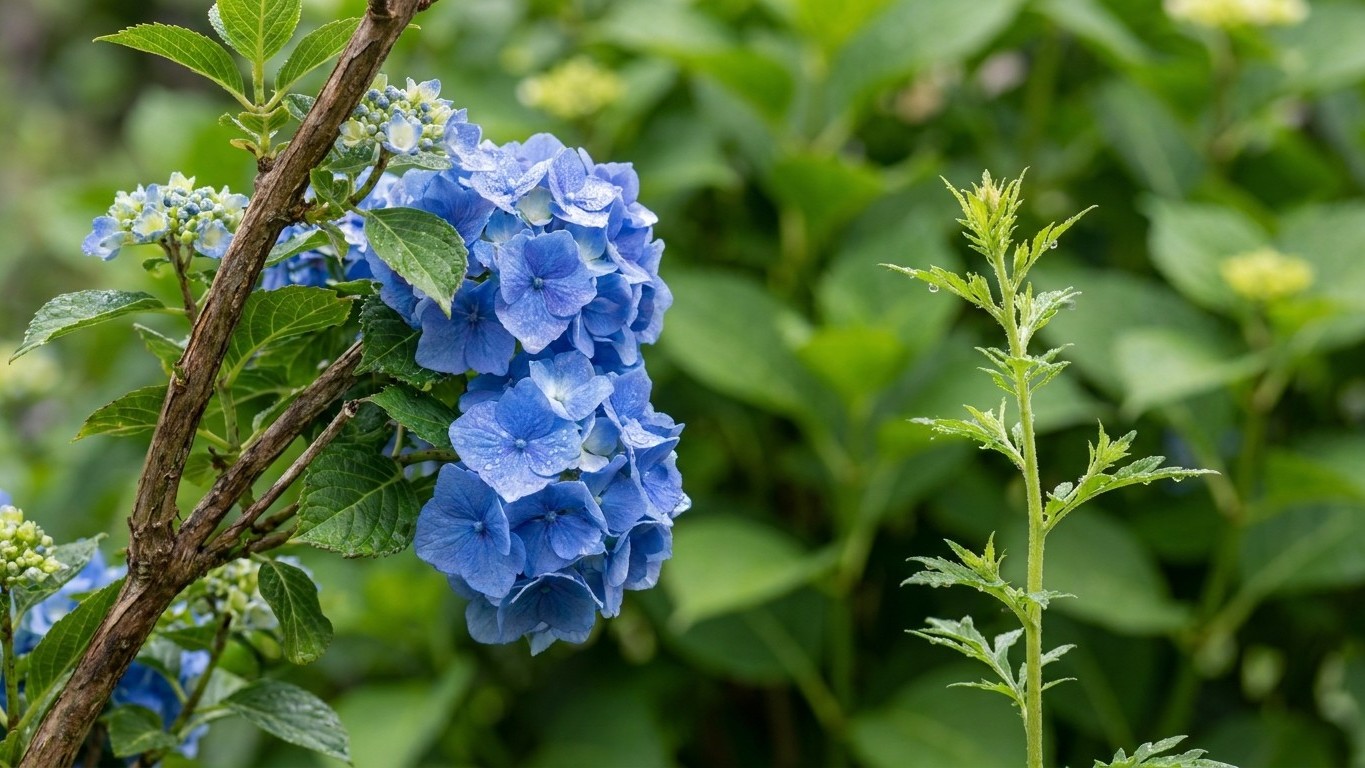

Pink hydrangeas in Texas come down to soil chemistry. Much of the state has alkaline ground, and at high pH the aluminum a bigleaf hydrangea needs for blue flowers gets locked up where roots cannot use it. Blue takes acid soil and aluminum the plant can actually absorb. That is slow work, usually a full growing season, and it only works on certain kinds of hydrangea.
What this comes down to in Texas
Much Texas soil is alkaline, so pink is common, and the fix is timed to the start of spring growth. At the Houston reference station (IAH), the last spring freeze typically comes between early February and early March, and the first fall freeze in early to mid December, according to NOAA NCEI climate normals. The months between those two windows are when roots are active, buds are forming, and a soil change shows up in the flowers.
Those dates describe the mild Gulf end of a very large state. Texas spans USDA hardiness zones from roughly 6 to 10 (the USDA system rates zones by the average annual extreme minimum temperature), the Panhandle freezes far earlier in fall and later in spring, and North Texas and the Hill Country each run on their own calendars. Even within Houston, Hobby airport typically runs a little milder than IAH.
Why does Texas soil turn hydrangeas pink?
The blue pigment forms only when the plant takes up aluminum. Aluminum dissolves in acidic soil and locks into solid minerals in alkaline soil. In acid soil the flowers lean blue, in alkaline soil they go pink to red, and the stretch between gives purple or a mix on the same shrub.
Texas has plenty of ways to push pH up. Limestone and caliche underlie much of the central and western part of the state. Gulf Coast clay often tests neutral to alkaline. Irrigation and city water carry dissolved carbonates that nudge pH higher with every watering. Concrete foundations leach lime into the bed beside them, which is why a hydrangea against the house often turns pink even where the yard soil is milder.
Which hydrangeas can actually turn blue?
Only bigleaf (Hydrangea macrophylla) and mountain (Hydrangea serrata) types respond to soil chemistry. White-flowered bigleaf cultivars carry no pigment to shift, so they stay white. Panicle, smooth, and oakleaf hydrangeas ignore pH entirely. When a panicle bloom blushes pink in late summer, that is the flower aging, and no soil treatment will change it.
Working it out for your own garden
The plant itself is your first soil test. Pink to red blooms mean high pH, purple means the middle zone, and blue means the soil is already acidic enough. Bloom time follows your zone and spring warmth: shrubs on the warm Gulf side leaf out and flower weeks ahead of those in North Texas, where a cold snap can stall the whole schedule. Watch the buds swell rather than trusting a calendar date.
How do you test and adjust soil pH for blue flowers?
Start with a number. A home kit works for a rough read, and a lab test through Texas A&M AgriLife Extension gives pH plus nutrient levels. Sample a few inches deep near the drip line, where feeder roots sit. For blue, aim for acid soil.
Elemental sulfur lowers pH slowly as soil microbes convert it, so apply it months ahead. Aluminum sulfate acts faster, but it can burn roots, so follow the label rate and apply it to wet soil. Switch to a fertilizer low in phosphorus, since phosphorus ties up aluminum, and retest after a season. Alkaline water works against you, so rain barrel water helps.
How do you prune an old-wood and a reblooming hydrangea?
Take Nikko Blue, a bigleaf that blooms on old wood. Its flower buds form on last year’s stems. Prune right after the blooms fade: snip spent flower heads back to the first pair of healthy buds, and cut a few of the oldest, weakest canes at the base. Cut everything to the ground in winter and you remove every bud it set.
Endless Summer, a reblooming bigleaf, flowers on old and new wood. A hard freeze that kills the old stems still leaves new growth to bloom. Tidy it lightly in late winter, once buds swell and you can see what is alive, and deadhead through summer.
How do you tell what is wrong with the leaves and buds?
Match the symptom before you treat. Round brown or purple spots with darker edges point to a leaf spot fungus, common in humid springs. A white, dusty film on the leaves is powdery mildew. Buds that turn brown and never open could be freeze damage or a fungus, and fuzzy gray growth on them means fungus. Chewed edges, stippling, or sticky residue point to insects, so find the insect before spraying anything.
Yellow leaves with green veins are a color problem too. That is iron deficiency from high pH. Lowering the pH is the lasting fix; a chelated iron product only gives temporary relief.
What changes across the state
Texas covers several climates, and the same shrub will behave differently depending on where it sits. Soil chemistry and winter cold both shift as you move across the map. The Houston reference point is a starting place, and it gets less useful as you move away from the Gulf.
Does East Texas soil make hydrangeas blue on its own?
Often, yes. The Piney Woods get heavy rain, which leaches lime out of the soil, and the ground under pines stays acidic. Hydrangeas there frequently bloom blue with no help, and the work is keeping pH from drifting up through hard water or lime from construction. Closer to the coast, the milder winters mean earlier leaf-out and an earlier start to treatments.
Can you turn hydrangeas blue in the Hill Country and West Texas?
It is a harder fight. Shallow limestone soils and hard water keep pH high, so ground-planted shrubs tend to drift back to pink even after treatment. Many gardeners there grow bigleaf hydrangeas in large containers or raised beds filled with acidic potting mix, where pH is easy to control. Farther west and into the Panhandle, dry air, wind, and hard freezes limit bigleaf types, and old-wood bloomers lose buds to late freezes more often.
North Texas sits between these cases. Winters are colder than on the coast, spring comes later, and a warm spell followed by a freeze can wipe out buds. Wait to start treatments until growth begins and the worst freeze danger has passed.
The mistakes this state punishes
One common mistake is treating once and expecting blue. Alkaline water and alkaline soil pull pH back up, so a single application of aluminum sulfate fades within a season. Plan on retesting and reapplying on the label schedule.
Heavy-handed dosing is another. Aluminum sulfate poured on dry soil, or at more than the label rate, burns roots, and a stressed hydrangea in a Texas summer rarely recovers well. Water the bed first, apply carefully, and rinse any product off the leaves.
Feeding with a standard high-phosphorus fertilizer undoes the work, because phosphorus binds aluminum. Choose a formula low in phosphorus instead.
Planting into a limestone-based bed is another trap. A hydrangea set next to a concrete foundation or in caliche-rich soil will fight you every year. Move it to a container or a raised bed with acidic mix.
Timing can cause costly losses. A warm spell in late winter tempts gardeners to prune hard or push growth with fertilizer, and a late freeze then burns the tender shoots and takes the buds with them. Wait until you have seen leaves emerge and the freeze window for your area has passed, then prune dead wood and treat the soil.
Checking this against your county
A statewide figure is a starting point. Frost dates, soil pH, and water hardness can differ between neighboring counties, and the Houston numbers above do not carry across the state. Your county office of Texas A&M AgriLife Extension can run a soil test, tell you what your local water does to pH, and confirm the frost window for your area. For care beyond color, see the full rundown on growing hydrangeas in Texas.
Common questions
Can I turn a white hydrangea blue?
No. White bigleaf cultivars lack the pigment that reacts with aluminum, and panicle, smooth, and oakleaf types do not respond to soil pH at all. Only pink or blue bigleaf and mountain hydrangeas will change.
How long does it take to turn pink hydrangeas blue?
Plan on a full growing season, sometimes two. Flowers already open will not change. Color shifts in the next flush of buds, after roots take up aluminum from soil you have acidified.
Do coffee grounds or rusty nails turn hydrangeas blue?
Not reliably. Used grounds acidify soil only weakly, and nails add iron, which is not what the plant needs. Soil sulfur or aluminum sulfate, guided by a pH test, does the job.
Will blue hydrangeas turn pink again?
They can. If the soil pH rises, from alkaline water or lime leaching from concrete, the color drifts back toward pink. Retest each year and reapply your soil treatment as needed to keep pH where it was.