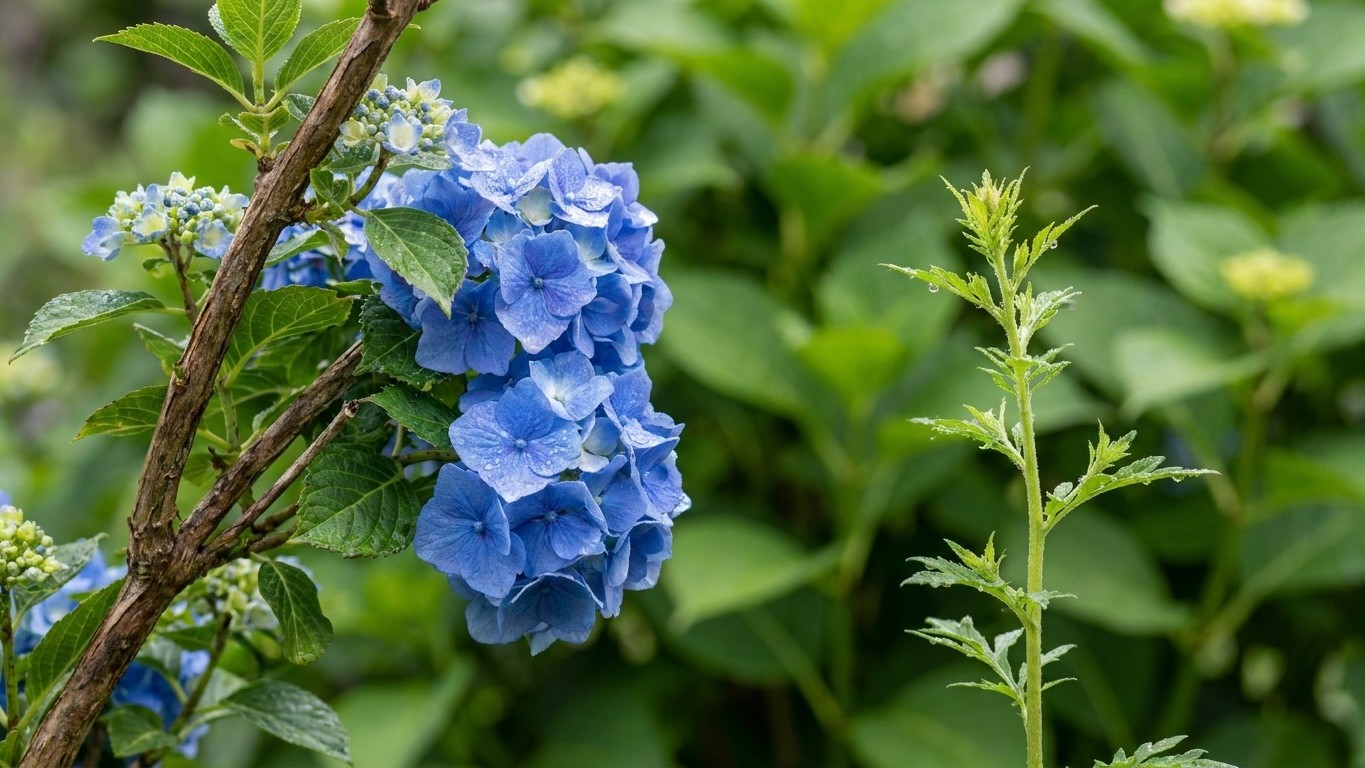

Hydrangeas bloom pink in many Wisconsin yards because the soil sits near neutral or alkaline, and that locks aluminum away from the roots. Blue flowers need aluminum inside the plant. Bigleaf hydrangeas (Hydrangea macrophylla) take it up when soil pH drops, while flowers turn pink at higher pH. Moving a shrub from one to the other is possible, but it often takes a full season or more of steady work.
What this comes down to in Wisconsin

The blue treatment starts when shoots leaf out, and at the Milwaukee reference station the last spring frost falls between April 16 and April 29, according to NOAA NCEI climate normals. Flowers open in summer and the first fall frost arrives October 17 to October 29, so the window for shifting color runs from spring into early summer, well ahead of the first fall frost.
The pigment in bigleaf hydrangea sepals is red-pink on its own. When the plant absorbs aluminum, the pigment binds to it and shifts to blue, with purple in between when only some of the aluminum gets through. Most soils hold plenty of aluminum. The catch is that it only dissolves into a form roots can absorb when the soil is acidic, and above pH 6.0 or so it stays locked in the mineral particles.
Much of southern and eastern Wisconsin sits on glacial deposits rich in limestone and dolomite, which keep the soil pH at neutral or above. Hard well water and city water drawn from limestone aquifers push it higher with every watering. That explains why a hydrangea bought in bloom blue from a garden center often returns pink the next summer: the nursery grew it in acidic potting mix, and your yard soil took over.
Only two species respond to soil chemistry: bigleaf hydrangea and its smaller relative mountain hydrangea (Hydrangea serrata). Panicle types such as Limelight, smooth types such as Annabelle, and oakleaf hydrangeas ignore soil pH completely. When a panicle hydrangea turns pink in late summer, that is the flower aging, and no amount of aluminum sulfate will change it. White bigleaf cultivars stay white, too, because they carry no pigment to shift.
Working it out for your own garden
Begin with a soil test taken under the shrub’s drip line. A home pH kit gives a rough reading; your county extension office can tell you how to send a sample to a lab for an exact number. The reading tells you how far you have to travel. Because pH is a logarithmic scale, each full point is a tenfold change in acidity. A drop from 7.2 to 5.5 is a big job, especially over limestone that keeps pushing the pH back up.
Next, work the calendar backward from the frost window. Roots become active around leaf-out, which comes after the last spring frost. Take April 16 to April 29 and add two weeks, and the first application lands between April 30 and May 13. Repeat every four weeks and the second falls between May 28 and June 10, the third between June 25 and July 8. After that, stop. Applications late in summer do little for flowers that are already formed, and they can stress the plant going into winter.
For the application itself, dissolve aluminum sulfate in water and pour it onto the soil under the shrub. Water the plant well the day before, keep the solution off the leaves, and follow the product label if its strength differs. Too much burns roots. Elemental sulfur is the slower route: soil bacteria convert it to acid over several months, so it works best worked in during early spring or the previous fall.
Phosphorus matters too. A fertilizer high in phosphorus ties up aluminum in the soil and pushes flowers toward pink, so pick a formula with a low middle number. Retest the soil in midsummer. If the reading is at or below 5.5 and flowers still come out pink, the cultivar itself may be a stubborn pink, or the soil may be a sandy one with little aluminum to release.
In clay or limy soil, a dependable result comes from a container or a raised bed filled with acidic mix: peat moss, pine bark, and a little sulfur. Water the container with rainwater when you can, since tap water raises pH over time.
What changes across the state
Wisconsin runs from USDA zone 3b in the north to 6a, according to the USDA Plant Hardiness Zone Map, which is built on a single variable, the average annual extreme minimum temperature. Milwaukee is the reference point for the frost dates above, and the lakeshore behaves differently from the rest of the state. Lake Michigan delays the first fall freeze along the shore, while inland southern Wisconsin typically freezes in early October, and the north freezes far earlier. A gardener in the north has a shorter stretch of spring and summer to shift color than one on the lakeshore.
Soil chemistry changes too. The limestone-rich glacial till of the southeast and much of the south keeps pH high, so blue is an uphill project there. Farther north, sandy and pine-forest soils tend to be naturally more acidic, and bigleaf hydrangeas there may turn blue with little effort, if they bloom at all. That qualifier matters. Most bigleaf hydrangeas set their flower buds on old wood, the stems grown the previous year, and in colder parts of the state winter cold often kills those buds. A shrub that never blooms has no color to change.
Water supply matters as well. A yard on a private well drawing from a limestone aquifer will see its soil drift back to alkaline faster than one watered with rainwater. If you irrigate from a hard-water well, expect to repeat your acidifying treatments more often.
The mistakes this state punishes

The first is treating the soil without testing it. Wisconsin gardeners with alkaline soil and gardeners with naturally acidic soil need opposite things, and aluminum sulfate on soil that is already at pH 5.0 can damage roots. A test costs little and saves a shrub.
The second is applying aluminum sulfate to cold soil too early. Roots take up very little before leaf-out, so a drench in early April, before the last spring frost window of April 16 to April 29 has passed, mostly washes away. Wait until the leaves open.
The third is planting next to a concrete foundation, walkway, or driveway. Concrete slowly leaches lime into the surrounding soil, and a hydrangea beside a basement wall will drift toward pink no matter what you pour on it. Plant a few feet out, or grow it in a container.
The fourth is spreading wood ash or garden lime nearby, along with fertilizer high in phosphorus. Both raise pH or lock up aluminum, and they undo the work you have been doing. Check the label on every bag you buy for the lawn, because lawn lime and fertilizer wash toward shrub beds.
Finally, spring pruning cuts off the old-wood buds. Cutting back a bigleaf hydrangea in April removes the very flowers you are trying to color. Timing is covered in When to Prune Hydrangeas in Wisconsin.
Checking this against your county
The frost dates here come from one Milwaukee station, and your own yard may run earlier or later depending on distance from the lake, elevation, and the pocket of cold air in your low spots. The soil pH in your county matters even more. Your county office of University of Wisconsin-Madison Extension can explain how to take a soil sample and read the result, and for everything else about the shrub, see our guide to growing hydrangeas in Wisconsin.
Common questions
Can I turn a white or panicle hydrangea blue?
No. Only bigleaf and mountain hydrangeas respond to soil chemistry. Panicle, smooth, and oakleaf hydrangeas keep their own colors whatever the pH is, and white bigleaf cultivars stay white.
How long does it take for the color to change?
Often a full season, sometimes two. Flower buds are already formed on last year’s growth, so the first summer after treatment may bring purple or mixed blooms, with clearer blue the year after.
How do I turn blue hydrangeas back to pink?
Raise the soil pH toward 6.0 to 6.2 with garden lime applied according to a soil test, and switch to a fertilizer higher in phosphorus. In Wisconsin’s limestone soils, pink is the default, so often the easiest path is to stop treating the soil.
Do coffee grounds or vinegar work as acidifiers?
Used coffee grounds are close to neutral and barely move soil pH. Vinegar lowers pH briefly, then limestone soil pulls it back up, and repeated doses can harm roots. Aluminum sulfate or elemental sulfur are the dependable choices.