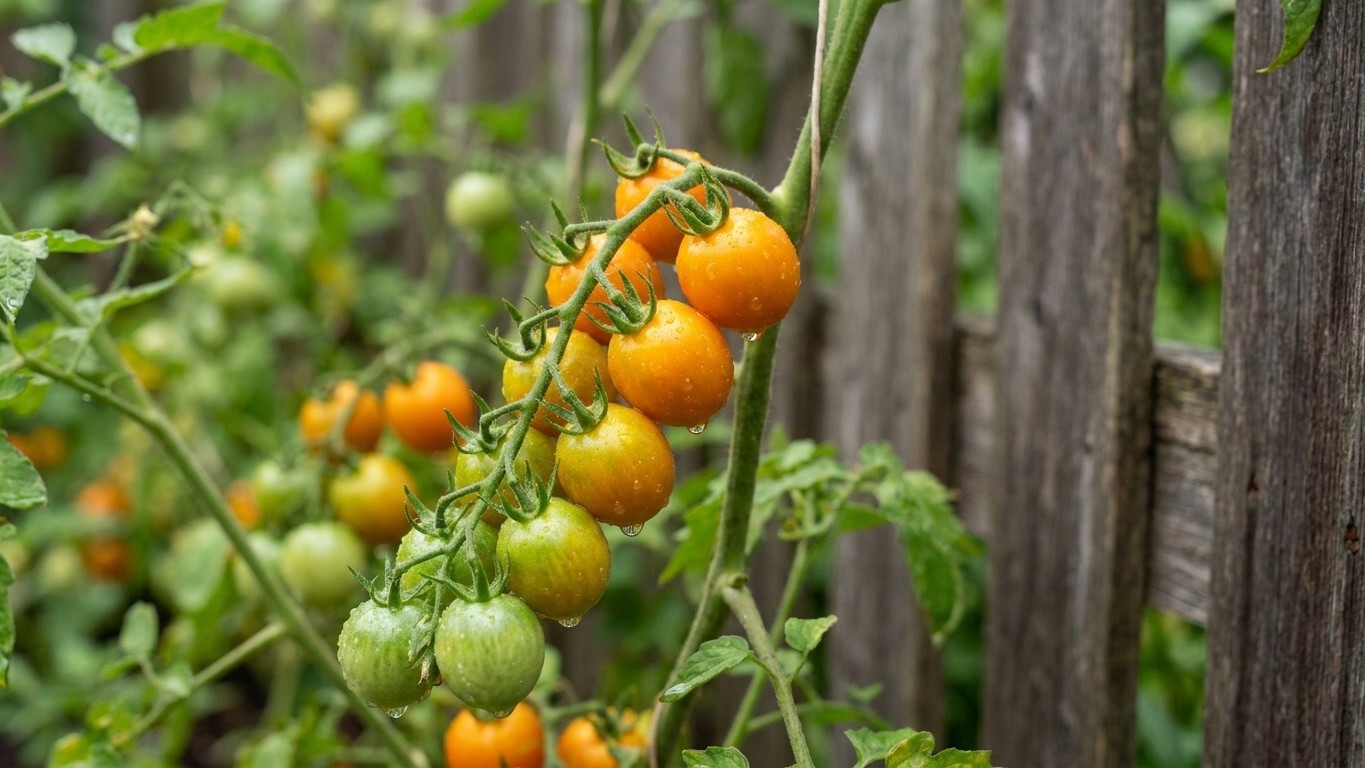

Sun Gold is an indeterminate orange cherry tomato with an intense fruity flavor, ripening in about 57 days from transplant. That speed puts it within reach of far more short-season gardens than a full-size slicer would ever manage, but a fast cherry still needs enough frost-free weeks after that count to actually fill a basket. Check your local frost-free window against that 57-day figure before deciding how many plants to start.
What Sun Gold actually is

Sun Gold is a hybrid, and it grows as an indeterminate vine, meaning it keeps extending, flowering and setting fruit all season instead of stopping after one flush. That habit decides how you grow it before you even get to timing: it needs a tall stake, a cage built for a six-foot plant, or a trellis string, and it wants real space between plants rather than the tight spacing a compact bush tomato tolerates.
The fruit is a small round cherry, thin-skinned, with a distinctive golden-orange color at full ripeness rather than the red of most cherry types. The flavor is markedly sweet with a tropical, almost fruity edge that is the main reason gardeners grow it year after year despite the thin skin’s habit of splitting after rain. Clusters run long, often a dozen or more fruits to a truss, and they ripen a few at a time rather than all at once.
Sun Gold’s days to maturity are listed at about 57, and that figure is counted from the day of transplant into the garden, not from the day you sowed the seed. Seed catalogues state maturity this way across the board, so when you compare Sun Gold to a slicing variety listed at 75 or 80 days, you are comparing two counts that both start at the same point: the transplant date, not the sowing date, and both will run a week or two either way depending on the season’s warmth.
What Sun Gold is good for
A cherry tomato like this one is built almost entirely around water and skin, with very little flesh in proportion to the whole fruit. That ratio is what determines the kitchen, not any particular preference of the plant. There isn’t enough dense material in a Sun Gold to reduce into a sauce; put a bowl of them in a pan and you get mostly steam and skins before you get anything resembling a paste. Sauce and paste tomatoes work because their flesh is thick and their seed cavities are small, so the water cooks off fast and what’s left thickens on its own. Sun Gold has the opposite proportions, so cooking it down means a lot of time for very little result.
What that same small size and thin skin do well is deliver a piece of fruit you can eat whole, unsliced, with no prep beyond rinsing. That’s why the use here is salads and snacking rather than anything that goes near a stove. Tossed into a salad, the fruit stays intact under dressing and gives a burst of juice per bite rather than watering down the bowl the way a chopped slicer would. As a snack, it needs nothing at all: no cutting board, no salt, no cooking, which is a large part of why cherry tomatoes in general have a reputation for never making it back to the kitchen. Picked warm off the vine and eaten standing in the garden is a legitimate way most of this crop gets used, and Sun Gold is grown by a lot of people specifically for that.
Beyond salads and eating out of hand, there isn’t a documented culinary use to point to here — no paste, no canning tradition, no roasting application on record for this variety. That absence isn’t a gap in research so much as a consequence of the fruit itself: there’s rarely enough left of a picked Sun Gold to cook with in the first place.
Where it ripens in time, and where it is a gamble
The arithmetic behind this question is always the same three steps: take the frost-free window, subtract the couple of weeks the soil needs to warm before a tomato transplant will actually grow rather than sit and sulk, then subtract the variety’s days to maturity. Whatever is left is the stretch you actually get to pick fruit, and for an indeterminate cherry like Sun Gold, that stretch matters more than for a determinate variety, because more of the harvest happens in that leftover window rather than in one early flush.
Where the margin is thin
At the tightest end, Yukon, measured at the Whitehorse station, gives Sun Gold a set-out in mid June and a first ripe fruit around mid August, which leaves only about 10 days of margin before frost closes the season. Ten days is one wave of ripe cherries, and a cool year takes even that. Worse, Whitehorse accumulates only around 600 degree-days across the year, which is short of what a tomato needs to build fruit regardless of how long the frost-free stretch runs. A greenhouse or high tunnel is not optional there, it is the difference between a crop and none.
Nunavut, at Rankin Inlet, is similar in shape: a set-out in early July, first ripe by late August, and about 15 days of margin before frost, with annual degree-days around 159, far too little heat for open-ground fruiting. Across the prairie provinces the picture improves but does not clear: Alberta at Calgary and Manitoba at Winnipeg both land in the 45 to 51 day margin range with a June set-out, and Winnipeg’s roughly 1832 annual degree-days are described by extension figures as borderline, the kind of number where an early plastic mulch to warm the soil, or choosing the shortest-season cultivar available, tips the result. Saskatchewan at Saskatoon sits in the same borderline band. In all of these, the honest verdict is greenhouse or tunnel, not open garden.
Where the margin is generous
At the other end of the scale, margin stops being the limiting factor at all. Washington, measured at Seattle, gives a set-out from mid March to early April and a first ripe fruit by late May, leaving around 169 days of margin before the next frost. That is a season long enough to run Sun Gold well past its 57-day count and still have months of picking left. Texas at Houston and Louisiana at New Orleans push past 200 days of margin, with set-outs as early as mid February. In territories like these, frost is not the constraint on Sun Gold at all. Something else is, and it shows up in the next section.
The two ways a season goes wrong
A long frost-free window on paper does not guarantee a full harvest, and two limits explain most of the disappointments that a frost table alone cannot predict.
In the cold territories, the problem is not the calendar, it is accumulated warmth. A plant can survive a frost-free window that looks adequate and still fail to ripen fruit if the days in between are not warm enough, and if nights fall below roughly 50F for stretches during flowering, blossoms drop without setting fruit at all. This is the exact situation behind the Yukon and Nunavut figures above, where degree-day totals sit in the low hundreds. For Sun Gold specifically, being a fast cherry helps here more than it would help a slow slicer, since less cumulative heat is needed to close out 57 days than 80, but a genuinely cold, short summer still beats it without protection.
In the hot territories, the failure runs the opposite direction. Once daytime temperatures push past roughly 86F, tomato pollen becomes sterile and flowers drop without setting fruit, which is why growers in South Carolina, Florida, Texas, Nevada and Louisiana plan on two separate cropping windows, a spring one and an autumn one, rather than one continuous summer harvest. This is where Sun Gold’s short 57-day count actually works in its favor: a plant set out early enough can complete much of its first flush before the hottest stretch of summer arrives, something a slower-maturing slicer often cannot manage. Of the two limits, cold and missing degree-days matter more for this variety, precisely because its speed already buys it some protection against the southern heat gap.
What it resists, and what it does not
Sun Gold carries high resistance to Fusarium Wilt race 1, per the Fusarium Wilt races 1 grading on the seed packet and catalogue listing. High resistance means the plant is bred to largely shrug off infection from that specific race in soil where the pathogen is present, which matters most for gardeners replanting tomatoes in the same bed year after year.
That is the only resistance code Sun Gold’s catalogue listing carries, and it is worth being direct about what that means in practice: the variety has no bred-in defense against late blight, early blight, verticillium wilt, or root-knot nematodes. Growing it where any of those are established in the soil or common in wet seasons means relying on rotation, spacing for airflow, and fungicide where needed, not on the plant’s own genetics.
The more everyday risk with Sun Gold is not disease at all but its thin skin, which splits readily after a heavy rain or an uneven watering schedule following a dry spell. It is not a disease and no resistance rating covers it, but it is the single most common complaint growers report with this variety, and it is manageable with consistent watering rather than any spray.
Growing it without the usual mistakes
Support and spacing
Because Sun Gold is indeterminate, it needs a plan built for a vine that keeps growing until frost, not one that ripens in a single flush and then stops. A cage sized for a compact bush tomato will not hold it. Use a tall stake, a sturdy cage rated for six feet or more, or a trellis with string you can wind as the plant climbs, and set it in place at transplant rather than trying to retrofit support around an established vine loaded with fruit and side shoots.
Give plants more lateral room than a determinate variety needs, since the side growth on an indeterminate vine is real and will crowd its neighbors by midsummer if you space as tightly as you would a bush type. Extension guidance on general tomato spacing is worth checking with your local university extension service, since the right distance varies with your soil and staking method.
Feeding and picking
Stop heavy nitrogen feeding once the plant is setting fruit well. Sun Gold’s habit of continuous flowering means it is easy to overfeed it into producing more leaf than fruit, especially later in the season when you might assume more feeding equals more crop. A balanced feed timed to fruit set, then tapering off, keeps the plant’s energy going into the clusters rather than the vine.
Pick continuously rather than waiting for a big harvest day. Because the truss ripens a few fruits at a time rather than all together, the mistake most new growers make is checking the plant every week or two and finding overripe, split fruit on the vine and unripe green ones next to it. A quick pass every day or two once fruiting starts keeps ahead of both the splitting and the birds. If you are weighing Sun Gold against another cherry for a shorter or longer window, it is worth comparing it directly with a variety like the one covered in Supersweet 100 Tomato: Where It Ripens in Time, since the two are often grown side by side and ripen on a similar clock. For the fuller picture of how other tomato types stack up on timing and habit, the Tomato Varieties guide covers the wider field.
Common questions
Is Sun Gold determinate or indeterminate?
Indeterminate. It keeps growing and setting fruit until frost or disease stops it, which is why it needs a tall, sturdy support rather than a small determinate cage.
Why do my Sun Gold tomatoes keep splitting?
The skin is thin by nature, and splitting usually follows a heavy rain or a dry spell broken by a big watering. Keeping soil moisture even, with mulch and a regular watering schedule, cuts down on splitting far more than any spray or feed will.
Can I grow Sun Gold in a container?
You can, but plan for its size. It is not a patio variety bred to stay small, so a container needs to be large and paired with a tall stake or cage, and it will still need the same feeding and watering attention as one grown in the ground.
How many Sun Gold plants do I actually need?
Fewer than you think. A single well-supported indeterminate vine produces heavily over a long season, and two or three plants is plenty for most households wanting fresh cherry tomatoes rather than a canning-scale harvest.