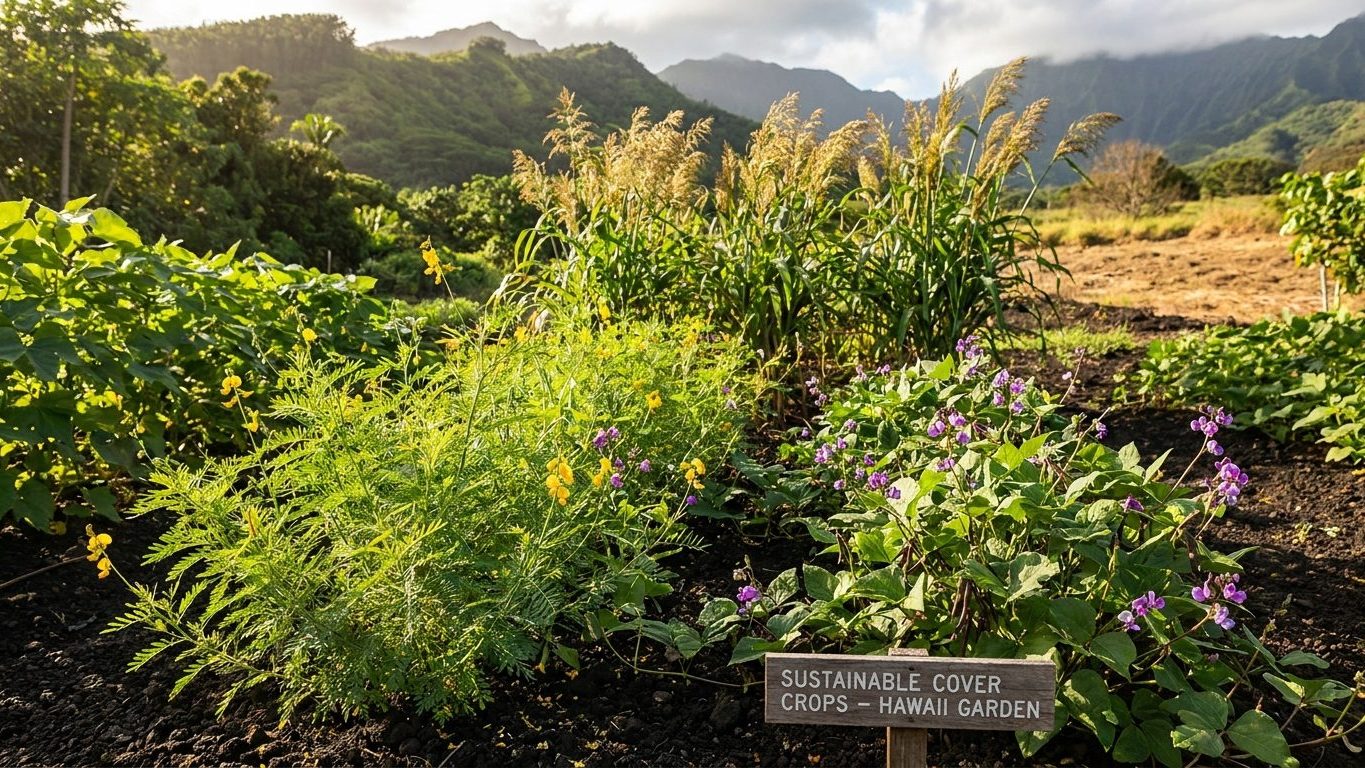

Alabama’s long, mild season points to winter-hardy legumes and cereal grains as the backbone crop, with warm-season fillers for the gaps. Crimson clover, hairy vetch, and cereal rye handle the fall-to-spring stretch statewide, while cowpeas or sorghum-sudangrass cover the hot months between vegetable rotations. The right mix still depends on where in the state you garden.
The short answer for Alabama
Start with the legumes. Crimson clover and hairy vetch survive Alabama winters without effort, because the coldest month here averages a daily minimum of just 33.1°F at the Huntsville reference station, a temperature that barely dips below freezing on an average night. Neither plant needs protection, and both fix nitrogen through the cool months while most gardens sit idle.
Cereal rye earns its place as the erosion-control default. It germinates fast in the fall window between the November 2 to 16 frost date and stays green through winter, holding soil on slopes and garden beds that would otherwise wash out during Alabama’s wet season. Oats can do the same job, but with a catch covered in the next section.
For the warm months, cowpeas and sorghum-sudangrass take the heat that would stall a cool-season crop. Both germinate in warm soil, grow fast enough to smother weeds before the humidity brings on fungal pressure, and tolerate the kind of dry spell that shows up most Julys across the state.
| Cover crop type | Role in Alabama | Planting window | Statewide note |
|---|---|---|---|
| Crimson clover / hairy vetch | Nitrogen fixation, overwinters | Fall, ahead of first frost | Hardy across all of 7a-9a |
| Cereal rye | Erosion control, weed suppression | Fall | Reliable statewide, may need mowing to terminate |
| Oats | Erosion control with a natural die-back | Early fall | Winterkills reliably only in cooler zone 7a pockets |
| Cowpeas | Summer nitrogen, heat-tolerant biomass | Late spring through summer | Best fit statewide for the hot months |
| Sorghum-sudangrass | Summer biomass, weed suppression | Late spring through summer | Handles dry spells better than buckwheat |
What will not work here
Cover crops bred for a hard, reliable winter kill struggle in most of Alabama. Oats, for example, are supposed to die back on their own once temperatures drop into the low 20s, leaving a dead mulch that needs no herbicide or tillage. But with a coldest-month average minimum of 33.1°F, large stretches of the state never see that kind of sustained cold. The oats stay alive, green, and growing right into spring, which means a gardener counting on a clean winterkill instead finds a living stand that has to be mowed, crimped, or sprayed before beds can be planted.
Cool-season legumes sown in summer are a different kind of mistake. Field peas and other spring-loving legumes need cool nights to set pods and avoid bolting. Push them into Alabama’s summer heat and they flower early, stop putting on biomass, and often succumb to the fungal diseases that thrive once daytime humidity climbs. The same humidity punishes anyone who plants hairy vetch or crimson clover too thick. A dense, close-spaced stand traps moisture at the soil line, and powdery mildew or other foliar disease moves through it fast. Extension guidance for the Southeast consistently favors thinner seeding rates here than in drier climates for exactly this reason.
Buckwheat is not a failure so much as a crop that needs to be managed on a short leash. It grows fast in warm soil and blooms in as little as 30 to 45 days, but that speed cuts both ways: in Alabama’s heat, a single planting burns through its cycle quickly and dies, so anyone expecting one buckwheat planting to carry a whole summer fallow period will end up with bare ground and weeds by midsummer. It works, but only as a fast, repeated succession rather than a set-and-forget crop.
What changes across Alabama
Alabama spans USDA hardiness zones 7a through 9a, and that range changes how a cover crop behaves more than most gardeners expect. In the northern part of the state, near the Tennessee line and at higher elevation, winters run colder and closer to true zone 7a conditions. That cold is actually useful: oats and other covers meant to winterkill are far more likely to actually die back there, giving a clean, herbicide-free start to spring planting.
Move toward the Gulf Coast, where the state edges into zone 9a, and winters rarely deliver that kind of hard freeze. Covers that are supposed to die on their own often don’t. A gardener there needs a termination plan, whether that’s mowing, crimping, or a targeted herbicide, because nature isn’t going to do the job.
The frost dates themselves shift by roughly two weeks across the state, based on the November 2 to 16 fall frost window recorded at the reference station. A grower in the cooler north should plant fall cover crops earlier to get a full stand established before frost slows growth, while a grower near the coast has more room to delay. None of this replaces knowing your own zone: the USDA Plant Hardiness Zone Map is built from one variable, average annual extreme minimum temperature, and it’s the tool to check rather than guessing from a state-wide range.
Where to check this for your own county
This page describes Alabama as a whole. Your county is not the whole state, and a county recommendation from a local Extension office will beat anything written here every time. The Alabama Cooperative Extension System, at aces.edu, is the place to go for that detail.
Once there, look for two specific things. First, a county-level planting calendar, which will translate the frost-date ranges on this page into dates that reflect your actual local station rather than the airport-based averages NOAA publishes for the whole region. Second, look for any variety trial results for cover crops in your part of the state. Extension agents test how crimson clover, cereal rye, cowpeas, and other covers actually perform in local soil and local rainfall patterns, and that trial data reflects field conditions no state-wide article can capture.
If your county page doesn’t cover cover crops directly, call the county Extension office. Agents there work with row-crop and market-garden operations that use these same species and can tell you, from direct local experience, whether oats reliably winterkill in your specific area or whether growers there plan on mowing them down every spring instead.
Checking this against your own garden
No calendar, including this one, knows your yard as well as you do. Three simple observations will tell you more than any published date.
Feel the soil before you seed a fall legume. If it’s still warm to the touch six inches down in October, when you’d expect it to be cooling off, your site holds heat longer than the regional average, and you can push your planting date a little later without risk. A cold, damp feel earlier than expected means the opposite: plant sooner.
Watch how your oats behave over winter. If they reliably brown off and die by January, your particular spot runs on the cooler end of the state’s range, and you can count on that natural termination going forward. If they stay green and keep growing, plan on mowing or crimping every year, because your microclimate isn’t cold enough to do that work for you.
Track your own first frost against the November 2 to 16 window from the reference station. Low-lying beds and open fields often freeze a week or two earlier than that range suggests, while a spot near a house wall or wooded edge often lags behind it. A season or two of watching your own thermometer will tell you which side of that gap your garden falls on.