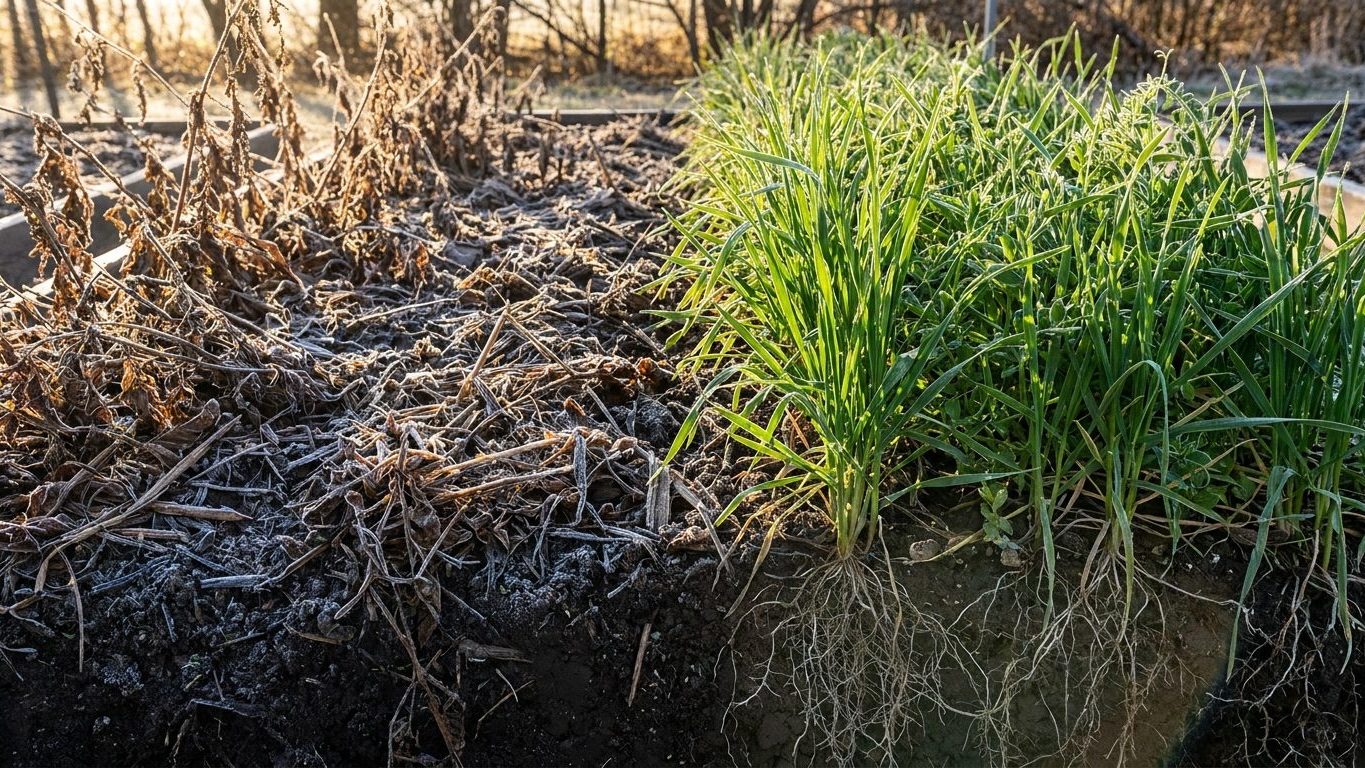

The species you pick decides how much work spring will be. Winter-killed cover crops die from hard freezes and settle into a flat mulch that needs no more attention. Overwintering species survive the cold, keep their roots alive, and start growing again as soon as the ground warms, which means they need to be cut, mowed, or crimped down before they compete with whatever you plant next.
What is actually going on
Cold kills plant tissue by forming ice crystals inside the cells. When water inside a leaf or stem freezes, the crystals rupture the cell walls, and the plant collapses into mush once it thaws. Some species have almost no defense against this. Others have spent millions of years developing one, and that difference is the entire story behind winter-kill versus overwintering.
Cold-hardy species protect themselves through a process plant physiologists call cold acclimation, or hardening off. As days shorten and temperatures drop gradually in the fall, these plants move water out of their cells and load up on sugars and proteins that act like an internal antifreeze. Cereal rye and hairy vetch, for example, can survive temperatures that would liquefy a stand of buckwheat or spring oats within hours. The plant isn’t avoiding the cold. It’s chemically preparing for it, and that preparation takes weeks, not days.
This is why the same species can behave differently from one fall to the next. A cover crop that gets a full month of gradually cooling weather before the first hard freeze hardens off properly and stands a real chance of overwintering. The same species planted three weeks later, caught by an early cold snap before it acclimated, can die outright even though the books call it winter-hardy. Planting date changes the outcome as much as the species does.
Snow cover matters too, in a way most gardeners underestimate. A few inches of snow acts as insulation, keeping soil and crown temperatures well above the air temperature above it. A cover crop that would die at a certain air temperature in a bare, exposed bed can survive the same air temperature under a blanket of snow. That’s part of why regional advice about “winter-hardy” crops has to be read with a grain of salt: the same species, same latitude, can overwinter in a snowy year and die in a dry, exposed one.
None of this is about killing the plant on purpose with a spray. This site terminates cover crops the way home gardeners actually can, by mowing, crimping, cutting, or simply letting frost do it, and the goal of understanding the mechanism is knowing which of those tools you’ll actually need come spring.
In the garden
Species fall roughly into two camps, but each one comes with its own way of surprising a gardener who trusts the label too much. The table below groups common cover crops by their usual winter fate, and describes what tends to go wrong when the season doesn’t cooperate.
| Species | Typical winter fate | What goes wrong |
|---|---|---|
| Oats | Winter-kills at a hard, sustained freeze | Planted too late in a warm fall, it never builds enough biomass to matter; in an unusually mild winter it can survive in patches and regrow unevenly, complicating a clean spring bed |
| Buckwheat | Winter-kills at the first light frost, sometimes before | Gardeners leave it standing too long hoping for more growth, and it sets seed first, turning next year’s helper into this year’s weed problem |
| Forage or tillage radish | Winter-kills at a hard freeze, collapsing into a strong-smelling mulch | In milder winters or warmer zones it doesn’t fully die, and a live taproot resprouts in spring right when a gardener expected bare soil |
| Field peas (spring type) | Winter-kills readily, similar to oats | Confused with hardy Austrian winter peas, which behave very differently and can survive the same cold |
| Cereal (winter) rye | Overwinters reliably in most regions, among the hardiest cover crops grown | Its biomass and stem toughness increase fast once it resumes spring growth, so a gardener who waits too long to mow or crimp it ends up fighting a much bigger, tougher stand than planned |
| Hairy vetch | Usually overwinters, but less reliably than rye in harsher climates | Where winters are more severe than expected, it can winter-kill unpredictably, leaving no legume cover behind and no nitrogen benefit to draw on before planting |
| Crimson clover | Overwinters in milder regions, marginal to unreliable in colder ones | Planted based on generic advice without checking local hardiness, it dies in a harder-than-usual winter, wasting the seed and the planting window |
| Winter wheat | Overwinters reliably, somewhat less aggressive in spring regrowth than rye | Gardeners expecting oat-like winter-kill are caught off guard by a living stand in April that still needs mechanical termination |
The pattern across every row is the same: the label “winter-kill” or “overwinter” describes a tendency, not a guarantee. Species at the edge of their hardiness range, like crimson clover in a colder pocket or hairy vetch after an unusually brutal cold snap, can flip categories depending on the year. Exact seeding rates and planting windows depend on the species, your soil, and your goals for the bed, which is exactly the kind of detail your local Cooperative Extension office is set up to answer for your specific conditions.
What it depends on where you are
Everything above is biology that holds true anywhere in the country: ice damages unprotected cells, hardening off takes time, snow insulates. What changes from one region to another is the timing and the margin for error, and that part genuinely can’t be answered from a national page.
Season length sets how much time a cover crop gets to establish and harden off before the first hard freeze arrives. A shorter fall window means less time for cold acclimation, which pushes borderline species like hairy vetch or crimson clover further toward winter-kill even if the same species would comfortably overwinter with a longer, slower cooldown. Summer heat and rainfall shape the other end of the calendar too, since they determine how early a garden bed is even free to plant a fall cover crop in the first place. A garden that finishes its summer harvest early has a wider window and more flexibility in species choice than one where the last tomatoes don’t come out until late in the season.
Minimum winter temperatures obviously matter, but so does how consistent they are. A region with a hard, early freeze followed by a long stretch of mild weather puts different stress on a cover crop than a region with a gradual, steady decline into deep cold. The first pattern punishes species that haven’t hardened off yet; the second rewards them. Snow reliability compounds all of this, since a species surviving thanks to an insulating snowpack in one winter can die from the same air temperature the next winter if the snow doesn’t show up.
None of this can be reduced to a single map or a single date without misleading someone. The state-specific pages on this site work through these regional differences in more detail, and your local Cooperative Extension office, run through the land-grant university system and coordinated nationally by the USDA’s National Institute of Food and Agriculture, can tell you what actually survives a typical winter on your soil. You can find your local office through the USDA NIFA Cooperative Extension directory.
The mistake that costs the most
The costliest mistake isn’t picking the wrong species. It’s treating “winter-kill” as a promise instead of a probability, and showing up in spring with no backup plan.
Here’s how it plays out. A gardener plants oats or tillage radish in the fall, reads that they winter-kill, and mentally files the bed as “handled.” Spring arrives, the bed gets tilled or seeded on schedule, and only then does anyone notice a patch of radish that didn’t fully die, or a stand of oats that limped through an unusually mild cold snap. Now there’s live plant material competing with newly planted seedlings, and no mower, no crimper, and no plan standing by to deal with it.
The fix costs nothing and takes five minutes: walk the bed before you plant into it, every single spring, regardless of what the species is supposed to do. If it’s dead and flattened, plant right through the mulch. If it’s green and growing, mow it, crimp it, or cut it down before it competes with your cash crop or reseeds itself into a weed problem. This single check turns every uncertain winter, mild or brutal, into a non-issue, because the decision about how to terminate the cover crop gets made from what’s actually growing in the bed, not from what a seed packet predicted back in September.