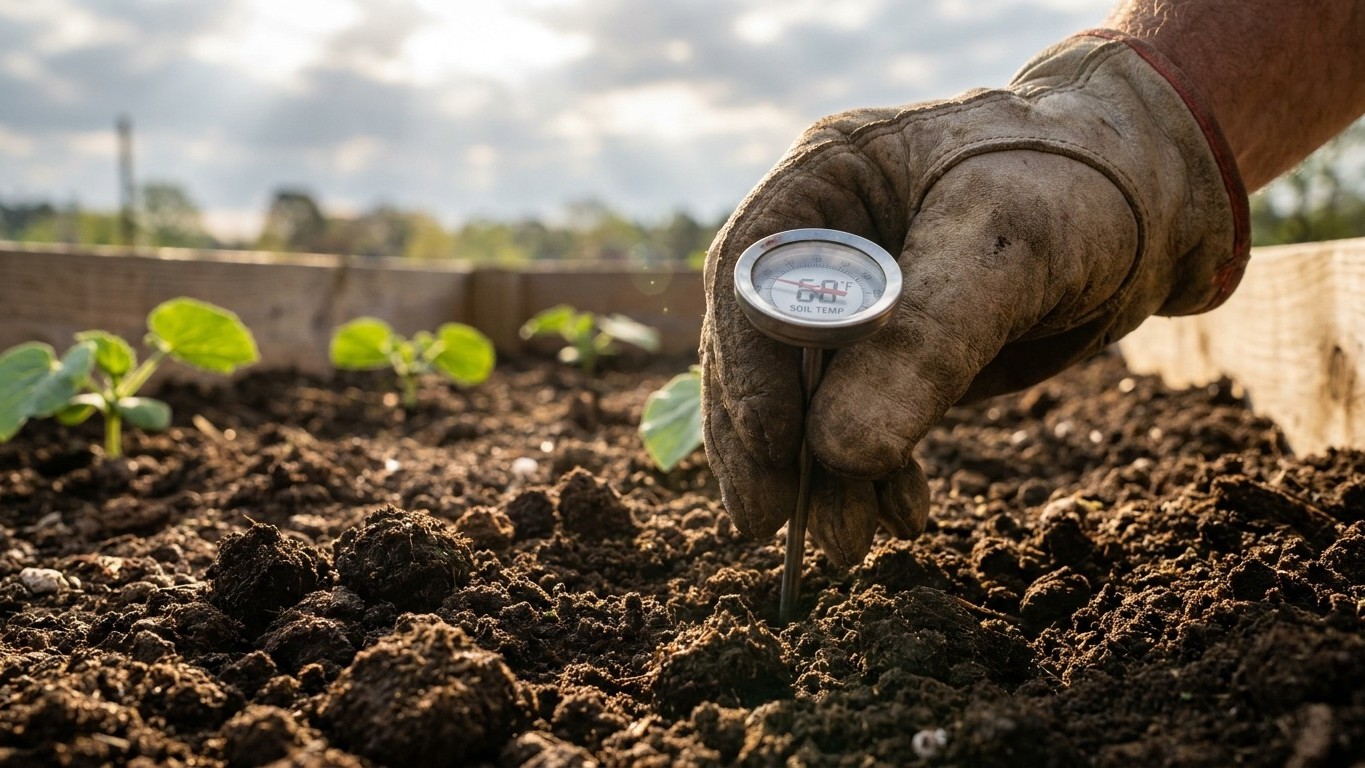

The short answer: soil needs to hold steady in the mid-60s before melon seed or transplants go in, which in most of Alabama lands somewhere between mid-April and early May. The date moves by county, by soil type, and by how the spring behaves that particular year, so the calendar is only a starting point.
When the soil is warm enough in Alabama

According to NOAA’s 1991-2020 Climate Normals for reference station USW00003856, the last spring frost in this part of Alabama falls somewhere between March 19 and April 3. That range reflects the 30-70% freeze probability band, meaning it’s a statistical likelihood built from three decades of data, not a guarantee tied to any single year. Some springs will freeze later, some earlier, and the station itself sits at an airport, where pavement and open exposure tend to record frost clearing sooner than a shaded backyard a few miles away.
Why soil temperature outranks the calendar
Melons don’t care what the frost date says. They care about the dirt they’re sitting in. Seeds sulk or rot in cold, wet soil, and transplants set out too early just sit there, stunted, while the temperature catches up. The useful number isn’t the frost date at all, it’s soil temperature holding near 65 to 70 degrees Fahrenheit for several consecutive days, measured with a simple soil thermometer pushed a couple of inches into the bed. That threshold typically arrives two to four weeks after the last frost risk has passed, since bare ground warms slower than the air above it.
Gardeners on sandy soil, which drains and warms faster, often hit that mark earlier than neighbors working heavier clay, which is common across much of the state and holds both cold and moisture longer into spring. Black plastic mulch laid down a week or two ahead of planting, or simply using raised beds that shed water and catch more sun, can nudge that timeline forward without changing anything about the actual frost risk. What it does change is how fast the root zone gets to the temperature melons actually need.
Because the reference station is an airport, treat March 19 to April 3 as a benchmark rather than a countywide promise. Rural and suburban plots, especially those in low-lying areas where cold air settles, commonly see frost linger a week or two past that window. Checking with a local extension office or simply tracking a home soil thermometer for a season removes the guesswork better than any published date can.
How long the season lasts here
Pairing both frost dates from the same station gives a workable range for the frost-free window. Counting from the earliest last spring frost (March 19) to the latest first fall frost (November 16) stretches the season to roughly 242 days. Counting the more conservative combination, the latest spring frost (April 3) to the earliest fall frost (November 2), shortens it to about 213 days. Either way, that’s a long growing window by national standards, and it changes what’s worth attempting in a single year.
What a season this long makes possible
A frost-free stretch of seven months or more means most melon plantings finish well before fall frost even becomes a factor, leaving real room for a second sowing if the first crop is pulled by midsummer. That’s a meaningfully different calculation than gardeners face in shorter-season states, where the first planting is the only shot and every week of delay matters. Here, a grower who gets seed in the ground close to the early end of the window can realistically plan a second round timed to mature before the fall frost risk climbs back up in late October or November.
The length of the window also affects whether transplants are worth the trouble. Melons dislike root disturbance, and direct seeding avoids that risk entirely. With 213 to 242 frost-free days on the table, there’s rarely a hard need to rush transplants just to squeeze out a harvest, though a grower chasing an especially early first crop might still choose them, understanding the tradeoff. For the specifics of timing a second sowing to land inside this window, the succession sowing guide on this site walks through the spacing between plantings.
As with the frost dates themselves, remember these figures come from one airport station. A rural garden nearby may lose a week or two off either end, which trims the season closer to the 213-day figure even in a year when the wider region enjoys something closer to 242.
Heat and water in Alabama

Summer heat here isn’t marginal. The Huntsville reference station in NOAA’s Climate Normals logs an average of 58.5 days a year at or above 90°F, which is a substantial heat load and puts this territory solidly in the camp where accumulated warmth, not the sowing date, drives how fast melons size up and sweeten. That’s good news for the crop in one sense: melon vines thrive on sustained heat, and a summer like this rarely leaves them wanting for warmth.
Water is a different story, and a more complicated one. The same station’s monthly normals put summer rainfall at about 12.1 inches across June, July, and August, broken down as 4.06 inches in June, 4.49 in July, and a noticeably drier 3.55 in August. That’s not a drought-prone total, but it’s also not evenly spread, and August, the very month when melon vines are often filling out fruit and building sugar, is the driest of the three.
Heat and moderate rain together create a specific set of tradeoffs. High evaporation on 90-degree days means soil dries out fast between rain events, and a lot of Southern summer rainfall arrives as short, heavy thunderstorms that run off clay soils rather than soaking in. That combination makes supplemental watering, especially through August, the factor that decides fruit size more than the total rainfall figure suggests on paper. Growers on sandy soil will need to water more frequently still, since that same rain passes through within a day rather than lingering in the root zone.
The flip side of a warm, moist Southern summer is disease pressure. Humidity that lingers after those thunderstorms, combined with heat, is exactly the environment that favors powdery and downy mildew on melon foliage. Good airflow between plants, watering at the soil line rather than overhead, and keeping vines up off wet ground all matter more here than in a drier climate, where heat alone would be the bigger concern. In Alabama, it’s the combination, not either factor alone, that shapes how the crop performs.
Which melons suit Alabama
Given a frost-free window that runs 213 to 242 days, a heat load averaging close to 60 days above 90°F, and summer rain that arrives unevenly with a dry August, three qualities matter more than any specific variety name: disease resistance, given the humidity; tolerance for sustained heat, given the long hot stretch; and, for gardeners on the shorter end of the frost-free range, an earlier-maturing type that leaves margin for a possible second sowing.
Variety performance depends heavily on local disease pressure, soil type, and even which strain of mildew or wilt is active in a given county in a given year, information that changes from season to season and that no general guide can responsibly claim to know for every reader. What does hold steady is the type of melon suited to this climate: a shorter-season type for growers working the tighter end of the frost-free window near USW00003856, and a disease-resistant type as close to a universal requirement across the state given how reliably summer humidity shows up alongside the heat.
Alabama’s own land-grant extension service, reachable at aces.edu, publishes variety trial results specific to Alabama growing conditions, and that’s the resource worth checking before buying seed. Those trials account for the soil-borne diseases and regional pest pressure that a national gardening guide simply can’t track county by county. Pairing that local variety guidance with the timing and watering principles laid out here, rather than a name pulled from a seed catalog with no Alabama data behind it, is what actually moves the needle on a successful crop.