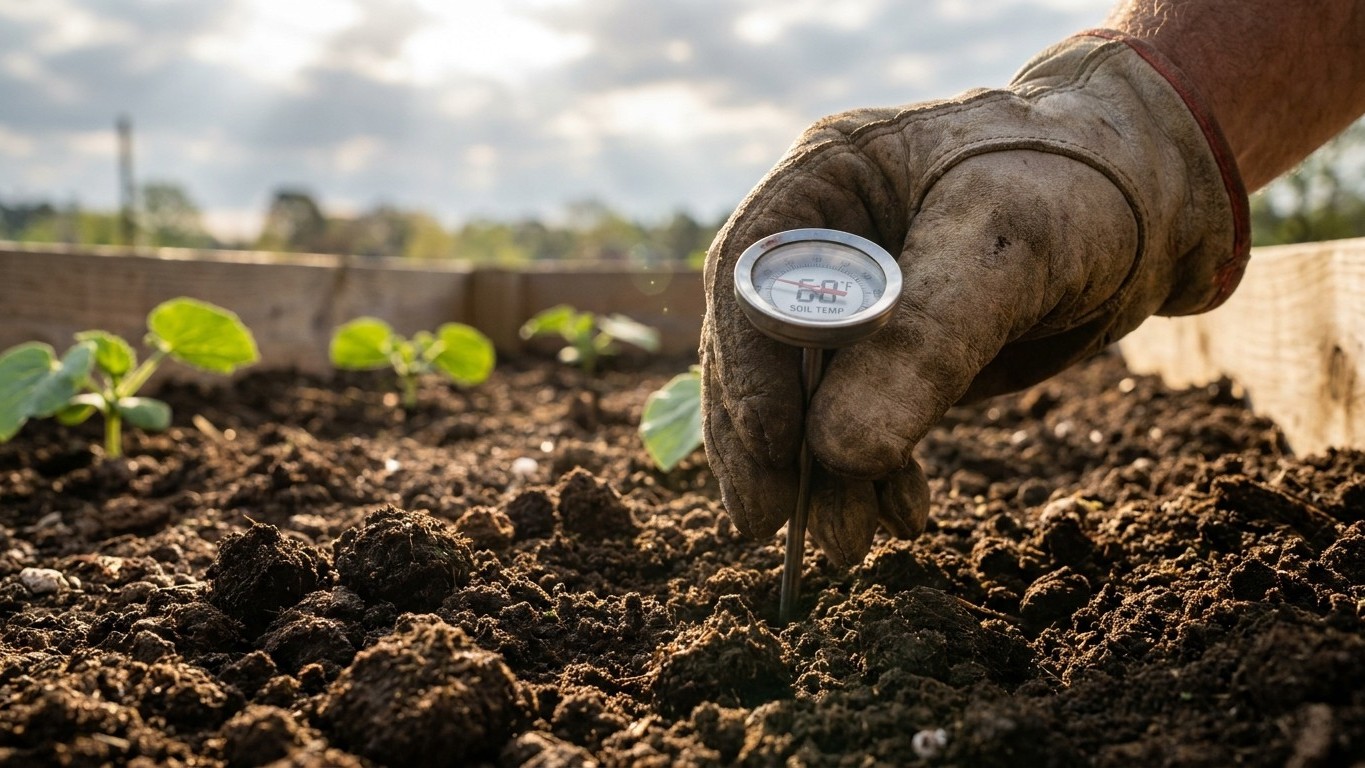

New Brunswick gardeners can direct-sow or transplant melons once soil temperature at planting depth holds above 65°F for several consecutive days, which in most seasons lands in the first half of June, well after the average last frost. Waiting for the calendar date alone is not enough: the soil itself has to catch up, and in this province that lag is the whole story.
When the soil is warm enough in New Brunswick

The average last spring frost at the Moncton station is May 23, according to Environment and Climate Change Canada’s Canadian Climate Normals for 1981-2010. That date is a mean, not a guarantee: in roughly one year out of two, frost arrives later than May 23, sometimes by a week or more. Treat it as the midpoint of a risk window, not a green light for the trowel.
Here is the part that trips people up. Melons don’t respond to the frost date, they respond to soil temperature. Air can sit safely above freezing for weeks while the top few inches of ground are still cold from a long winter and a slow-warming spring. Cold soil stalls germination, rots seed before it sprouts, and stunts young transplants even when the air feels mild. So the practical rule is: let the frost date pass, then keep waiting until the soil itself, not the thermometer on the porch, tells you it’s ready. A simple soil thermometer pushed a couple of inches down is worth more than any date on a seed packet.
New Brunswick sits in Canadian hardiness zone 5a, based on Natural Resources Canada’s Plant Hardiness Site using 1991-2020 normals for the reference municipality. That’s worth flagging clearly: it is the Canadian zone system, built from seven climate variables, and it does not translate directly to the single-variable USDA zones used elsewhere on this site. Canadian zone 4a alone can overlap nine different USDA zones. So use the Canadian number to compare New Brunswick against other Canadian provinces, not to cross-reference American planting charts.
In practice, growers here lean on techniques that push soil warming ahead of the calendar rather than trying to outrun frost risk. Black plastic mulch laid a week or two before sowing, raised beds that drain and warm faster than flat ground, and row covers set over the bed once seed goes in all buy real days in a province where the ground warms slowly. None of that changes the frost date. It changes how soon after that date the soil actually becomes hospitable to a melon seed, which is the number that matters. For variety choice suited to that slow start, your provincial or federal extension service is the source to consult, since local trial results carry more weight than any general guide.
How long the season lasts here
Subtracting the average last spring frost (May 23) from the average first fall frost (October 2), both from the same Moncton station and the same 1981-2010 normals, gives a frost-free window of about 132 days. That’s a touch under four and a half months, and it counts from the frost dates themselves, not from whenever the soil actually warms up enough to plant, which as the section above makes clear, comes later.
What does 132 days buy a melon grower? Not much slack. Melons are a warm-season crop that wants sustained heat more than it wants a long calendar, and with the soil-warming delay eating into the front of the window, the effective growing period for a heat-loving vine shrinks further still. That reality changes two decisions at once. First, a second sowing later in summer, the kind of succession planting that makes sense for lettuce or beans, is a hard sell for melons here: sow a second round in July and there simply isn’t enough warm season left behind it to bring fruit to maturity before the average October 2 frost closes things out. If you want a broader look at how succession sowing works and where it does pay off, this site’s succession sowing guide walks through the crops and timing where staggered sowings make sense.
Second, the short window tips the balance firmly toward transplanting rather than direct-seeding. Starting melon seed indoors three to four weeks before the soil is expected to be workable effectively borrows time the outdoor season doesn’t have. The tradeoff is real, though: melons resent root disturbance, so any transplant needs to move to the garden with its root ball intact, ideally grown in a biodegradable or deep-cell container from the start rather than a shallow flat that forces a rough transplant later. In a province with 132 days between average frosts, that root check at transplant time is not a nicety. It’s often the difference between a vine that establishes and one that sulks for two critical weeks it doesn’t have to spare.
Heat and water in New Brunswick

The Moncton reference station records an average of 0.0 days a year above 90°F, per the 1981-2010 Canadian Climate Normals. That number says plainly what kind of summer this is: not hot. Melons ripen on accumulated warmth over the whole season, not on a handful of scorching afternoons, and a territory that essentially never crosses 90°F is one where every degree of that accumulated heat has to be earned through technique rather than assumed from the climate.
That reframes the whole growing strategy. In a genuinely hot territory, the questions are about irrigation volume and how the final weeks of dry heat concentrate sugar in the fruit. None of that applies here. In New Brunswick, the real levers are the ones that raise soil and microclimate temperature around the plant: black plastic mulch, clear or slitted row covers left on longer than a warm-climate grower would bother with, siting vines against a south-facing wall or fence that banks radiant heat, and choosing the earliest-maturing types available, since anything bred for a long hot season simply won’t finish here.
On the water side, the Moncton normals show summer rainfall of about 10.5 inches across June, July and August combined, broken down as 3.73 inches in June, 3.63 in July and 3.18 in August, against 47.3 inches for the full year. That’s a meaningfully wet summer by melon standards, and it comes with its own problem: cool, damp air around the foliage is exactly the condition that breeds powdery mildew and other fungal disease on melon vines, and it slows ripening by keeping soil and air temperatures down when the plant wants heat. A hot dry summer would put the decision in the grower’s hands through the irrigation hose; a cool wet one puts it in the hands of airflow, spacing and drainage instead.
The rainfall figure also never reads alone. The same 10.5 inches behaves very differently depending on what’s underneath it: a sandy bed drains that rain away within a day, while heavy clay holds it for a week and keeps roots sitting wet, which in a cool climate raises rot risk further. A rain gauge on the actual plot, cross-checked against the bed’s own drainage, tells a grower more than the regional average ever will.
Which melons suit New Brunswick
Given a frost-free window of roughly 132 days, a soil-warming delay that eats into the front of it, essentially no days above 90°F, and a wet, cool summer that favors fungal disease, three criteria matter more than any variety name: earliness, disease resistance, and tolerance of a shorter accumulated-heat total than a melon would get further south.
The earliest-maturing types within a melon category will always be the safer bet in this province, simply because they ask for less total warmth before fruit ripens, leaving a buffer against a late soil-warming spring or an early fall frost. Within that earliness filter, resistance to powdery mildew and other foliar disease should be the next thing a grower checks, given how consistently the summer rainfall and moderate temperatures here favor those pathogens over a long, dry, sun-baked season. Spacing vines generously and training them for airflow, rather than letting foliage sit dense and damp, does real work alongside that resistance rather than replacing it.
Seed catalogs list dozens of melon types marketed as early or disease-resistant, but which of those actually perform in a New Brunswick season is a question only local trial data can answer, and that data lives with the extension and agriculture services closest to the ground here, not with a general guide covering many Territories at once. Canada’s federal agriculture department, at agriculture.canada.ca/en, is the verified starting point for that local variety information, since the provincial department’s own site currently blocks automated access.