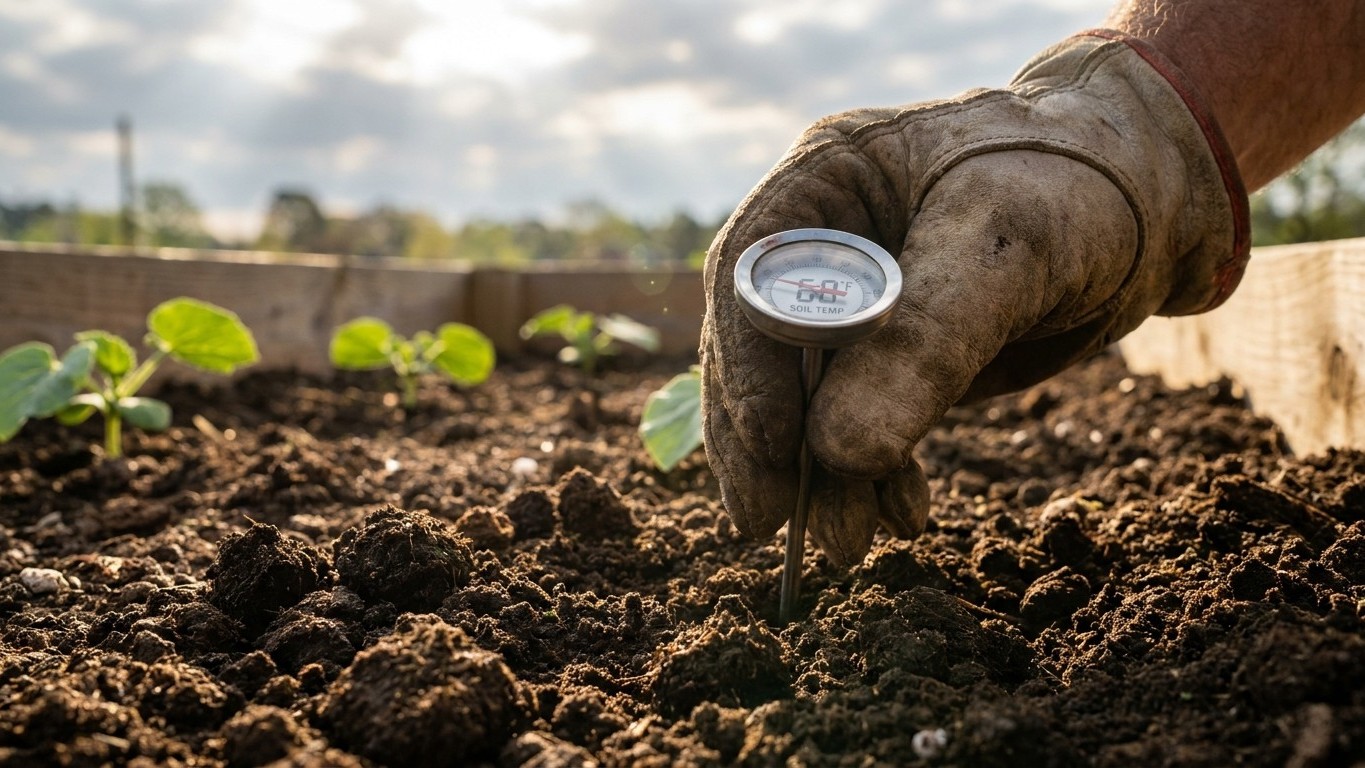

Melon seedlings need soil that has climbed well past the mid-60s, not just a calendar date past frost. In Arkansas that usually means direct-seeding or transplanting between mid-April and early May, with the far south of the state a week or so ahead of the Ozark highlands. The details below explain why the frost date alone won’t get you there.
When the soil is warm enough in Arkansas

The reflex question is “when’s the last frost,” so here it is: at the reference station USW00013963, NOAA’s 1991-2020 Climate Normals put the last spring occurrence of a 32°F freeze somewhere between March 12 and March 28, and the first fall freeze between November 7 and November 20. That’s a probability band, not a guarantee, built from thirty years of data, and it moves depending on where in that band your particular spring lands.
Melons don’t actually care about that 32°F threshold. They care about soil temperature, and soil takes weeks to catch up once the air stops freezing. A patch of ground can be safely frost-free in mid-March and still be too cold and wet to sprout a melon seed without it rotting. That’s the gap a lot of first-time growers fall into: they plant on the frost-free date and then wonder why nothing comes up for three weeks, if it comes up at all.
For tender crops like melons, the more useful number is the light-frost threshold, not the hard freeze. NWS Little Rock gives April 3 as the average last light frost (36°F) in spring and October 31 in fall, a tighter, more realistic window for anything that can’t tolerate even a light nip.
| Frost threshold | Last spring date | First fall date |
|---|---|---|
| 32°F hard freeze (30-70% probability band, USW00013963) | March 12 – March 28 | November 7 – November 20 |
| 36°F light frost (NWS Little Rock) | April 3 | October 31 |
In practice, that means aiming for direct seeding or transplanting once the calendar clears early April, and using techniques that push soil temperature up faster rather than trying to beat the frost date itself. Black plastic mulch laid a week or two ahead of planting, raised beds that drain and warm faster than flat ground, and row cover pulled tight over young plants on cold nights all buy real days. None of that changes the biology: melon roots stall below the mid-60s regardless of what the thermometer says about air temperature.
Arkansas sits in USDA Hardiness Zone 6b-8a, a range wide enough that a grower in the Delta and one in the Ozarks are working with genuinely different springs. The zone map is built on winter extreme minimums, so it says nothing about how fast spring soil warms, but it’s a fair signal that “early April” in the south of the state can mean two weeks ahead of the same date in the northwest corner.
How long the season lasts here
Stack the two frost windows against each other and Arkansas comes out with a long frost-free stretch. Counting from the latest date in the spring band (March 28) to the earliest date in the fall band (November 7) gives roughly 224 days of workable growing season on the conservative end. Push it to the generous end, from March 12 to November 20, and it stretches past 250 days. Either way, that’s a season long by national standards, and it’s the reason melons are a realistic crop here rather than a gamble.
That length changes what’s worth doing in the garden. A window this long isn’t just enough for one melon crop to mature and ripen; it leaves slack for planning a second sowing behind the first, especially with faster-maturing types planted again in early-to-mid summer for a fall harvest before the first frost band arrives in November. That’s a decision worth working through properly rather than guessing at, and the succession sowing guide on this site walks through how to time a second planting against a known frost window like this one.
The flip side is that a long season also raises the stakes on the transplant-versus-direct-seed question. Melons resent root disturbance, and with this much calendar to work with, there’s less pressure to force an early transplant just to squeeze out a harvest before frost. A grower here can afford to direct-seed once soil warms properly, skip the root check that transplanting risks, and still finish well ahead of the November frost band. In a shorter-season state that trade-off tilts the other way; in Arkansas, patience usually wins.
None of this erases the year-to-year swing built into a 16-day spring band and a 13-day fall band. A grower who plants right at the early edge of the safe window in a year that lands late is exactly the grower who loses a stand of seedlings to a surprise frost. The season is long here, but the two ends of it are still probabilities, not fixed dates.
Heat and water in Arkansas

At the Little Rock reference station, the 1991-2020 normal is 69.2 days a year at or above 90°F. That’s not a mild summer by any national comparison, and it puts Arkansas squarely in the category where heat accumulation, not the calendar, is what decides how a melon crop performs. Melons want warmth banked up over the season more than they want a specific number of days; a state clearing 90°F on nearly seventy days a year has that warmth in surplus, which is good news for sugar development and vine growth alike, provided the water side keeps pace.
That’s where it gets less generous. Summer rainfall averages about 10.0 inches across June, July and August, out of 50.4 inches for the full year, with the driest month landing right in the middle of the growing push: August comes in at 3.16 inches, just behind June’s 3.55 and July’s 3.33. So the water isn’t scarce over the year as a whole, but it thins out precisely when 90°F afternoons are pulling the most moisture out of the soil.
Put those two numbers together and the picture is a hot summer with rainfall that doesn’t reliably match the demand. Much of that summer rain in Arkansas arrives as thunderstorms rather than steady soaking rain, which means a good chunk of it runs off before it reaches root depth, especially on compacted or clay soil. A garden on sand behaves differently again, letting water through fast enough that even a wetter week can leave the root zone dry within a day or two. That’s the reason a rain gauge on the actual plot tells a grower more than any regional average.
For melons specifically, this combination puts irrigation in the driver’s seat for fruit size, and puts the final two to three weeks before harvest in charge of sugar. Vines that go dry mid-season stall and produce smaller fruit; vines watered heavily right up to the finish line often produce larger, blander melons because sugar concentration depends partly on easing water back as the fruit ripens. Consistent deep watering through the hottest stretch, then a deliberate pullback in that last stretch, is the practice that threads the needle. It’s also worth remembering that Little Rock is one station in a state with real geographic spread; the Delta lowlands run hotter and more humid than the Ozark highlands, so a grower in the northwest corner should expect somewhat fewer 90°F days than this normal suggests.
Which melons suit Arkansas
Given a long frost-free season, real summer heat, and rainfall that arrives unevenly and often as humid thunderstorms, three things end up mattering more than any variety name: earliness for a second-round crop, tolerance for heat stress at the root, and resistance to the fungal diseases that thrive when humid nights follow warm rain. That last point deserves more weight in Arkansas than in a drier state, powdery and downy mildew and various vine wilts find exactly the conditions they want when summer humidity sits on top of 90°F afternoons and periodic downpours.
What the season and climate favor
- Earlier-maturing melon types, useful both for hitting the first harvest window comfortably and for leaving enough season for a second succession sowing behind them
- Types and growing setups that give good airflow around the vines, since dense, humid foliage is where mildew gets a foothold fastest
- Disease-tolerant lines as a first filter, before earliness or size, precisely because the humidity here raises fungal pressure more than cold or drought would
- Mulching and drip irrigation over overhead watering, to keep foliage drier through the muggiest stretches of June through August
None of that points to a single cultivar. Variety trials run by the University of Arkansas System Division of Agriculture and its county extension offices track which specific melon varieties actually hold up against local disease pressure and heat, year over year. A state spanning Zone 6b to 8a, with the Delta running hotter and wetter than the Ozarks, doesn’t have one right answer anyway, it has a handful, sorted by region. The Cooperative Extension Service publishes those trial results and updates them as new varieties come through testing, which makes it the only source worth trusting for the actual name to plant, rather than a type description written from three decades of weather averages.