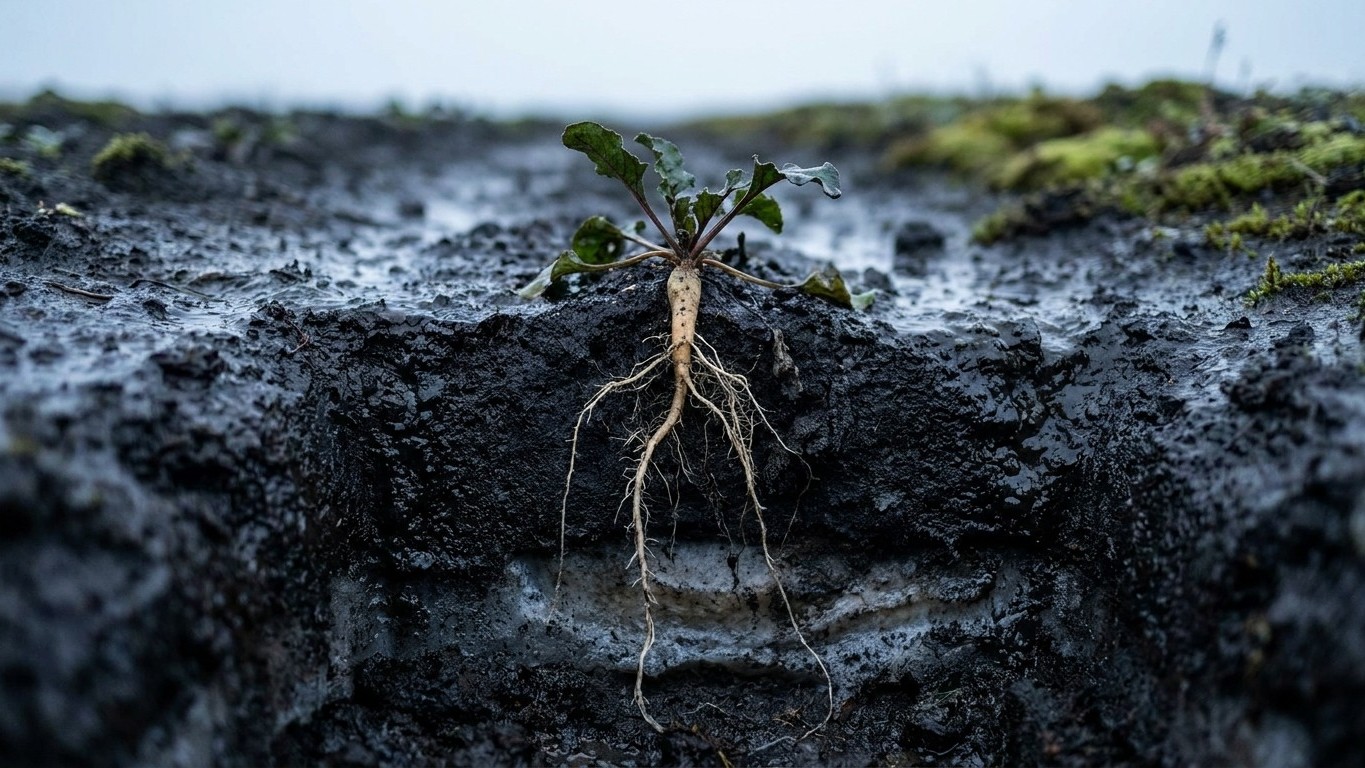

Alaska’s beets meet a soil built around permafrost, not root vegetables: strongly acid, poorly drained, and carrying organic matter that has nothing to do with a tilled garden bed. That combination, plus a last frost that lands anywhere from May 3 to May 12, means the plant’s first six weeks decide almost everything. Get the drainage and the water schedule right and a beet will still size up in the state’s long summer light. Get either wrong and the root pays for it.
The short answer
The soil USDA lists as representative of Alaska is the Tanana series, a Gelisol, which is the technical way of saying permafrost sits within reach of the profile. The surface horizon runs 30 percent sand, 7 percent clay, and 63 percent silt, which reads as a silt loam, and on paper a silt loam is a reasonable texture for a root crop. The catch is the drainage class: poorly drained. A frozen layer underneath does not let water pass the way an open subsoil would, so water backs up in the root zone instead of moving through it. For a beet, that raises the odds of a waterlogged, rot-prone root rather than the deep, well-drained ground the crop actually wants.
The pH tells a similar story. Surface pH on the Tanana series runs about 4.7, strongly acid, well outside the range most root vegetables tolerate comfortably. And the organic matter figure, about 90 percent, looks generous until you know what it represents: this is the surface of a natural organic layer, peat or muck built up over time, not a worked garden bed. A gardener amending a raised bed will never see 90 percent organic matter, and shouldn’t try to. It is a clue to how the untouched ground behaves, not a target to hit.
On heat, the published record used for this page does not carry a count of days above 90 F for the reference station, so that figure is not published here. What the frost data does show is a short, cool season, roughly 143 frost-free days at the reference site, which points toward a climate where sustained heat is the smaller threat and cold, wet ground is the bigger one. Woodiness from heat and water stress together, as described by Utah State University Extension, is a real risk anywhere beets are grown, but in this state it competes with a more immediate problem: getting the root through cold, saturated soil in the first place.
None of this describes any single garden. Alaska spans hundreds of mapped soil series, and river bottoms, hillside plots, and any ground a builder has filled or graded will differ from the Tanana series completely. Treat this as a starting point for what the region’s ground tends to do, then confirm your own numbers with a soil test.
The six weeks that decide it here
Beets are sown in place, not transplanted, and the 60 to 80 days to maturity run from that seeding date, not from a seedling going into the ground. Sowing 2 to 3 weeks before the last frost puts a beet’s first six weeks squarely inside Alaska’s spring, and the last spring frost at the reference station falls somewhere between May 3 and May 12. That is not one date but a band, which means some years clear frost risk earlier and some years hold it later, and a gardener sowing at the early edge of that window is trading a longer season for more frost exposure on tender seedlings.
What that spring actually does to the soil matters more than the calendar date. Where permafrost sits close to the surface, as it does in the Tanana series, snowmelt has nowhere to drain, so native ground tends to run cold and saturated early in the season rather than dry. That is the opposite of the classic bolting trigger, which is drought stress on young roots. But gardeners in this state routinely build raised beds or heavily amended rows specifically to escape that poor natural drainage, and fast-draining, sandy amended soil dries out quickly, especially under the long daylight hours Alaska summers are known for. That is where the real bolting risk in this state tends to concentrate: not in the wet native ground, but in the well-drained beds gardeners build to fix it, if watering doesn’t keep pace with how fast that soil loses moisture.
Utah State University Extension is specific on the mechanism: water stress in the first six weeks after seeding causes premature flowering, and that clock starts the day seed goes in the ground. In a state where the growing season is already short, a beet that bolts early has effectively lost its harvest. The six weeks that decide it here are less about temperature and more about whether a fast-draining raised bed gets watered on a schedule that matches how quickly it dries under near-constant daylight.
What goes wrong here
- Waterlogged, rotting roots where permafrost or a compacted subsoil perches water near the surface, mirroring the poorly drained Tanana series. Build raised beds or mounded rows so the root zone sits above the saturated layer rather than in it.
- Acid soil locking up nutrients, since a surface pH near 4.7 is well outside what most root crops handle well. Test the actual garden soil before planting and correct it based on what the test recommends, rather than guessing.
- Over-amended beds that repeat the state soil’s extreme organic-matter content instead of a workable garden mix. Utah State University Extension caps organic matter additions at 1 inch of composted material per 100 square feet; more than that undermines drainage rather than helping it.
- Early bolting in fast-draining raised beds that dry out under long daylight hours during the first six weeks after seeding. Keep watering consistent from the seeding date, not just once seedlings are established.
- Woody roots during any stretch of heat above 85 F combined with dry soil, a lower-frequency risk here than in warmer states but still possible in a warm spell. Mulch and maintain steady moisture rather than letting the bed cycle between dry and soaked.
Common questions
Can beets grow in Alaska’s permafrost soils?
Not directly in ground where permafrost sits close to the surface and drainage is poor, like the Tanana series. Raised beds or mounded rows that lift the root zone above that saturated layer are the practical workaround.
What pH do beets need, and how does Alaska’s soil compare?
The state’s representative soil runs a surface pH near 4.7, strongly acid. Utah State University Extension’s guidance centers on deep, well-drained, organic-rich ground rather than a specific pH target, but a soil test is the only way to know where a given garden bed actually sits.
How many days do beets take to mature from seed in Alaska?
Beets typically mature in 60 to 80 days, and that count starts the day seed goes into the ground, since beets are sown in place rather than transplanted. That timeline has to fit inside the state’s frost-free window.
Does a roughly 143-day frost-free season give beets enough time?
For the reference station, yes, on paper: even the longer end of the 60 to 80 day range fits comfortably inside about 143 frost-free days. The tighter constraint isn’t the length of the season but what happens in the first six weeks after seeding, when water stress can trigger bolting regardless of how much season is left.