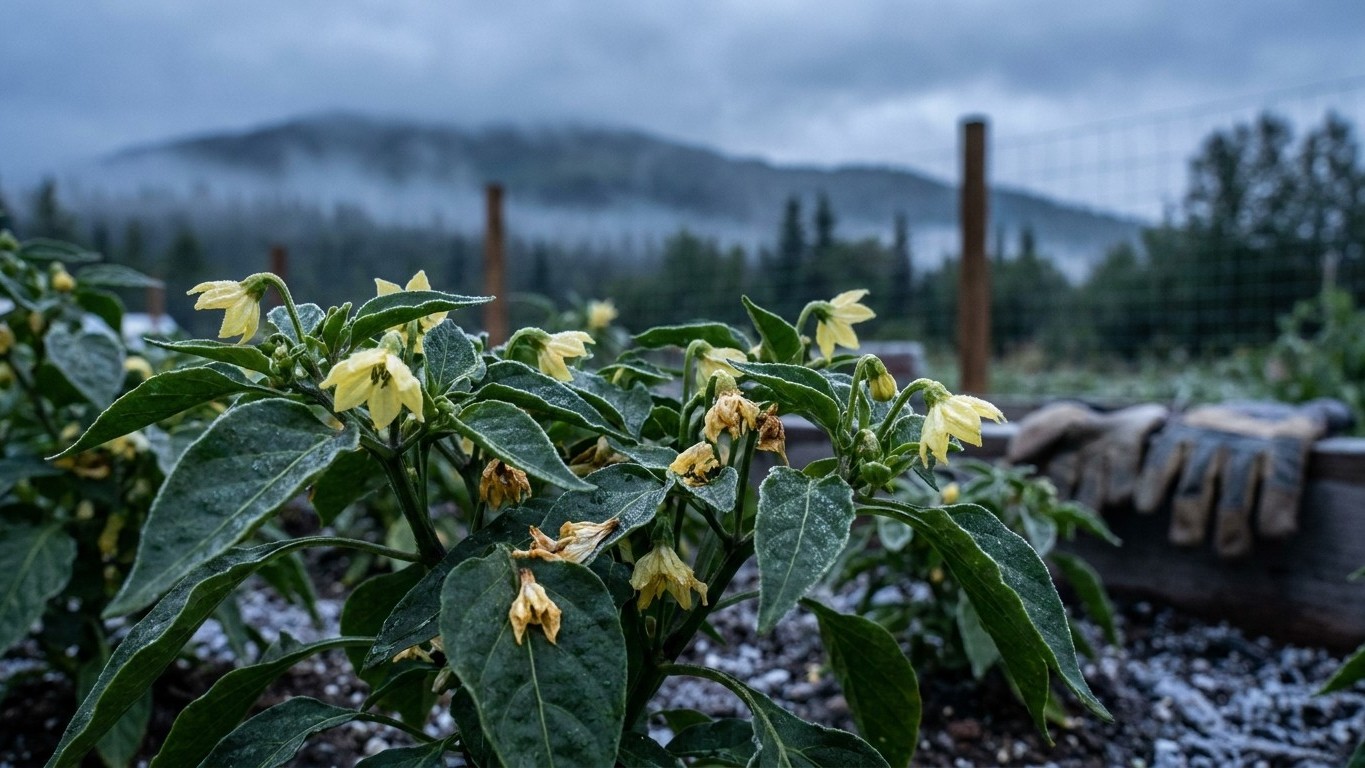

In Alaska, pepper plants rarely fail because of extreme heat. The Anchorage reference station logs zero days a year at or above 90 F, so scorching afternoons aren’t the threat. The real risk sits on the cold side of the equation: chilly summer nights that this site does not track for you, and a growing season so short that timing becomes everything.
The short answer
Start with the number that matters most for heat stress: 0.0 days a year at or above 90 F, averaged over the 1991-2020 period at the Anchorage reference station, according to NOAA NCEI Climate Normals. For pepper growers in most of the country, that threshold is the enemy, because daytime heat above 90 F causes flowers to abort before they ever become fruit. Alaska gardeners can mostly set that worry aside. Heat-driven blossom drop, sunscald from prolonged high-heat exposure, and the kind of stress that shuts down pollen viability in a Southern July just don’t show up here in any meaningful way.
But pepper fruit set fails at both ends of the temperature scale, not just the hot one. Utah State University Extension is blunt about this: nights that drop below 55 F cause the same kind of flower and fruit failure as days above 90 F. Cool night air interferes with pollen development and fertilization, so blossoms form, then drop without ever becoming peppers. This is the threshold that actually governs pepper success in Alaska, and it’s the one this site cannot hand you a number for. Coverage here stops at daytime heat extremes; summer night minimums are not part of the recorded data for this territory.
That gap matters more in Alaska than almost anywhere else in the country. This state spans a huge range of microclimates, from the relatively mild coastal pockets to interior valleys where nighttime cooling can be sharp even in the middle of summer. A reading from a regional station tells you nothing reliable about what’s happening in your own backyard on a given August night. If you’re growing peppers here, a min-max thermometer placed near your pepper bed is not optional gear, it’s the single most useful tool you own for this crop. Track your lows for a few weeks after transplant. If you’re consistently seeing nights dip under 55 F, that’s very likely why blossoms are falling instead of swelling into fruit, regardless of how warm your days feel.
Don’t try to guess night temperatures from your latitude or from how cold your winters run. Those two things aren’t connected the way people assume. A location’s coldest month says very little about what a July or August night does, especially in a state where terrain, elevation, and proximity to water all shape local air drainage and radiative cooling in ways a broad climate normal can’t capture.
When to start seed here
Peppers are slow. Utah State University Extension recommends starting seed 8 to 10 weeks before transplant, and transplanting only after both conditions are met: the frost danger has passed and the soil has warmed to 60 F. In Alaska, those two conditions rarely align at the same moment, and working the arithmetic backward from your own dates is the only way to get this right.
- Find your local frost-free date. For the Anchorage reference station, NOAA NCEI’s 1991-2020 normals put the last spring freeze (32 F) in the 30-70% probability band between May 3 and May 12. That’s roughly 143 frost-free days in a good year, among the longest windows in the state, since Anchorage sits in one of the mildest inhabited parts of Alaska. Interior locations and anything farther north will see a much shorter frost-free stretch, so pull your own station’s normals rather than borrowing this one.
- Don’t stop at the frost date. Soil temperature lags behind air temperature, often by several weeks, especially in a northern growing season where the ground stays cold from a long winter. A frost-free calendar date doesn’t mean the soil in your raised bed or garden row has reached 60 F. Check it directly with a soil thermometer pushed a few inches into the root zone, rather than assuming it from the forecast.
- Use whichever date comes later. If your last frost falls around May 10 but your soil doesn’t hit 60 F until sometime after that, your real transplant date is the soil date, not the calendar date. This is where Alaska gardeners often lose weeks of growing time by transplanting too early into cold soil that stalls root growth even without a frost event.
- Count back 8 to 10 weeks from that transplant date. If your soil-and-frost combination points to a transplant window in late May or into June, sowing indoors needs to happen roughly two months ahead of that, under lights, with steady warmth for germination.
- Build in a buffer for a short, cool-adjacent season. Because Alaska’s summer daylight is long but the season itself is compressed, a seedling that goes out a week or two late has less runway to reach flowering and then the 35 to 45 days from flower to harvest that peppers typically need. Erring toward the earlier end of that 8 to 10 week indoor window gives more margin.
Redo this math for your own county rather than for Anchorage. A grower in the Interior, working with a much shorter frost-free window, may need to start seed even earlier indoors and lean on season-extension tools like cold frames or row cover to stretch the growing window on both ends.
What goes wrong here
- Blossom drop from cool nights. This is the dominant failure mode in Alaska pepper growing. Per Utah State University Extension, nights below 55 F disrupt fruit set even when daytime conditions look perfectly fine. Flowers open, then fall off without setting fruit. The remedy is protective: cover plants on nights when you expect a dip, use a greenhouse, hoop house, or cold frame to buffer night air around the plants, and place peppers against a south-facing wall or other heat-retaining structure that releases stored warmth after sundown.
- Blossom drop from a hot spell. Even in a state that averages zero days at or above 90 F, an unusual short-lived heat spike can still stress plants, particularly ones grown in a greenhouse or under plastic where interior temperatures run well above outdoor air. Ventilate structures aggressively during any warm stretch, and avoid trapping heat in a closed hoop house during midday sun.
- Sunscald. Where sun exposure is strong and unfiltered, especially given Alaska’s long daylight hours in midsummer, exposed fruit and foliage can scald on the side facing direct sun for extended hours. Keep foliage full and healthy so it naturally shades developing fruit, and avoid heavy pruning that strips leaf cover right when fruit is sizing up.
- Blossom-end rot. This shows up as a sunken, leathery patch on the bottom of the fruit and traces back to inconsistent watering that interferes with calcium uptake, not a soil calcium shortage in most cases. Water on a steady schedule rather than letting the root zone swing between soggy and bone-dry, and mulch to even out soil moisture through the growing season.
Common questions
Can peppers set fruit outdoors in Alaska without a greenhouse?
It’s possible in the mildest, most sheltered spots, particularly where a south-facing wall or windbreak buffers nighttime cooling. But given how often summer nights in this state can drop below the 55 F threshold that Utah State University Extension identifies as the cool-side failure point, many growers get more consistent fruit set with a hoop house, greenhouse, or at minimum row cover on cooler nights.
Does the long summer daylight in Alaska make up for the short season?
It helps with vegetative growth, since plants get more hours of light to photosynthesize each day. It does not substitute for warmth. Fruit set still depends on temperature at flowering, not on how many daylight hours the plant receives, so long days alone won’t rescue a crop that’s losing blossoms to cold nights.
How do I know if my soil has reached 60 F without waiting on the calendar?
Use a soil thermometer pushed several inches into the bed and check it in the morning before the sun has warmed the surface, since that gives a more accurate reading of the root zone than a midday check. Test over a few consecutive days rather than relying on one reading, since a single warm afternoon can give a misleadingly high number.
Why do peppers need 8 to 10 weeks indoors instead of the 6 weeks common for tomatoes?
Peppers germinate more slowly and grow more slowly early on than tomatoes do, so Utah State University Extension’s 8 to 10 week window reflects that slower pace, not a preference. In a state with a compressed frost-free season, giving seedlings the full 10 weeks rather than the minimum 8 tends to produce sturdier transplants ready to use whatever growing time the season allows.