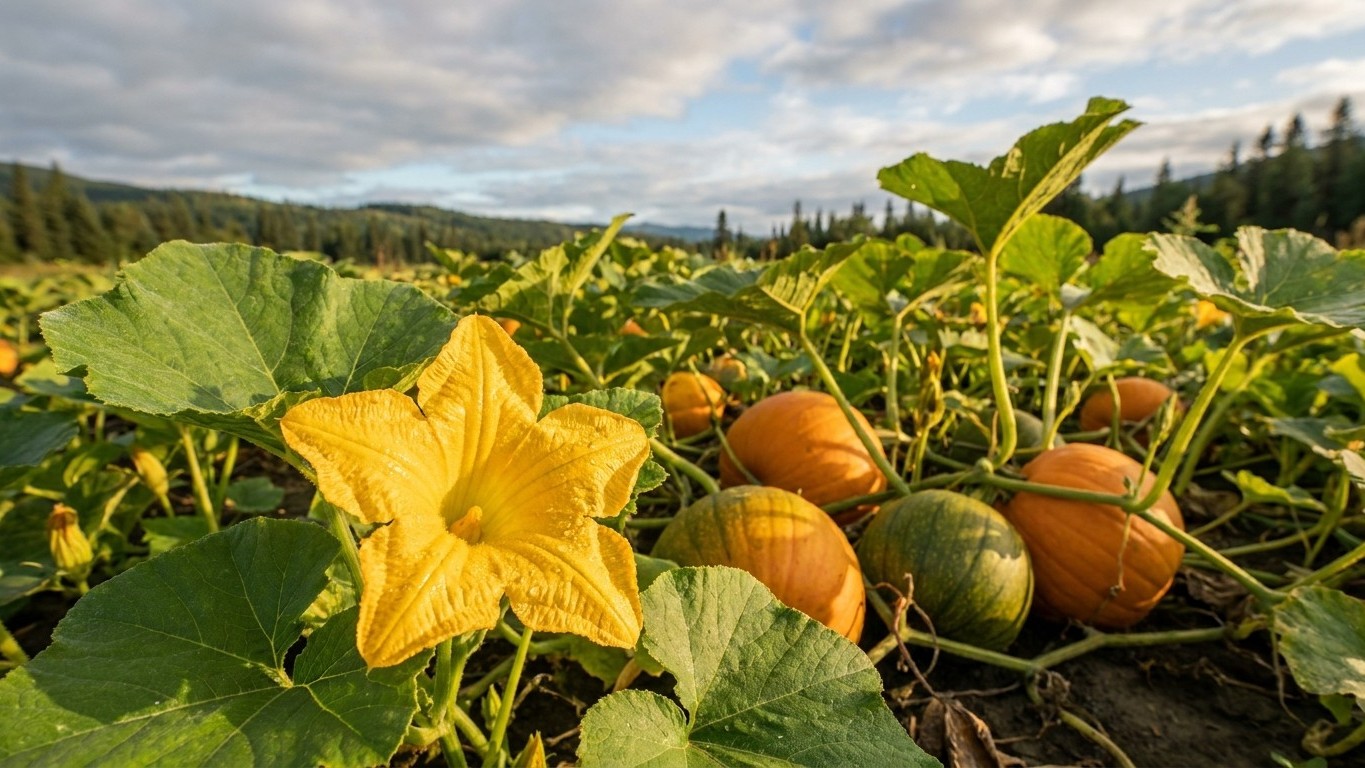

Will Pumpkins Ripen Before Frost in Alaska? In most of Alaska’s populated areas, pumpkins can ripen outdoors, but only if the flowers open inside a narrow window that closes well before Labor Day. Around Anchorage, that window runs roughly from late July to mid-August. Miss it, and you’re left with a vine full of green fruit when the first hard freeze arrives. The Interior and the far north have even less room to work with.
The short answer
Start with the end date. Around Anchorage, the first fall freeze typically arrives sometime between September 22 and October 1, based on 1991-2020 climate data from NOAA’s National Centers for Environmental Information. That’s the wall you’re building backward from, and it’s not a date you can push. Once that freeze hits, any pumpkin still green on the vine stops developing.
Now work the math from the other end. Pumpkins need 45 to 55 days after flowering to reach maturity, according to Utah State University Extension. Not 45 to 55 days from when you drop the seed. Not from transplant. From the day the flower opens. That distinction changes everything about how you plan the season, because a vine can look strong and leafy for weeks before it ever produces a bloom worth counting.
Subtract 45 days from September 22 and you land on August 8. Subtract 55 days from that same date and you get July 29. Do the same subtraction from October 1, the later edge of the frost window, and you get August 17 for the short end and August 7 for the long end. Put those four numbers together and the picture is a flowering cutoff that falls somewhere between late July and mid-August, with the exact spot depending on which end of the frost window your yard actually experiences and how many days your particular pumpkin needs after bloom.
A cautious grower plans for the earlier edge of that range, treating July 29 as the last safe day for a flower to open rather than banking on the later end. That leaves a buffer if the season runs cold or if the fruit setting late needs the full 55 days rather than 45. Anchorage sits inside a run of about 143 frost-free days, which sounds tight until you remember it’s paired with nearly around-the-clock daylight through June and July. That extra light doesn’t lengthen the calendar, but it does push growth harder during the days that are available. Anchorage is also one of the milder inhabited pockets of the state. The Interior runs a shorter frost-free stretch, and the calculation above only holds for locations with a comparable fall freeze date, not for growers farther north or at higher elevation.
When to sow here
The last spring frost in the Anchorage area falls between May 3 and May 12. That date tells you when the air stops freezing. It tells you nothing about when the soil is actually ready for pumpkin seed, and treating those two dates as the same thing is the mistake covered in more detail in When to Sow Pumpkins in Alaska, which walks through the most common planning mistake in a short-season garden.
- Mark the last frost window first. May 3 to May 12 is when the air clears of freezing risk, but bare soil at that point is still cold from months under snow and ice.
- Wait for the soil, not the calendar. Pumpkin seed needs soil temperature at 65 F to germinate reliably, per Utah State University Extension, and soil consistently lags behind air temperature by a matter of weeks rather than days. In practice that pushes the realistic direct-seeding window well past the second week of May, often into the last week of May or into June depending on how the season is running and how exposed the bed is to sun.
- Use row covers to close the gap. A row cover over the bed traps daytime heat and buys roughly two weeks, effectively moving the usable sowing date earlier by pulling the soil up to 65 F sooner than open ground would reach it on its own.
- Check soil temperature directly rather than guessing. A simple soil thermometer pushed a couple of inches into the bed removes the guesswork; waiting for a warm afternoon and assuming the soil has caught up is how seed rots in cold ground instead of germinating.
- Count backward from your flowering deadline. Once the soil is at 65 F and seed goes in, the plant still needs time to grow, set flowers, and then run the 45-to-55-day clock from bloom to harvest. Sowing late doesn’t just shorten the season on paper, it eats directly into the margin calculated above.
What goes wrong here
- A flower opens too late to matter. If bloom happens after the mid-August cutoff, the fruit is still counting down its 45-to-55-day clock when the first fall freeze arrives, and it never colors past green. The remedy is upstream: get the soil to 65 F earlier with row covers or black plastic mulch, and pick a plant that’s already showing flower buds by early-to-mid July rather than one still putting out leaves.
- A fruit sets in time but frost catches it before it finishes. Even a fruit that bloomed inside the window can stall if a cold snap arrives early, inside the September 22 to October 1 range rather than at the tail end of it. Covering individual fruits with a blanket or frost cloth on forecast cold nights can buy a few extra days for the final stretch of ripening.
- The vine dies back before the skin hardens. Foliage killed by an early frost or by disease pressure late in the season can leave a fruit that colored up but never developed a fully hardened rind, which shortens how well it holds up off the vine. Harvesting with the stem attached as soon as color is complete, rather than leaving the fruit on a failing vine hoping for more hardening, protects what ripening has already happened.
- Insect damage weakens the vine before the season’s clock runs out. Squash bugs and cucumber beetles can both stress a vine enough to cut ripening short in a season with no days to spare; this site’s dedicated pages on squash bugs and cucumber beetles cover identification and control in detail.
Checking this against your own county
The frost dates above are built from a single Anchorage-area weather station, and Alaska’s growing conditions shift fast with latitude, elevation, and distance from the coast. A garden in the Interior or along the northern edge of the state is working with a shorter frost-free stretch than the one used in this calculation, which moves the safe flowering cutoff earlier still.
The University of Alaska Fairbanks Cooperative Extension Service tracks local frost data and variety performance by region, and its office network is the most direct way to confirm how this timeline shifts for a specific county. Their site is at uaf.edu/ces.
Common questions
Can I still get a ripe pumpkin if my flower opens in late August?
It’s a stretch. A late-August bloom is already past the conservative cutoff calculated from the September 22 to October 1 freeze window, and it leaves little to no margin if the fruit needs the full 55 days rather than 45.
Does starting seed indoors change the flowering math?
It can help the plant reach flowering age sooner, but the 45-to-55-day clock still starts at bloom, not at transplant. Indoor starts buy time toward an earlier flower, they don’t shorten the maturation period itself.
How do I know if my soil has actually hit 65 F?
A soil thermometer inserted a couple of inches into the bed is the only reliable check. Air temperature and calendar dates are not a substitute, since soil warms well behind the air.
Is there a published safe storage temperature for the ripened fruit?
Not in the Utah State University Extension guidance this timeline is built on. It specifies only that fruit should be kept somewhere it will not freeze, without giving a specific temperature or storage duration.