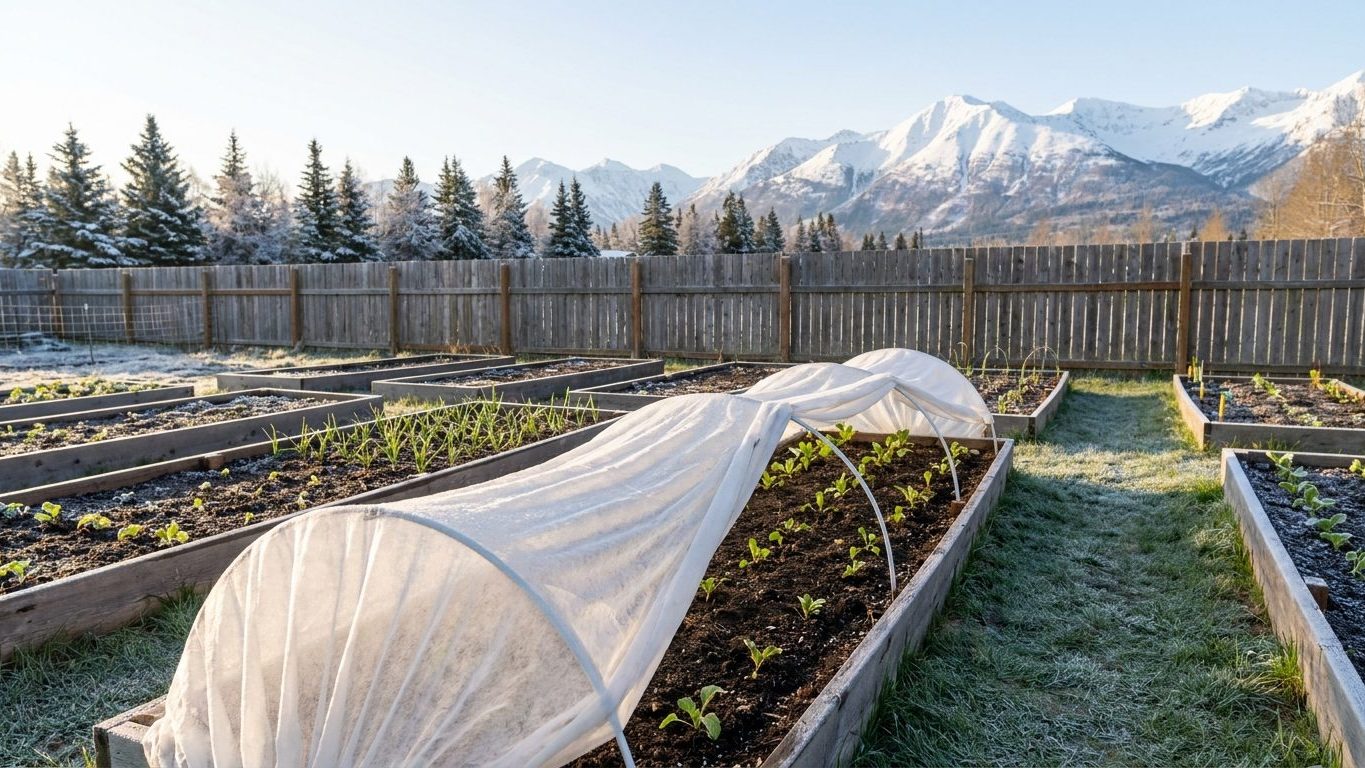

Cover on the nights, not by the date: any time the forecast reaches 32°F, from the day tender plants go outside until the first hard freeze ends the season. A calendar only tells you when to start watching the forecast. The dates below come from Anchorage, the reference city for this page, and the rest of Alaska runs shorter.
The short answer for Alaska
Start watching nightly lows in the May 3 to May 12 window, and keep covers within reach until the September 22 to October 1 window has passed. Both ranges are NOAA 1991-2020 Climate Normals for Anchorage, and both describe the same thing: the odds of a 32°F freeze.
The spring range is not “the last frost date.” It is the stretch of days when the chance that the last 32°F freeze is already behind you sits between 30 and 70 percent. On May 12, a freeze is still a live possibility in some years. The fall range works the same way in reverse: between September 22 and October 1, the chance that the first freeze has already arrived runs from 30 to 70 percent.
| Measure (Anchorage, 1991-2020 normals) | Value |
|---|---|
| Last spring freeze, 30-70% probability band | May 3 to May 12 |
| First fall freeze, 30-70% probability band | September 22 to October 1 |
| Frost-free days | About 143 |
| Latitude of the station | 61.17 degrees north |
Spring: cover after planting out, not before
Covers earn their keep in the first weeks after transplanting, when a single clear, calm night can take out a bed of tender seedlings. Clear and calm is the key phrase. Heat stored in the soil radiates upward on a cloudless night, and a layer of fabric or a low tunnel slows that loss enough to hold a few degrees. It will not rescue a plant in a hard, deep freeze, which is why the 32°F forecast is your trigger and not the date on the calendar.
Fall: cover to stretch the harvest
In September the same logic applies, with a twist. Cold-sensitive crops still in the ground, such as squash, beans and tomatoes, can often be carried through the first light freeze and then pulled in whatever condition the weather leaves them. Hardier crops barely notice that first night. Roots and brassicas get sweeter in the cool, so the cover for them is about the later, harder nights.
Alaska has one advantage that a southern calendar would not give you. Summer daylight at 61.17 degrees north runs long into the evening, so plants make growth in a season that looks short on paper. Covers protect that advantage at both ends. For gear, see Which Season Extenders Work in Alaska, and for the wider picture, Extending the Growing Season in Alaska.
What will not work here
Waiting for the date to clear is the first thing that fails. Even at the late end of the spring band, May 12, the probability of a later freeze has not dropped to zero. Gardeners who set out tomatoes on a mid-May date and skip the cover are gambling on a coin that is still weighted against them some years.
Covering only on the first-frost date fails just as often. The fall band starts September 22, so in a meaningful share of years the first 32°F night has already come by the end of that window. A gardener who plans to cover “around October 1” will sometimes be covering a bed that froze a week earlier. Keep the material on hand and drape it on the forecast, not on the calendar.
Slow crops defeat any cover, because a cover adds degrees but not days. With about 143 frost-free days, a plant that needs a long, hot stretch from transplant to harvest runs out of season even when the tunnel is perfect. Fabric cannot lengthen daylight or supply the summer heat a warmer state would give. Choose varieties by how fast they mature, and use covers to protect those choices, not to rescue a bad one.
Day length is another thing no cover changes. At 61.17 degrees north, the length of the day, not warmth, is what tells an onion to stop making leaves and start making a bulb. Plastic over the bed does nothing to that signal. If you are growing onions, the answer lies in which variety you pick and when you plant it, a point worth confirming with local trial results (more on that below).
Winter is a different problem. The mean daily minimum of the coldest month in Anchorage is 11.0°F, and that is an average night, not the extreme. A light row cover that holds a few degrees on a September night does nothing to keep a plant alive through that. Anything that has to survive the winter outdoors needs to be hardy enough on its own, or it needs deep insulation such as snow, mulch or a heavy structure. Fabric is for the shoulder seasons only.
Last, a cover left on in a warm, bright spell will overheat the bed, and one left on a flowering plant keeps pollinators out. Vent the tunnel on sunny days and uncover blossoming crops when the freeze risk has passed.
What changes across Alaska
Every number above belongs to Anchorage. Alaska spans USDA hardiness zones 1a to 8a, according to the USDA Plant Hardiness Zone Map (2023, based on 1991-2020 normals), and that spread is enormous. Zone is built on one variable, the average annual extreme minimum temperature, so it tells you whether a plant survives the winter, not whether the summer is long enough to ripen it. There is no single answer for the state, only a range.
Anchorage is one of the mildest inhabited parts of Alaska. The Interior and the north have far shorter frost-free seasons, so their spring and fall windows are narrower and the 143-day figure does not apply. A reader in those regions should treat the Anchorage dates as a generous upper bound and expect covers to matter more, with the late-spring and early-fall risks sitting closer together.
Altitude does the same job as latitude. A garden on a hillside or at a higher elevation will freeze earlier in fall and later in spring than the valley floor, even a few miles away. Cold air also settles in low spots and hollows, so a garden at the bottom of a slope can see a freeze when the one above it escapes. If you are in either position, shift the watching period outward at both ends and lean on your own observations.
Latitude counts too. The 61.17 degree figure belongs to the Anchorage station, not the whole state, so a reader near the edge of the territory should check their own latitude. For the zone itself, use the USDA Plant Hardiness Zone Map and look up your own location, because this page cannot tell you which zone you are in.
Where to check this for your own county
The state-level view on this page gives a frame. The University of Alaska Fairbanks Cooperative Extension Service is the next stop, and it will know your area better than any statewide page can. Alaska is organized into boroughs more than counties, so look for the office or agent that covers your borough or region.
Two things are worth finding there. The first is a local planting calendar, which will place spring and fall dates closer to your garden than the Anchorage normals can. The second is the list of varieties trialled in your area. A variety that matured reliably in a nearby trial is better evidence than any general rule of thumb, especially for crops sensitive to day length, such as onions.
This page does not hold a local calendar or a trial list for your area, and it does not pretend to. A county or borough recommendation beats a state one, and what you are reading is the state one, built from a single Anchorage weather station. Where the two disagree, trust the local source.
Checking this against your own garden
Your own beds will outrank every date on this page. Three observations cost nothing and tell you what the calendar cannot.
- Soil warmth by feel. Push a bare hand a few inches into the bed in the morning. If it feels distinctly cold, seedlings will sit and sulk, and a cover that warms the soil earlier pays off. A bed that feels mild sooner than your neighbor’s has a warmer microclimate, which usually means a south-facing slope or a spot sheltered from wind.
- The first male flowers. Squash and cucumber plants produce a flush of male flowers before the females. Note the date they appear. If it lands later than you expected, your garden is running behind the regional pace, and covers or earlier starts are worth more to you.
- The first true leaves. The seed leaves come first, and the first true leaves signal that a seedling has settled in and is growing. Writing down when they appear, bed by bed, shows you where the cold pockets are and which spot gets going earliest.
Keep a short note each year: the date you first covered, the date of the first killing freeze in your yard, and what survived. Within a few seasons you will have a calendar more accurate than any normal, because it comes from your own ground.
Common questions
Should I cover my garden on the date of the average last frost?
No. In Anchorage the May 3 to May 12 window is a probability band, so a freeze can still follow it. Cover whenever the forecast reaches 32°F.
How many frost-free days does Anchorage have?
About 143, based on NOAA’s 1991-2020 Climate Normals. The Interior and the north are far shorter, so that number is a ceiling for much of the state.
Will a row cover protect plants through an Alaska winter?
No. The mean daily minimum of the coldest month in Anchorage is 11.0°F. Covers are for spring and fall nights, and overwintering plants need their own hardiness or heavy insulation.
Does my USDA zone tell me when to cover?
No. The USDA zone rests on the average annual extreme minimum temperature, so it speaks to winter survival, not frost dates. Alaska spans zones 1a to 8a, so check the USDA map for your location and your local extension office for dates.