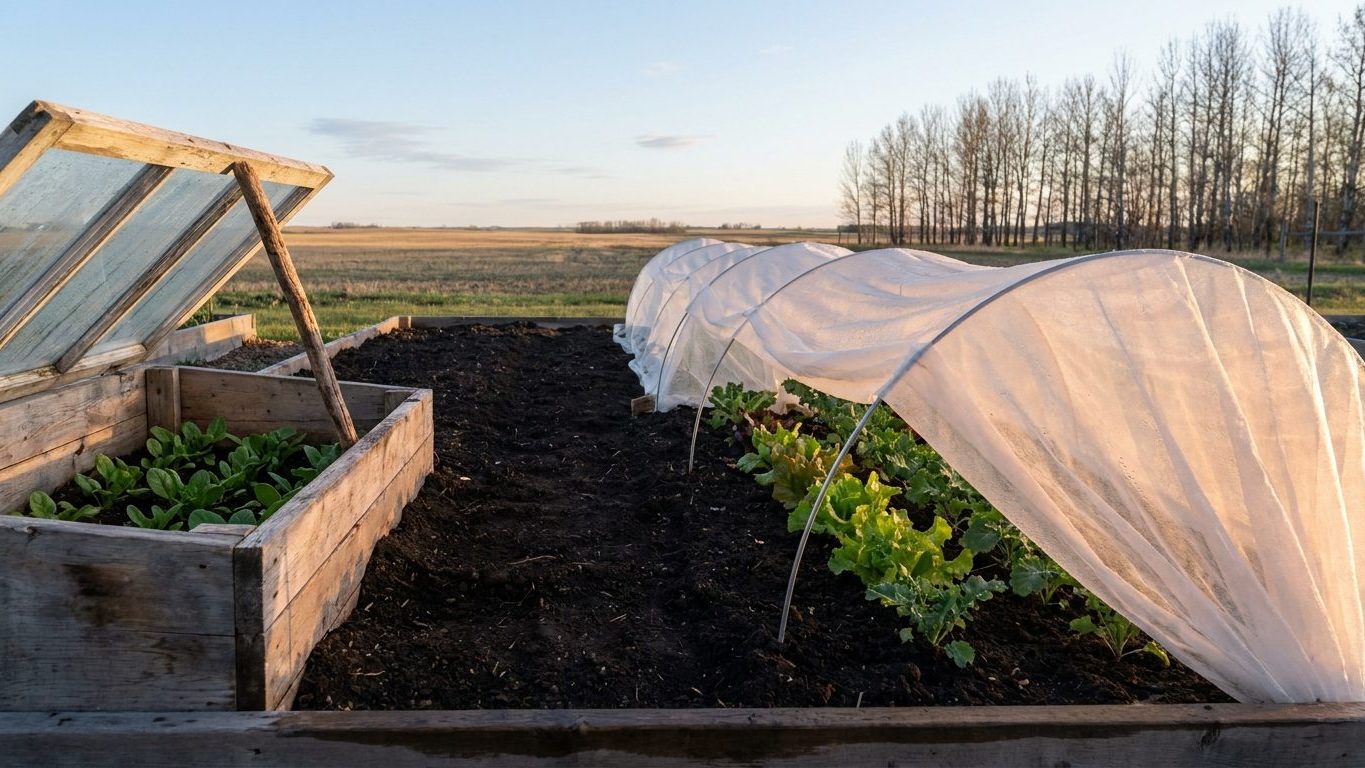

For most Alaska gardeners, the dependable season extenders are low tunnels with row cover, cold frames, black plastic over the soil, and, for warm-season crops, an unheated high tunnel or greenhouse. Which one earns its cost depends on whether cold spring soil, a fall freeze, or wind and snow is your bottleneck. The figures below come from Anchorage, one of the milder places to garden in a very large state.
The short answer for Alaska
Start with low tunnels and black plastic mulch. Move to a high tunnel or greenhouse only if you want tomatoes, cucumbers, or peppers to finish reliably. Cold frames handle early greens and hardening off. That ranking follows the Anchorage numbers, where the last spring freeze falls between May 3 and May 12 and the first fall freeze between September 22 and October 1. Those dates are probabilities, not promises. They mark the band where a 32°F freeze is between 30 and 70 percent likely, so a hard freeze can still show up outside that window.
Between those dates sit about 143 frost-free days (NOAA NCEI 1991-2020 Climate Normals, Anchorage station). That is workable for hardy crops and tight for anything that wants heat. Long summer daylight partly makes up the difference, which is why cabbage and potatoes do so well here. An extender cannot add daylight, but it can add days on both ends of the season.
Which extender does what
| Extender | What it buys you | Main Alaska risk |
|---|---|---|
| Row cover on hoops | Frost cushion in spring and fall | Wind tears loose fabric; snow crushes weak hoops |
| Cold frame | Early greens, seedling hardening | Overheats on sunny days if not vented |
| Black plastic mulch | Warmer soil before transplanting | Needs anchoring against wind |
| High tunnel or greenhouse | Room for heat-loving crops | Cost, snow load, summer overheating |
Spring is where most gardeners get the biggest return. Soil that is still cold in early May slows roots long before the air does, and plastic laid a couple of weeks ahead of planting starts the clock sooner. Fall is the second payoff: a cover thrown over beds on a clear September night can carry crops past the first freeze. The timing of that decision gets its own treatment in When to Cover Your Garden in Alaska.
What will not work here
A thin cover will not save a warm-season crop from a hard freeze. Row cover buys a few degrees, which is plenty on a frosty morning at the edges of the season and nothing against a deep freeze. Gardeners who plant tender transplants on May 12 under a single layer of fabric are betting against a probability band that still allows a later freeze.
Winter is a different problem
Season extension is not overwintering. In Anchorage the mean daily minimum of the coldest month is 11.0°F, and that is a long-term average, so nights run colder. Plastic over a hoop does not carry tender plants through that. Treat winter harvest from an unheated structure as a separate project with hardy crops, and do not expect an extender built for September to do the job.
Daylight and wind
Extenders cannot change day length. Anchorage sits at 61.17 degrees north, and it is day length, not warmth, that tells an onion to stop making leaves and start making a bulb. A tunnel will speed early growth, but it will not move that trigger, so variety choice still matters more than plastic for onions. The same goes for crops that need many hot days: 143 frost-free days is a short runway, and a cool, cloudy summer under cover is still a cool summer.
Structures fail in less obvious ways too. Lightweight hoops and loose plastic suit a mild climate, but wind and wet spring or fall snow punish them. Leaving a tunnel closed during a sunny stretch can cook plants that were fine the day before. Vent it, and anchor everything harder than seems necessary. A tunnel that blows into the neighbor’s yard in May has extended nothing.
What changes across Alaska
There is no single answer for the state. The USDA Plant Hardiness Zone Map (2023, built on 1991-2020 normals) runs from zone 1a to zone 8a across Alaska. That is one of the widest spreads of any state, covering everything from the far north to the milder southern coast. Zones rest on one variable, the average annual extreme minimum temperature, so they describe winter survival. They do not tell you how many frost-free days you get.
The Anchorage figures are a reference point, not a state average. Anchorage is one of the mildest inhabited parts of Alaska, while the Interior and the north have far shorter frost-free seasons. A gardener there should treat an extender as part of the plan rather than a bonus. In practice, that means quick crops, stronger frames, and starting everything under cover earlier. Altitude pushes the same way: higher ground runs colder and later, so shift your dates back and expect the fall freeze sooner.
Latitude matters too. The 61.17 degrees north figure belongs to Anchorage, not to the whole state, so if you garden well north or south of it, look up your own latitude before relying on day-length advice. To find your own hardiness zone, use the USDA map rather than guessing from a neighbor. For the wider picture, see Extending the Growing Season in Alaska.
Where to check this for your own county
Your state extension service is the next stop. In Alaska that is the University of Alaska Fairbanks Cooperative Extension Service. It publishes guidance written for Alaska conditions, and its local offices know the weather patterns in their area.
Look for two things there. The first is a local planting calendar with frost dates for your area, which will be more specific than the Anchorage band on this page. The second is a list of varieties trialled near you, since a cultivar that thrived in one valley may sulk in another. Ask also whether they have guidance on tunnels and high tunnels for your area, including snow-load advice.
A county or district recommendation beats a state one, and this page is the state one. It rests on a single reference station, and it does not include an Alaska species-by-species calendar. If a number here disagrees with what your local extension office says, believe the office.
Checking this against your own garden
Your own observations outrank every date above, because your yard has its own microclimate. A south-facing wall, a low spot where cold air pools, or a windbreak can shift your season by days. Three things are worth watching, and none of them needs equipment.
- Soil warmth by feel. Push your hand into the bed in spring. If the soil still feels cold and clammy a couple of inches down, seeds will sit. Compare a plastic-covered bed with a bare one to see how many days the plastic actually gains you.
- The first male flowers. On squash and cucumbers, male flowers open before female ones. When they appear under cover and not outside, you know the structure is paying off.
- The first true leaves. Seedlings show their seed leaves first, then true leaves. If true leaves arrive much later in an exposed corner than in a sheltered one, you have found the warm and cold zones of your yard.
Write the dates down for a season or two. Your own notes will soon be a better guide than any average.
Common questions
Can I grow tomatoes outdoors with row cover in Alaska?
Row cover only offers light frost protection, and tomatoes want sustained warmth, so a high tunnel or greenhouse is the safer route. With about 143 frost-free days in Anchorage and less farther north, the heat is the limiting factor, not just frost.
When should covers go on in fall?
Have them ready before September 22, the early end of the Anchorage first-freeze band, and watch clear, calm nights. A freeze outside the band is still possible.
Do season extenders work in the Interior or far north?
They matter more there, since the frost-free season is far shorter than in Anchorage. Build them sturdier, start crops under cover earlier, and ask extension for local dates.
Will an extender help onions?
It helps early growth, but it does not change day length, which is what triggers bulbing. Anchorage sits at 61.17 degrees north, so choose varieties suited to northern day lengths, and check your own latitude if you garden far from Anchorage.