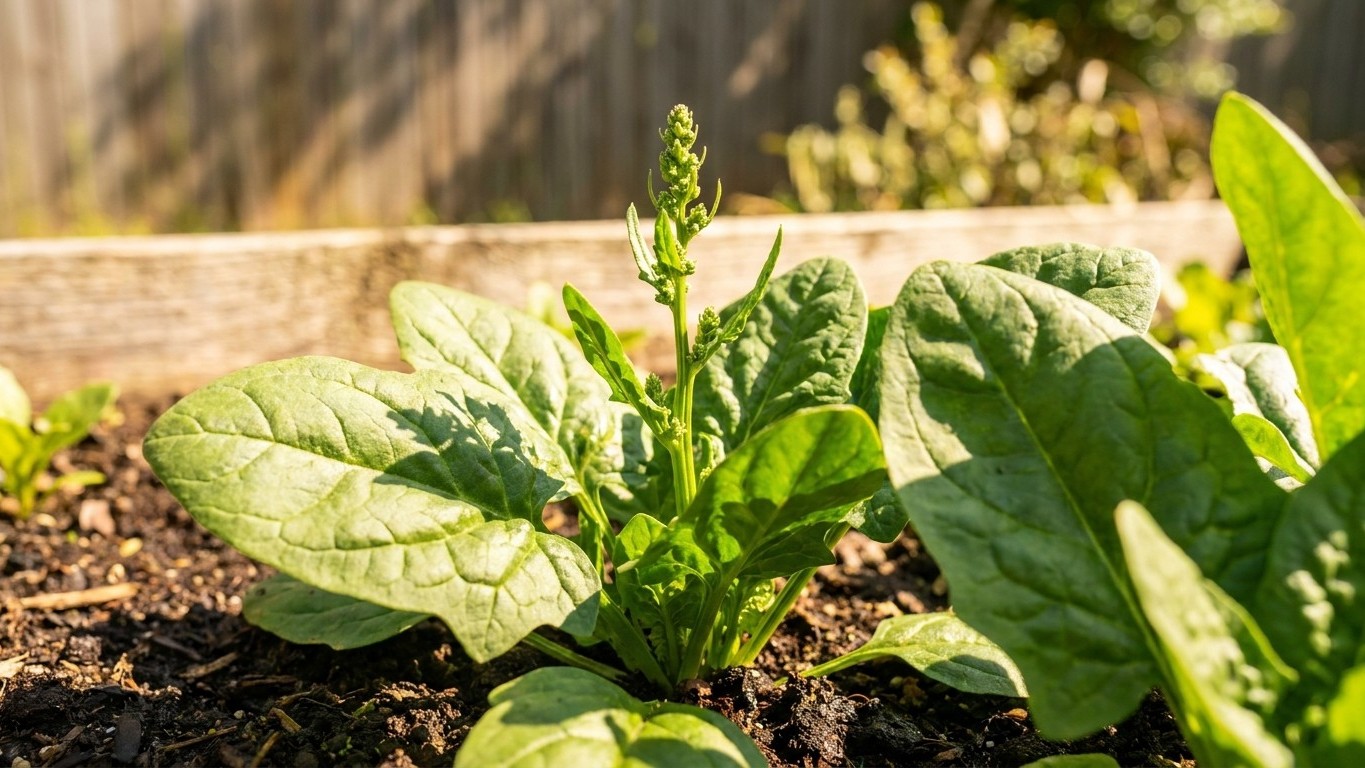

Yes, spinach in Anchorage bolts early regardless of how mild the summer feels, and heat has almost nothing to do with it. The trigger is daylight: on the longest day of the year the reference station logs 18 hours and 56 minutes of sun, and spinach treats that stretch of light as a signal to flower rather than grow leaves. A cool Alaska summer doesn’t buy extra weeks here, because the clock running against this crop is the calendar, not the thermometer.
The short answer
Eighteen hours and fifty-six minutes. That’s the gap between sunrise and sunset at Anchorage on June 21, and for most crops that number is a selling point. For spinach it’s the opposite. It’s close to the exact condition that flips the plant’s internal switch from making leaves to building a flower stalk, and that switch responds to hours of light, not to degrees on a thermometer.
This is the part that trips up gardeners who move north expecting Alaska’s famously cool summers to slow everything down. Spinach reads day length as a countdown that ignores temperature entirely. A gardener in a hot state might delay bolting by keeping plants cool and shaded; that trick does nothing here, because shade lowers leaf temperature without shortening the number of hours the plant actually sees light.
Now compare that to the heat side of the equation. The reference station averages 0.0 days a year at 90°F or hotter. There is essentially no heat stress in an Anchorage summer, and the 75°F growth ceiling that Utah State University Extension sets for spinach, the same number that marks where leaves start turning bitter, is rarely even approached. If temperature were the only obstacle, Alaska would be close to ideal spinach country for months at a stretch.
But temperature and day length are two separate switches on this plant, and mild weather only shuts off one of them. The other is set by latitude and the calendar, and in Anchorage it flips early and stays flipped through most of the growing season, since days lengthen fast this far north and hover near their peak for weeks around the solstice. So the honest read on the question is this: the limiting factor for spinach in Alaska is day length, full stop, not heat. That distinction matters for how you plan the crop, because it means the fix isn’t shade cloth or extra water, it’s timing the sowing to dodge the long-day window as much as possible, then leaning on a second, autumn round once the days shorten back down.
How long the spring window really is
Working backward from the region’s frost dates and the crop’s own rules gives a realistic picture of how much spring spinach you actually get before quality falls apart.
- Start from the last frost. The reference station’s last spring freeze falls between May 3 and May 12, with roughly 143 frost-free days on average for the year, a relatively mild window by Alaska standards since Anchorage sits among the mildest inhabited parts of the state.
- Back off two to three weeks for sowing. Spinach seed goes into the ground two to three weeks ahead of that last frost date, which puts outdoor sowing somewhere between mid-April and the very end of April, while soil is still carrying winter cold.
- Let it grow through the cold snap. That’s fine for spinach; it germinates and develops well in cool soil, and this early timing is exactly what lets it get a head start before the days stretch too far.
- Watch day length overtake temperature as the real limit. By the time seedlings are established, Anchorage’s daylight is already climbing fast toward that 18-hour-56-minute peak on June 21. Because bolting answers to day length rather than to the mild temperatures logged here, the plant can start running to seed well before the solstice arrives, without ever coming close to the 75°F ceiling.
- Add it up. Sowing in mid to late April, followed by a few weeks of usable leaf growth, leaves a workable spring harvest through roughly late May into early June. In practice that’s a window closer to a month than a full summer, closed by lengthening days rather than by rising heat.
That short window is exactly why a second, autumn planting matters more in Alaska than it might in a milder-latitude garden: it’s the only other stretch of the year when day length works with the crop instead of against it.
The autumn crop, and when the soil lets you sow
A fall round of spinach faces two separate obstacles, and in Anchorage’s case they don’t carry equal weight.
Soil still too warm to germinate
Utah State University Extension notes that spinach seed germination drops once soil temperatures climb above 80°F, and in much of the country that’s the real bottleneck for fall sowing, gardeners have to wait out late-summer heat before seed will even sprout. Anchorage mostly sidesteps this problem. With an average of 0.0 days a year reaching 90°F, soil here rarely gets anywhere near that 80°F mark to begin with, so this obstacle carries far less weight than it would in a hotter state further south.
The frost that ends the season
The obstacle that actually matters is the one closing in from the other direction. The reference station’s first fall frost arrives between September 22 and October 1. Utah State University Extension doesn’t publish a days-to-maturity figure for spinach; instead its fall guidance is a planting rule, sow 50 to 75 days before the date you want to harvest. Counting back from an early target harvest of September 22 puts sowing anywhere from August 3 (50 days out) to July 9 (75 days out). Aiming for the later end of the frost window, October 1, shifts that range to August 12 or July 18. In practice, a fall spinach crop here wants seed in the ground sometime between early July and mid-August, depending on how much cushion you want before that first hard frost.
Extension guidance for spinach commonly names four varieties, Bloomsdale, Melody, Teton, and Olympia, but the source doesn’t break down germination, bolt resistance, or yield by variety, so there’s no verified basis here for claiming one performs better than another under Alaska’s day length and frost timing.
Common questions
Does shade cloth stop spinach from bolting in Anchorage?
No. Bolting responds to hours of daylight, not leaf temperature, so shading the plants lowers heat stress without changing how many hours of light they’re exposed to. It won’t delay flowering triggered by long days.
Is the Interior or northern Alaska worse for spinach bolting than Anchorage?
The frost-free season shrinks considerably away from Anchorage, since it’s noted as one of the mildest inhabited parts of the state while the Interior and the north run far shorter. That leaves less total time on either side of summer to work with, even though the day-length mechanics driving bolting are the same statewide.
Can I plant a second spinach crop after the spring round bolts?
Yes, and it’s the more reliable route in this climate. Once days start shortening again after the solstice, the fall sowing window opens, guided by the 50-to-75-day rule counted back from the September 22 to October 1 frost dates.
Does warm soil ever block fall sowing in Anchorage the way it does in hotter states?
Rarely. Since the reference station averages 0.0 days a year at 90°F, soil temperatures seldom approach the 80°F point where spinach germination starts to suffer, unlike in warmer regions where gardeners have to wait for soil to cool before sowing.