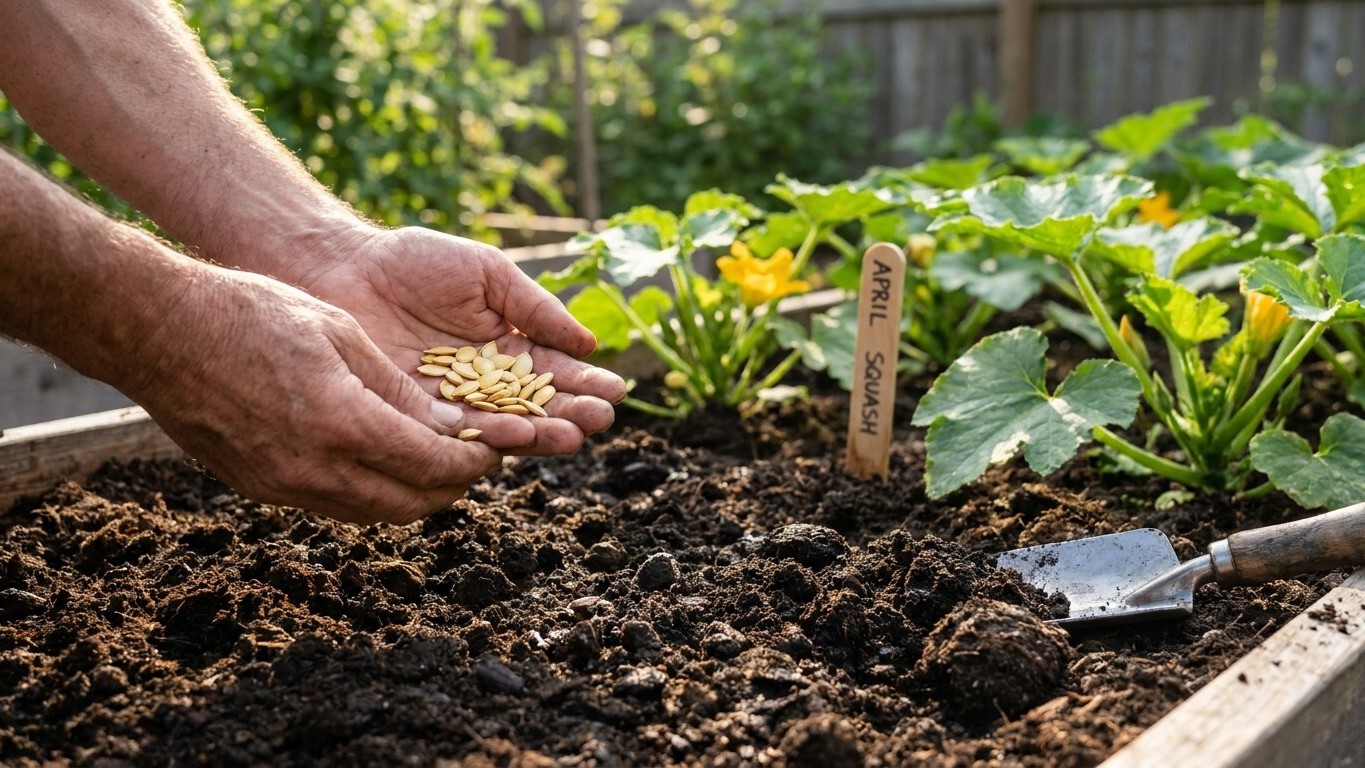

In Anchorage and other mild coastal parts of Alaska, sow summer squash outdoors between May 12 and May 20, once the 30-70% frost probability window has passed, and expect to stop harvesting by late September. That’s the state-level answer. What actually decides your dates, though, is how those frost dates were built and how much they shift the moment you leave the Anchorage reference station.
The short answer for Alaska
The last spring frost at Anchorage’s reference station falls between May 3 and May 12, and the first fall frost arrives between September 22 and October 1. Those dates come from NOAA’s 1991-2020 Climate Normals, using the 30-70% probability band for a 32F freeze at station USW00026451. That band matters more than the dates themselves: a date inside it isn’t a guarantee, it’s a coin-flip zone where roughly three years in ten still bring a freeze before or after it. Gardeners who plant right at May 3 are betting on the early edge of that spread.
Given that, direct-sowing summer squash makes sense only after the window closes on the later side, around May 12 to May 20, once soil has had a couple extra weeks to warm past the point where squash seed simply rots instead of germinating. That leaves a frost-free stretch of about 143 days before the first fall frost risk begins in late September. It sounds workable on paper, and for fast bush zucchini and yellow crookneck types bred for 45- to 55-day maturity, it usually is, especially with black plastic mulch or a low tunnel to push soil temperature up in the first few weeks.
The caution attached to these numbers is worth repeating on its own: Anchorage is one of the mildest inhabited parts of the state. Its 143 frost-free days are close to the best Alaska offers. The Interior, around Fairbanks, and anything farther north runs a noticeably shorter season, sometimes by a month or more, even though the long summer daylight there partially compensates by pushing plant growth harder during the days it does get. Nobody outside the Anchorage bowl should copy the May 12-to-20 window and assume it applies to them.
None of these dates say anything about whether the fruit will actually set once the vine flowers, which is a separate problem in a state where daytime heat almost never builds the way it does farther south. That’s the piece the frost calendar alone can’t answer, and it’s the subject of the next section.
What will not work here
Start with the number that trips up more Alaska squash growers than frost ever does: 0.0 days a year above 90F at the reference station. That’s not an average summer temperature, it’s a measure of heat load, the days that drive water demand, stress cool-season crops, and push flowering and fruit set along in warm-season vegetables. Summer squash is a warm-season crop that evolved to fruit heaviest under heat it rarely gets in Alaska. The practical effect isn’t that the plant won’t grow. Vines can get large and green in the long daylight. The failure shows up at the flower: fruit set stalls when nights stay cool, and growers report plenty of blossoms with disappointingly few squash to show for them.
The 143-day season closes off a second option: slow-maturing summer squash varieties bred for warmer, longer regions. A variety listed at 65 to 70 days to maturity somewhere in the Southeast is cutting it close to fine in Alaska once you subtract the week or two it takes soil to warm enough for germination after the frost window passes, plus the days lost to cool, overcast stretches that slow growth without technically frosting anything. Anything past about 55 days on the seed packet is working against the calendar from the start, not because of frost risk at the end, but because there simply isn’t enough warm-day accumulation in between.
The rainfall trap
Summer rainfall runs about 5.8 inches across June, July and August, with June the driest month at just 1.02 inches. That’s a modest number, and combined with zero days of real heat, it can lull a gardener into assuming squash needs almost no attention to water. The problem is that low summer rainfall paired with Alaska’s long summer daylight hours still pulls moisture out of leaves and topsoil steadily, even without triple-digit heat behind it. A grower who waters once a week on a Southern-summer schedule, assuming the mild climate means low water demand, often finds soil drier than expected by the second week of a rainless stretch in June. The rain totals here don’t argue for neglect. They argue for checking soil moisture directly rather than trusting the calendar or the mild temperatures to do it for you.
What changes across Alaska
Alaska’s USDA Plant Hardiness Zone range runs from 1a to 8a, according to the 2023 USDA Plant Hardiness Zone Map built on 1991-2020 normals. That’s one of the widest spreads of any state in the country, built entirely on average annual extreme minimum winter temperature, which is a winter-survival measure rather than a summer-growing one, but it’s a useful shorthand for just how differently the same “Alaska” garden advice can land depending on where it’s read. A zone 8a coastal pocket and a zone 1a Interior valley are not the same growing environment in any practical sense, even though both sit inside the same state’s borders.
The frost and heat figures in this article are anchored to the Anchorage reference station, which sits toward the milder end of that spread. Readers gardening in the Interior, in the far north, or at any real elevation should expect a shorter frost-free window than the 143 days cited here, often substantially shorter, and correspondingly less margin for a slow-to-mature summer squash variety or a late transplant date. There is no single Alaska planting date that covers all of it. The spread is the answer.
What that means practically is that the zone range itself, 1a to 8a, is not something to resolve by guessing. It’s not useful, and it’s not accurate, to estimate your own zone from a description of climate or elevation. The USDA Plant Hardiness Zone Map lets you check a specific location directly, and that’s the tool to use before adjusting any date on this page to your own garden. Treat this article’s Anchorage-based figures as one point in a very wide range, not as the range itself.
Where to check this for your own county
The state-level dates here come from one reference station and cover the whole spread of Alaska’s growing conditions only in the loosest sense. The more useful step is checking with University of Alaska Fairbanks Cooperative Extension Service. Extension offices work county by county (in Alaska’s case, borough by borough and district by district), and that local layer is where the state calendar gets corrected for the specifics this page can’t know: your borough’s actual frost record, its soil temperature patterns, and the summer squash varieties that have actually been trialled and performed well in local demonstration gardens.
Two things are worth looking for once there. First, a local planting calendar, if the office publishes one, which will reflect frost data specific to that district rather than the Anchorage reference station used here. Second, any list of varieties trialled locally, since Extension offices in short-season states routinely test which summer squash cultivars actually mature reliably within their specific frost-free window, information that a seed catalog’s national-average “days to maturity” figure can’t give you.
A county or borough recommendation beats a state one every time, for a simple reason: it’s built on data closer to your actual garden. This page works at the state level because that’s what a resource covering all of Alaska can responsibly do. It’s a starting point, not a finish line, and the extension office is where the finish line for your specific location actually gets drawn.
Checking this against your own garden
Every date in this article is a normal, an average built from thirty years of station records. Your own garden this year is not an average. It’s one plot, in one microclimate, in one particular spring, and it can run a week or two ahead of or behind the station figures depending on sun exposure, soil type, and whether it sits in a low spot that collects cold air. Three direct observations tell you more than any calendar.
Soil warmth by feel comes first. Squash seed sitting in cold soil doesn’t just grow slowly, it often rots before it germinates at all. Push a finger a couple of inches down; soil that still feels distinctly cool and damp, closer to refrigerator temperature than room temperature, is telling you to wait, regardless of what the date says.
The first flush of male flowers is the second signal. Summer squash produces male flowers before female ones, and a healthy early run of them means the plant has settled in and is building toward fruit. A vine that flowers late or sparsely, even after weeks of what looks like fine growth, is often responding to cooler-than-expected nights in your particular spot.
First true leaves matter last. The seed leaves that emerge first aren’t the plant’s real leaves; the first true, squash-shaped leaves that follow are the sign the plant has moved past its most fragile stage. Their appearance, and how long it took to get there from sowing, is the single clearest read on how your soil and microclimate compare to the averages this page is built on.