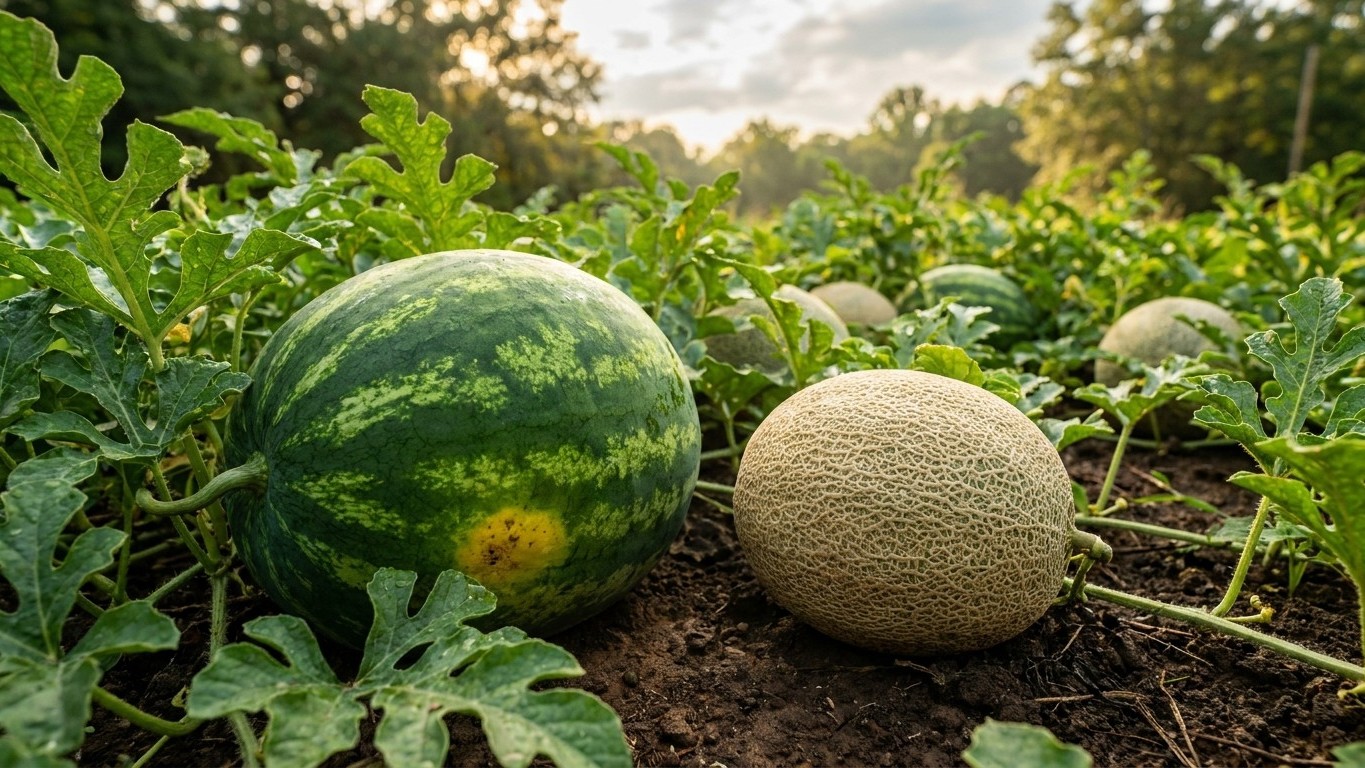

Alberta’s melon window runs from a mean last frost of May 21 to a mean first frost of September 16, in a climate with zero days a year reaching 90°F. That combination rules out slow, heat-hungry melon types and rewards only the fastest muskmelon and cantaloupe types, started indoors and finished under plastic or row cover. Full-size watermelon and honeydew, grown the standard way, rarely ripen before the cold comes back.
The short answer for Alberta
Two mean dates set the frame for every melon decision in this province: May 21 for the last spring frost and September 16 for the first one in fall, both drawn from the Calgary Int’l A reference station. Subtract one from the other and the frost-to-frost season averages 118 days. That figure is a ceiling, not a promise. It is a mean date from Environment and Climate Change Canada, which means in one year out of two the spring frost actually falls later than May 21 and the fall frost sometimes arrives before September 16. A gardener planning around the mean, rather than around the risk, loses days on both ends in a below-average year.
The second number that decides everything is heat, not just length: zero days a year reach 90°F at the reference station. Melons ripen on accumulated warmth, not just on the calendar, and a season with no real heat spikes means the plant never gets the burst that pushes sugar into the fruit late in the cycle. That single fact is why the decision in Alberta has to be made by type, not by taste preference.
Matching melon type to the window
Types that mature in roughly 65 to 80 days, the fast muskmelon and cantaloupe category, fit inside the mean 118-day window with room to spare, even after losing two or three weeks to a late spring or an early fall. Types built for 85 to 100 days, the standard full-size watermelon and most honeydew, use up nearly the entire mean season with nothing left for a bad year.
| Melon type | Typical days to maturity | Fits inside Alberta’s mean 118-day window |
|---|---|---|
| Fast muskmelon / cantaloupe | 65-80 days | Yes, with margin |
| Small icebox watermelon | 75-85 days | Marginal, needs a head start indoors |
| Full-size watermelon | 85-100 days | No margin for a shorter year |
| Honeydew | 85-100 days | No margin, and needs heat this climate rarely gives |
The practical takeaway: pick from the 65-80 day column, start seed indoors rather than direct-sowing, and use plastic mulch or row cover to add a few extra degrees of soil and air warmth on both ends of the season.
What will not work here
Full-size watermelon direct-seeded outdoors is the clearest failure mode this province produces. At 85 to 100 days to maturity, sown only after the May 21 mean frost date (itself unreliable), the fruit is racing the September 16 mean fall frost with no buffer. In a year where spring frost lingers into early June, which happens close to half the time by definition of a mean, that race is already lost before the vine has four true leaves.
Honeydew fails for a different reason layered on top of the same short season. Honeydew depends on sustained warmth late in its cycle to convert starches to sugar in the fruit, and a climate with zero days a year above 90°F simply does not deliver that push. Growers who do manage to keep the vine alive to the frost date often end up with a fruit that is technically mature but bland, because the sugar development that needs real heat never happened.
Direct-seeding any of the slower types outdoors, rather than starting transplants indoors, compounds both problems at once. Losing the first three to four weeks of the season to germination and early growth is a rounding error for a fast 65-day type. For an 85-to-100-day type it can be the difference between a harvest and a compost pile.
One failure mode that would fit a hotter, drier state does not really apply here. Alberta’s summer rainfall runs about 8.5 inches across June, July and August, with the driest month, August, still delivering 2.24 inches. That is not the kind of moisture-starved summer that punishes a weekly watering schedule. The more common local mistake runs the other way: sprawling, long-vine giant melon varieties bred for warmer regions demand more space and more fruit-per-plant than a short, cool season can actually finish, so the garden ends up feeding a vine that never sets a ripe fruit at all.
What changes across Alberta
The hardiness zone figure for this province, 4a on the Canadian scale at the Calgary reference point, is not a provincial constant. It belongs to one city. Natural Resources Canada’s own comparison shows that a single Canadian zone like 4a can overlap nine different USDA zones, from 3a to 7a, depending on where in the country it is measured. Alberta is not one climate wearing one number; it is a province where the reference station’s frost dates and heat totals are one data point among many.
Southern Alberta, in the chinook belt around Lethbridge and Medicine Hat, tends to warm earlier in spring and hold heat longer into fall than the Calgary reference figures suggest, thanks to the periodic warm winds that push through the region. The Peace River country in the north, and higher-elevation communities near the foothills and the Rockies, run the other direction: colder soil, a later effective start, and a fall frost that can arrive well before the September 16 mean used in this article.
None of this means a reader in Medicine Hat should assume they are a full zone warmer than a reader in Grande Prairie, or the reverse. It means there is no single frost date, no single zone, and no single melon answer for the whole province. Differences of two or three weeks in either direction between regions inside Alberta are common enough that a plan built purely on the Calgary station numbers deserves a local sanity check before seed goes in the ground.
That local check has an official version. Natural Resources Canada maintains a plant hardiness map by municipality, and it is the right tool for finding a zone that actually matches a specific town rather than a provincial reference point.
Where to check this for your own county
The province runs its own agriculture service at alberta.ca/agriculture-and-irrigation, and it is the next stop after these reference figures. This article works from one reference station’s frost dates and heat totals. A provincial or county service works from local trial data, which is a different and more precise kind of evidence.
Two things are worth hunting for on that site specifically. First, a local or regional planting calendar, if one exists for a reader’s district, which will adjust the May 21 and September 16 mean dates used here toward whatever that district’s own station or trial records actually show. Second, any list of melon or cucurbit varieties that have been trial-grown in a specific county or growing region of the province, since a variety that performed well in a controlled provincial trial plot carries more weight than a general days-to-maturity number pulled from a seed catalog.
A county-level or regional recommendation beats a provincial one every time, and a provincial one beats a single reference station. That is not a flaw in this article, it is simply the nature of a state-or-province-level resource: it describes a starting point drawn from one measured location, not a guarantee for every backyard in the territory. Treat the numbers here as the frame, and the county-level trial data as the fine-tuning that actually applies to one specific plot of soil.
Checking this against your own garden
Every date and figure comes from a weather station, not from the soil a reader is actually planting into, and the soil always has the final word. Three signs, read directly off the plant and the ground, tell a gardener more about their own microclimate than any mean frost date ever will.
- Soil warmth by feel: melon roots stall in cold soil regardless of the calendar date. Soil that still feels cool and damp to the back of a hand in late May is telling a gardener their plot runs behind the Calgary reference dates, whatever zone map says otherwise.
- The first flush of male flowers: melons typically produce male flowers before the female flowers that actually set fruit. An early, heavy flush of males is a sign the plant has enough accumulated warmth to move toward fruiting; a stalled, sparse flush late in summer suggests the season is running short on heat units for that particular plant and spot.
- The first true leaves: the pace at which true leaves follow the seedling’s first round cotyledons is a rough gauge of local growing conditions. Slow leaf development after transplant, even with warm air temperatures, usually points to cold or compacted soil rather than a problem with the variety itself.
None of these require a thermometer or a soil probe, just attention over the first few weeks after transplant. A garden that runs consistently behind these three signals, compared to what the mean dates would predict, is a garden that needs the fast end of the melon-type range and every trick available for adding a little extra warmth early in the season.