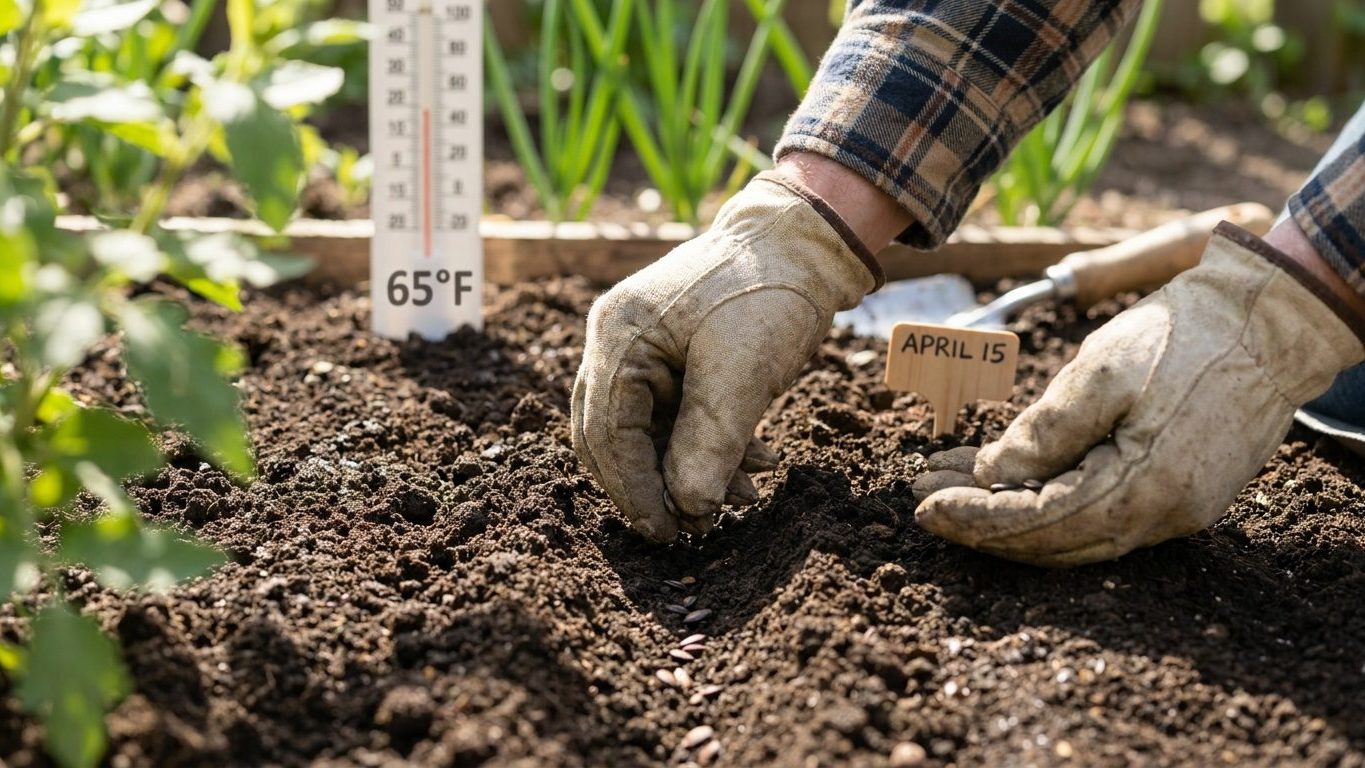

Transplant melons outdoors once the risk of frost has mostly passed, around the average last-frost date of May 21, and expect to bring them in before the average first fall frost of September 16. That’s a 118-day window on paper. But those two dates are averages, not guarantees, and Alberta’s summers add a complication most melon guides never mention: essentially zero days a year reach 90°F.
The short answer for Alberta
The frost dates for this page come from Environment and Climate Change Canada’s 1981-2010 normals at the Calgary Int’l A station: an average last spring frost of May 21 and an average first fall frost of September 16. Do the math and you get roughly 118 frost-free days in a typical year. That sounds workable for melons, until you factor in the second number: 0.0 days above 90°F in an average year at that same station.
Melons don’t just need frost-free days. They need heat, specifically the kind of sustained warmth that pushes soil temperature up, keeps vines growing fast, and ripens fruit before the season closes. A frost-free stretch with almost no days near or above 90°F is a season that stays open on the calendar but stays cool in practice. That’s the real constraint here, more than the frost dates themselves.
So the practical calendar looks like this: start seeds indoors 3 to 4 weeks before the last frost date, so transplants go into the ground with a head start rather than from seed sown directly into cold soil. Hold off transplanting until night temperatures are reliably above 50°F, which in most years runs a few days to two weeks past May 21, not before it. From there, count backward from September 16 to figure out whether a variety’s days-to-maturity actually fits, and lean on black plastic mulch or row cover to bank whatever heat the summer offers. Given the average May 21 frost date is a midpoint (frost falls later than that in one year out of two), treating it as a hard start date is the first mistake growers make here.
What will not work here
Direct-seeding melons into open garden soil in late May is the most common failure. Soil at that point is barely warm enough to avoid rot, let alone push fast germination, and every week spent waiting for seeds to sprout outdoors is a week stolen from an already short warm stretch. Transplants started indoors aren’t optional insurance here; they’re close to mandatory.
Long-season varieties
Melon varieties bred for 85 to 100 days to maturity from transplant are a poor match for a region averaging 118 frost-free days total, most of which aren’t warm enough to count as real growing days given the 0.0 average days above 90°F. A long-season melon planted at the mean frost date and counting on a full 85-plus days of vine growth is racing a clock it’s likely to lose, especially in a year where frost arrives on schedule or early rather than late.
Watering on autopilot
Growers who move here from hotter, drier climates often default to a weekly deep-soak schedule built for places where days above 90°F are common and evaporation is relentless. Alberta’s summer rainfall runs about 8.5 inches across June, July and August, with August, the driest of the three, still bringing 2.24 inches. Combined with near-zero extreme heat, that’s enough ambient moisture that a rigid weekly soak can leave soil waterlogged rather than thirsty, inviting root rot in melons, which are far more tolerant of underwatering than of sitting in wet ground. Watering here needs to respond to actual soil dryness, not a fixed hot-climate schedule borrowed from somewhere else.
Wide spacing without any heat-retention strategy is the third quiet failure. Bare soil in a cool summer loses whatever warmth it gains overnight; black plastic mulch or row cover isn’t a nice-to-have accessory here, it’s what keeps a marginal season viable at all.
What changes across Alberta
The hardiness zone figure available for this page is 4a on the Canadian system, tied to the Calgary reference station, and it comes with two caveats worth taking seriously. First, the Canadian zone system is built from seven climate variables, not the single minimum-temperature metric the USDA system uses, so a Canadian 4a doesn’t translate cleanly into a USDA zone; Natural Resources Canada itself notes that Canadian zone 4a overlaps nine different USDA zones, from 3a to 7a. Second, that 4a figure describes Calgary specifically, not the province as a whole.
Alberta stretches from prairie farmland in the south to the Peace Country in the north, with foothills and elevation changes running along the western edge. A garden at higher altitude or farther north than Calgary is very likely working with a shorter frost-free window and cooler summer soil than the numbers on this page describe, while a low-elevation southern garden may run a bit ahead of them. There isn’t one melon calendar for the whole province, and this page can’t responsibly hand out a single date that fits every county.
What it can say is this: treat the May 21 and September 16 dates as a starting reference for the Calgary area specifically, then adjust toward more caution (later transplanting, earlier harvest target) the farther north or higher up the growing site sits. Rather than guess at which zone applies to any individual garden, the right move is checking Natural Resources Canada’s Plant Hardiness Site, which maps zones by municipality using the same 1991-2020 normals framework referenced for this figure.
Where to check this for your own county
Alberta’s provincial agriculture and irrigation office publishes region-specific growing guidance, and that’s the next stop for anyone trying to firm up a melon calendar past the province-wide figures on this page. A single station reading from Calgary can’t speak for a garden in Grande Prairie or Lethbridge, and a county-level or regional recommendation will always beat a provincial one built around one reference city.
Two things are worth hunting for specifically once there. The first is a local or regional planting calendar, if one exists for the area, since it will reflect actual frost patterns for that district rather than a single normals station hours away. The second is a list of varieties that have actually been trialled in that region: extension and provincial agriculture programs often track which melon varieties have produced reliably ripe fruit locally, which is a far more useful signal than a seed packet’s generic days-to-maturity number, particularly given how much heat availability (not just frost timing) shapes whether a melon finishes here at all.
This page is built to answer the question at the provincial level, using the best station data available for Alberta as a whole. It isn’t, and can’t be, a substitute for county-level advice grounded in local trial results. Anyone gardening seriously in a specific district should treat this page as the starting frame and the provincial office’s regional resources as the refinement.
Checking this against your own garden
Every date on this page is a regional average, and a grower’s own garden will outvote it every time. Three things are worth watching directly, no thermometer or gauge required beyond what most gardeners already have on hand.
Soil warmth by feel is the first and most useful check. Pressing a hand into the top few inches of soil in late May tells a grower more about whether it’s ready for melon transplants than any calendar date. Soil that still feels cold and damp, rather than warm and slightly dry at the surface, is a sign the local microclimate is running behind the regional average, whatever the calendar says.
The first flush of male flowers on the vines is the second signal. Melons produce male flowers before female ones, and a healthy early flush means the plant has settled in and is building toward fruit set; a delayed or sparse flush suggests the vine is still recovering from a rough transplant or cool stretch, which matters a great deal in a season this short.
The appearance of the first true leaves, the leaves that emerge after the initial seed leaves and actually look like melon foliage, marks the point where the plant has shifted from surviving to actively growing. If that shift happens later than expected, it’s a sign the local season is starting slower than the Calgary-based averages suggest, and harvest timing should be pushed accordingly rather than forced to match a date on a page like this one.