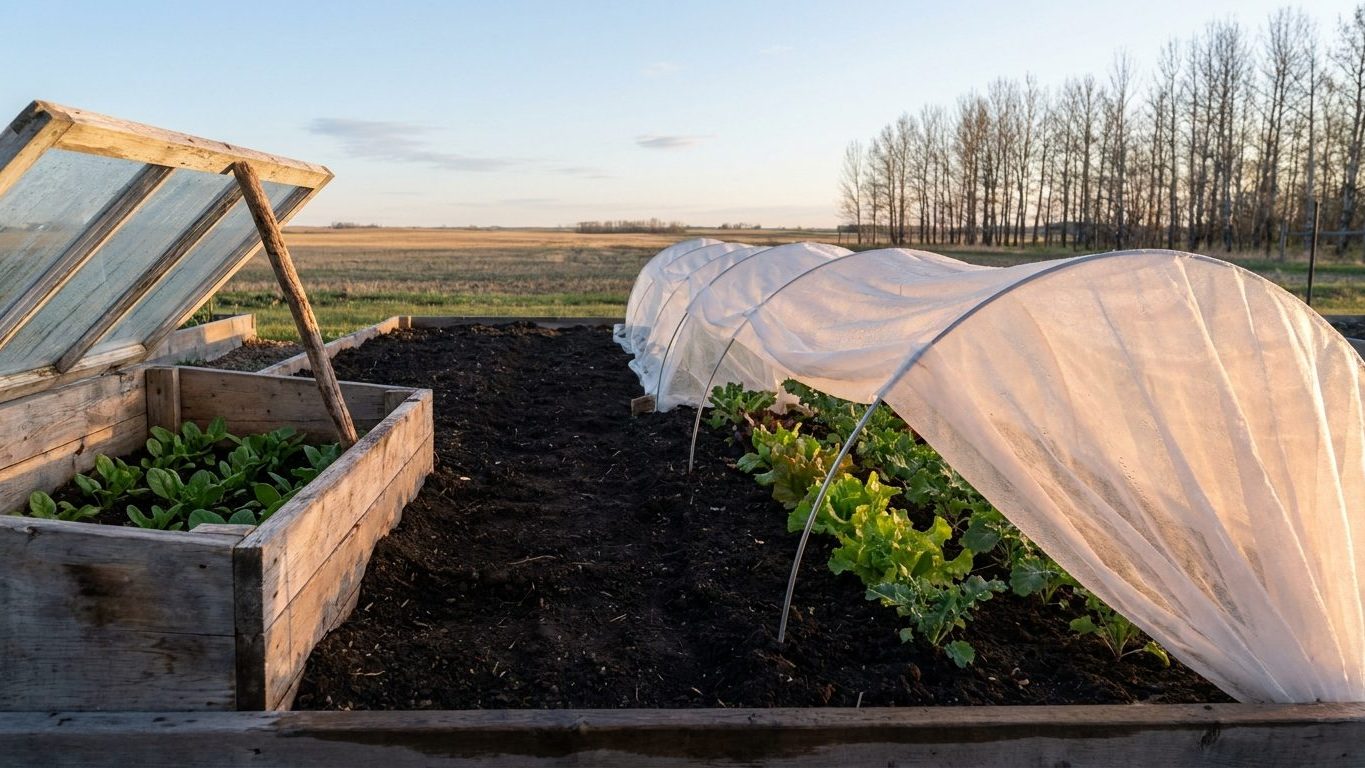

Lightweight row cover over hoops does most of the work in Alabama gardens. Cold frames cover winter greens, and shade cloth helps the other end of the year. The reason is the calendar: frost comes late in spring and early in fall, and the gap between the two is wide. Extenders earn their keep at those edges.
The short answer for Alabama
Floating row cover and low tunnels fit Alabama best, with cold frames as a second tool for cool-season crops in winter. The state’s problem is a few cold nights at the edges of a long season, not a short season, and that is exactly what thin fabric and low hoops handle. The broader picture is in Extending the Growing Season in Alabama.
Start with the numbers for the reference city, Huntsville (latitude 34.64 degrees north). NOAA’s 1991-2020 Climate Normals put the last spring 32°F freeze between March 19 and April 3. The first fall freeze lands between November 2 and November 16. Those are probability dates, not predictions: they mark the 30-70% band for a 32°F freeze, so a freeze after the early date in each range is still a real possibility. Between the later spring date and the earlier fall date sit roughly seven months. Between the earliest and latest, closer to eight.
The coldest month matters too. Its mean daily minimum is 33.1°F, a figure that sits just above freezing. Average winter nights are therefore mild, but the average hides the dips. A cover that adds a few degrees on a clear, still night turns a killing frost into a light one for hardy crops. It will not turn January into May.
How the main extenders compare
| Extender | Best use in Alabama | Main limit |
|---|---|---|
| Floating row cover | Early transplants, fall brassicas, light frost nights | Little help in a hard freeze |
| Low tunnel on hoops | Lettuce, spinach, kale and similar through winter | Overheats on sunny days unless vented |
| Cold frame | Winter greens, hardening off seedlings | Needs daily venting; small footprint |
| Shade cloth | Starting fall crops in late-summer heat | Does nothing for cold |
None of these needs a power source or a permit. All of them can be moved, which matters in a state where the right week to cover can change from year to year.
What will not work here
Growing warm-season crops through winter under cover tops the list of failures. Tomatoes, peppers and okra stop when nights run near freezing, and a coldest-month mean minimum of 33.1°F means plenty of nights sit at or below that. Row cover buys protection for a frost night. It does not supply the soil warmth and day length those plants want in December.
Leaving plastic sealed over a tunnel is the next mistake. Alabama winters swing between frosty mornings and mild afternoons. A closed tunnel on a sunny day can cook seedlings, and the trapped moisture then invites fungal disease in the humid air of the Gulf South. Cold frames and plastic tunnels need venting on every mild day, which makes them poor choices for anyone gone all day with no one to open the lid.
Treating the airport dates as your dates also fails. The figures come from a weather station at the reference city’s airport, and suburban and rural gardens typically see the last spring frost later and the first fall frost earlier, often by one to two weeks, and more at elevation. A gardener who sets out tender transplants on March 19 because a chart said so, with no cover on hand, is betting against the 30-70% band.
Heavy, long-term covers on long-season crops don’t hold up either. Alabama’s frost-free stretch is long enough that you rarely need to wrap crops for months. Short-term covers, put on for a cold night and pulled off the next morning, are the better match. Slow, expensive structures like heated greenhouses are built for places where the season is too short to finish a crop. Here, the season mostly finishes the crop by itself.
Finally, shade cloth is not a cold-season tool, though it gets lumped in with extenders. It earns its place in late summer, when fall seedlings need relief from heat to get started. Used in winter, it only blocks light you want.
What changes across Alabama
Alabama is not one garden. The USDA Plant Hardiness Zone Map (2023, built on 1991-2020 normals) places the state in zones 7a to 9a, a spread of three zones. There is no single answer for the state. Zone is built on one variable only, the average annual extreme minimum temperature, so it describes whether a perennial survives winter, not when to plant tomatoes. Frost dates do that, and they vary separately.
For a gardener in the northern hills or at altitude, the shift is toward the cold side. Later spring frost and earlier fall frost than the Huntsville figures mean row cover matters at both ends of the season, and a cold frame becomes a daily tool rather than an occasional one. Plan on starting hardy crops under cover in late winter instead of waiting for open ground, and keep covers within reach through the first weeks of November.
For the southern end of the state, the balance tips toward heat. Frost still comes, but the extender question changes: shade cloth for fall starts and fast-warming soil mean you may use covers for fewer nights. Because the figures here describe the reference city, a reader near the Gulf or near the Tennessee line should treat them as a starting point, not a ruling.
Latitude matters for one reason beyond frost. Day length, not warmth, tells an onion when to stop making leaves and start making a bulb. The 34.64 degrees north figure belongs to Huntsville. A reader far north or south of it should check their own latitude before copying a variety choice.
To find your zone, use the USDA map itself. This page cannot tell you which of the three zones you garden in.
Where to check this for your own county
Your state extension service is the next stop. In Alabama that is the Alabama Cooperative Extension System, which runs county offices staffed by people who know the local soils and frost pockets. A county recommendation beats a state one every time. This page is the state one.
Two things to look for there. First, a planting calendar written for your county, with sowing and transplant windows tied to local frost dates. A calendar built for the reference city can be one to two weeks off for a rural or elevated garden, and the local version corrects that. Second, the vegetable varieties trialled in your county. A variety that does well under row cover in one part of Alabama may bolt or stall in another, and trial results save a season of guessing.
I do not have a county-level calendar to offer here, and the sources behind this page do not include one for Alabama, so I will not borrow another state’s. Neighboring states publish their own calendars for their own conditions, and those dates would mislead an Alabama gardener. If your county office offers a calendar, a call or a visit is worth the time, since agents can also tell you which extenders local gardeners lean on.
Checking this against your own garden
Your observations outrank every date above. Three are worth tracking, and none needs an instrument.
- Soil warmth by feel. Push a hand into bed soil a few inches down on a spring morning. If it feels cold, wait or use a cover; if it feels neutral, transplants can go out. A low spot that stays cold longer than the rest tells you where cold air pools.
- The first flush of male flowers. On squash and cucumbers, male blooms appear before female ones. When they open under a cover and the neighbor’s open bed is still bare, you have measured how much warmer your tunnel runs.
- The first true leaves. The leaves after the seed leaves show a seedling has rooted and is growing. If seedlings under cover reach that stage days ahead of those outside, the extender is working; if they stall, venting or timing is off.
Over a season, these notes build a map of your own microclimate: the warm wall, the frost pocket at the bottom of the slope, the bed that thaws first. For when to put covers on and take them off, see When to Cover Your Garden in Alabama.
Common questions
Do I need a greenhouse in Alabama?
Most home gardeners do not. With the frost-free window at the reference city running roughly seven to eight months, row cover, low tunnels and a cold frame handle the edges of the season at a fraction of the cost.
Will row cover save tomatoes from a freeze?
Not reliably. Light fabric helps on a marginal frost night, but a hard freeze can still kill tender plants. Hold transplants until the frost risk has passed in your area, and keep cover handy for the odd late cold snap.
Do the frost dates on this page apply to my yard?
They are the Huntsville reference figures: March 19 to April 3 for the last spring freeze and November 2 to November 16 for the first fall freeze. Rural and suburban yards typically run one to two weeks later in spring and earlier in fall, and more at elevation. Check with your county extension office.
What is the cheapest extender to start with?
Floating row cover, held down with soil, boards or rocks over simple hoops. It is cheap, reusable, and works for both the spring and fall edges. A cold frame comes next if you want winter greens.