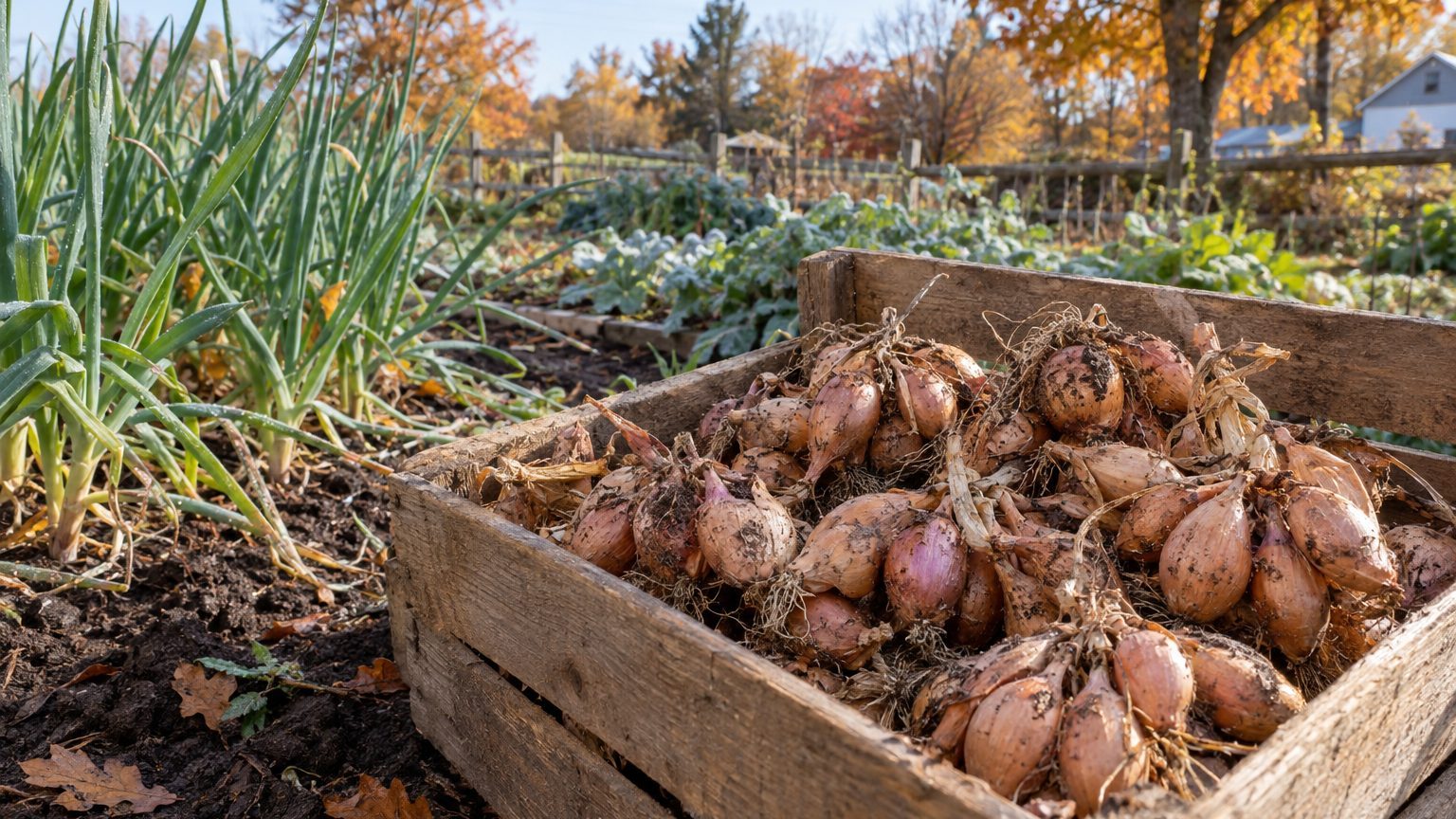

For most Alberta gardens, the best shallots are the ones that finish fast: bulb-grown types planted from sets or small bulbs, not slow seed-grown kinds. Calgary’s frost-free stretch averages a little under four months, and its winter minimums are harsh enough to make fall planting a gamble. This page sorts shallots by type for that climate, says what tends to fail, and points you to local sources for the rest.
The short answer for Alberta
Make spring-planted, bulb-grown shallots your default in Alberta. Seed-grown shallots can work if you start them indoors early, and fall-planted bulbs are a bet on the winter rather than a plan.
The numbers behind that call come from Environment and Climate Change Canada’s 1981-2010 normals for the Calgary International A station. The last spring frost falls on average on May 21, and the first fall frost on average on September 16. Those are mean dates, not safe dates. In roughly half of years the last spring frost comes after May 21, and in roughly half of years the first fall frost arrives before September 16. Treat each as the middle of a window. Also note that the Canadian normals cover 1981-2010, while US figures on this site cover 1991-2020, so don’t line them up one-for-one.
Between those two dates sits a growing season of a little under four months at that one station. A shallot grown from a set needs to leaf out, bulb up and then cure in dry weather, and that last step is easy to forget when you’re counting days. The shorter the season, the more the type you choose matters more than the individual variety.
| Type | Fit for Alberta | Main reason |
|---|---|---|
| Spring-planted sets or small bulbs | Best default | Starts the clock as soon as soil can be worked, with a head start over seed |
| Seed-grown, started indoors | Workable with an early start | Cheap and disease-clean, but needs weeks of indoor growing first |
| Seed sown directly outdoors | Poor | Seedlings begin too late for the frost-free window |
| Fall-planted bulbs | Risky | Depends on a dependable snow cover and mulch through a cold winter |
One limit on this page: it has no Alberta variety trial data to rank named cultivars. So the decision here is by type, and within a type you can favor whichever listing shows the shorter days to maturity. For the full growing routine, see Growing Shallots in Alberta, and for timing, When to Plant Shallots in Alberta.
What will not work here
Slow shallots fail first. A seed-grown type sown straight into the garden in late spring has perhaps three and a half months of frost-free weather at Calgary’s averages, and that is before you subtract germination time and the weeks when seedlings are too small to bulb. The plants survive, but they stall as thin, onion-like stems with no real bulb. If you want seed-grown shallots, the indoor start is not optional.
Fall planting is the second casualty, and it deserves a straight look at the cold. The mean daily minimum of the coldest month at the Calgary reference station is -13.2 °C (8.2 °F, if you’re comparing with US figures). That is an average of the lowest temperature each day, not the record low, so individual nights run well below it. Bulbs planted in fall need roots established before the ground freezes and then steady protection. Without a reliable snow blanket or a thick mulch, they can heave, rot or thaw and refreeze. Some gardeners succeed with it, but I wouldn’t build a harvest on it.
Planting too early in spring is a quieter mistake. Because May 21 is only the midpoint of the last-frost window, a bed planted on that date has about even odds of a later frost. Dormant sets tolerate cold soil well, and established shallot leaves generally shrug off light frost, but a hard freeze on tender new growth sets plants back. Planting the moment soil is workable and keeping a bit of row cover handy is smarter than gambling on one date.
Dry spells are the other trap. Shallots have shallow roots, so a long gap between waterings during bulb sizing shrinks the crop. Alberta’s drier prairie summers make that more likely than in a humid state, and sandy or fast-draining beds suffer most. Mulch and deeper, less frequent watering do more than a sprinkle every day.
Finally, a wet end to the season undoes good work. Shallots that mature as September frosts approach need dry days for curing. If the tops are still green when the first fall frost arrives, which happens in about half of years at those averages, the bulbs go into storage with thick necks and rot sooner. Late-maturing, long-storing types suffer most, so choose shorter-season ones and stop watering as the tops begin to fall over.
What changes across Alberta
Alberta is not one garden. The figures above come from a single Calgary station, and the province stretches from prairie to boreal forest to the foothills and mountains. The province’s frost dates therefore have no single answer, and the Calgary dates are a reference point, not a province-wide rule. Northern and upland districts run weeks behind it.
The hardiness zone tells the same story. The reference city here is Calgary, which sits in zone 4a of the Canadian plant hardiness system, according to Natural Resources Canada’s plant hardiness site. That is not a USDA zone, and it will not convert to one. The Canadian system draws on seven climate variables, the USDA system on one, and NRCan notes that Canadian zone 4a overlaps nine different USDA zones, from 3a to 7a. This page does not have the full zone spread for the rest of Alberta, so I won’t invent one. What I can say is that the province spans several zones and that your garden may sit well away from the 4a reference.
I can’t tell you which zone you’re in. Look up your own municipality on the NRCan map, which uses 1991-2020 normals, and compare it to 4a.
If your map result is colder than the reference, or your garden sits at altitude or in a frost pocket, shift your plan in three ways. Favor the earliest-maturing type and start seed-grown shallots indoors even earlier. Plant sets as soon as the soil can be worked, and keep row cover or a low tunnel on hand for late cold snaps. And forget fall planting unless you can pile on a heavy mulch. Gardeners in a milder pocket have more room to experiment, but even they should treat the May 21 date as the middle of a window.
Where to check this for your own county
The next step is your provincial agriculture office. Alberta Agriculture and Irrigation is the verified official source behind this page, and it is the best place to begin looking for horticulture guidance, regional frost information and contacts for your area.
When you get there, look for two things. First, a planting calendar written for your part of the province, ideally for onions or shallots, with frost dates for a station near you rather than Calgary’s. Second, any varieties trialled in your county or nearby, because a cultivar that matured well in a local trial tells you more than any general ranking. If a trial lists days to maturity and storage results, those are the numbers worth copying into your own plan.
One honest limitation: this page does not have an Alberta shallot calendar from the provincial service in hand, so I won’t pretend to summarize one. The planting calendar for a different crop, such as a lawn grass, doesn’t help a shallot grower either, and species-specific calendars matter.
A county recommendation beats a provincial one. This page is the provincial one, built on a single reference station, a single hardiness zone and normals that end in 2010. Treat it as a starting frame, then let local advice override it wherever the two disagree.
Checking this against your own garden
Your own observations outrank every date here. Three are worth watching, and none needs a gadget.
- Soil warmth by feel. Dig down a few inches in early spring and squeeze a handful. If it is still cold and soggy, sets will sit rather than root. Soil that crumbles and feels merely cool is ready. If your beds reach that point earlier than your neighbors’ do, you have a warm, well-drained spot.
- The first true leaves. Green shoots from your sets, or the first real leaves after the thread-like seedling stage, show how quickly your bed wakes up. A bed that is slow to green is cold or shaded, and you should plan a longer season there.
- The first flower stalks. If shallots send up flower stalks early in the summer, a cold snap or stress probably triggered it. Pinch them off and note when it happened. Many stalks in a particular corner point to a cold pocket or uneven watering.
Write the dates down for a season or two. They will show your microclimate better than a reference station can, and they make next year’s planting date a lot less of a guess.
Common questions
Can I grow shallots from seed in Alberta?
Yes, but start them indoors well ahead of the last frost. At Calgary’s averages the frost-free stretch is a little under four months, and a seed sown outdoors late has little time left to form a bulb.
Is fall planting worth trying in Alberta?
It can work, but it is a gamble. The coldest month’s mean daily minimum at the Calgary reference station is -13.2 °C, and individual nights go lower. Plant only if you can mulch heavily, and keep a spring-planted backup.
Is May 21 a safe planting date?
No. It is the average last spring frost at the Calgary station, so in about half of years the last frost comes later. Dormant sets can go in as soon as the soil is workable, with row cover ready.
Does zone 4a apply to my whole province?
No. Zone 4a is the Canadian hardiness zone for the Calgary reference city, not for Alberta as a whole, and it is not a USDA zone. Check your own municipality on the Natural Resources Canada map.