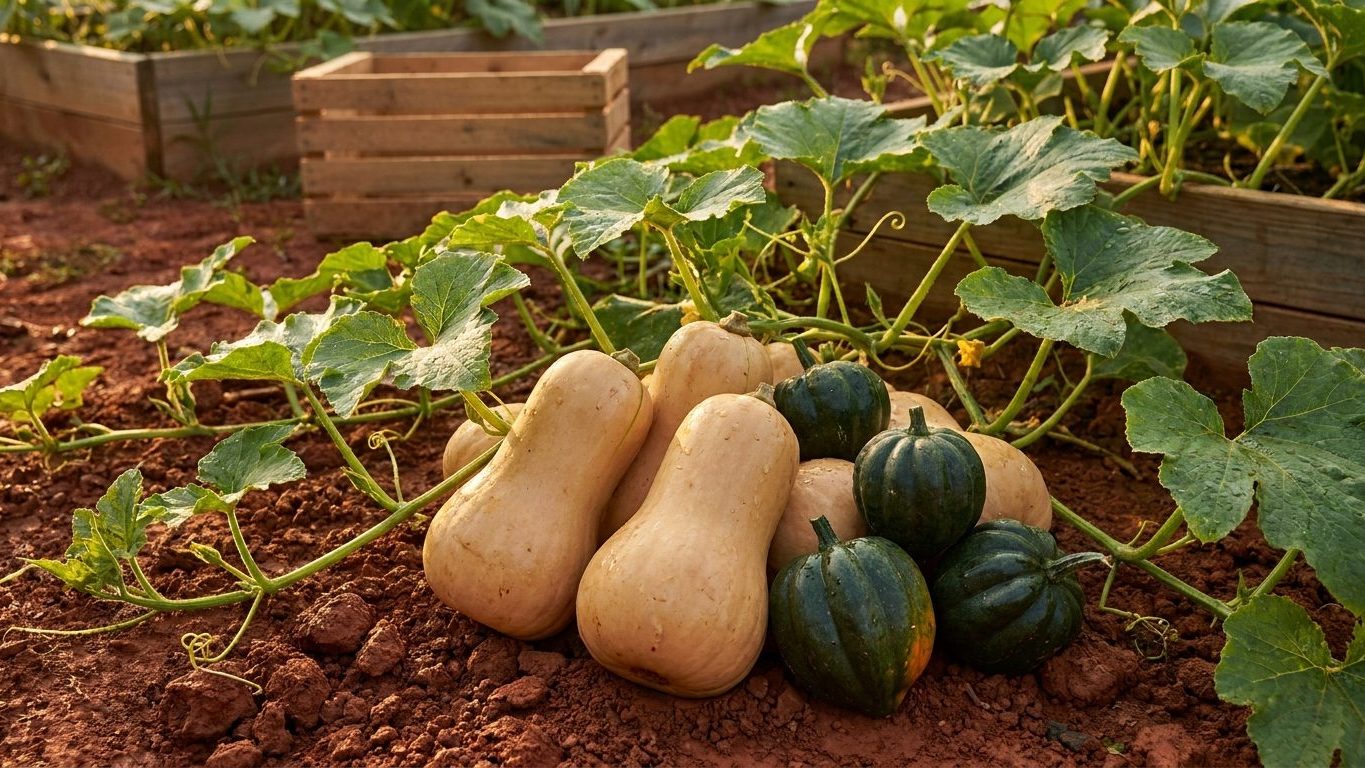

Fast-maturing winter squash varieties, the ones that finish in 80 to 95 days, are the safer bet across most of Arizona. The reason isn’t the calendar you’d expect. In the low desert, frost barely exists as a threat. What ends the squash season is heat, and it ends it for months at a time.
The short answer for Arizona
Arizona’s growing conditions split by elevation more than by frost date, and that split decides which winter squash type actually finishes a crop. In the low desert (Phoenix, Yuma, and similar elevations), the reference station data shows a frost-free stretch that NOAA classifies as 365 days in most years, with only 6 of the last 30 springs seeing a freeze at all. That sounds like an open invitation to grow anything. It isn’t. The same station logs 168.9 days a year at or above 90F, and that heat load is what actually limits winter squash, not cold.
Squash pollen loses viability and bees go inactive once daytime temperatures push past the mid-90s for weeks running, which is exactly the pattern from late May through September in the low desert. A slow variety needing 100 to 110 days to mature, planted at a normal spring date, walks straight into that wall before it sets fruit. The types that work are the ones that can flower, set, and size up before the heat locks the door: acorn, delicata, and spaghetti squash, most of which finish in 80 to 95 days. Planted very early in the year, they have a real shot at maturing before the worst of the heat arrives, or they can be timed as a fall crop planted once August heat starts easing.
Longer-season types, big Hubbard squash, large butternut, and most kabocha varieties bred for 100+ days, are a different story depending on where in the state you garden. At higher elevation, where summers run cooler and the growing window is longer in the mild months (spring through early fall, before hard freezes return), those slower varieties have more room to finish. The decision by type, then, comes down to this: short-season squash for the low desert, and only there does the choice between spring and fall planting timing really matter.
What will not work here

The clearest failure in Arizona winter squash growing is a slow variety planted on a normal spring timeline in the low desert. A 110-day Hubbard or a big storage-type butternut sown in March is still setting fruit, or trying to, in June and July, right as the region logs the bulk of its 168.9 annual days above 90F. Above roughly 95F for sustained stretches, squash flowers abort or the pollen simply doesn’t take. The plant survives. It just stops producing. Growers who see a full, healthy squash vine with no fruit on it in July are usually watching exactly this play out.
Watering on a weekly schedule
The second common failure is watering on a fixed weekly schedule, the habit that works fine in wetter states and falls apart here. Summer rainfall at the reference station averages about 1.9 inches across June, July, and August combined, out of 7.2 inches for the entire year. June is the driest month on record at just 0.02 inches, essentially nothing. July and August pick up slightly with the monsoon (0.91 and 0.93 inches), but that rain tends to arrive as short, hard thunderstorms that run off a dry, sun-baked bed rather than soaking into the root zone. A winter squash plant drawing water through 90-plus-degree days on a once-a-week watering routine is running a moisture deficit for most of that week, and fruit that does set often drops or stays small under that stress.
There’s a third, quieter failure worth naming: growers who assume the mild-winter reputation of Arizona means squash can be started almost any time of year in the low desert. It can’t. The window that avoids both the (rare) cold snap and the long heat wall is narrower than the frost-free label suggests, which is exactly why the timing decision matters more here than the frost date does. None of this applies evenly across the state. It’s a low-desert problem specifically, tied to that 168.9-day heat number, and it eases the higher and cooler you go.
What changes across Arizona
Arizona’s USDA hardiness zone range runs from 4b to 10b, according to the USDA Plant Hardiness Zone Map (2023, built on 1991-2020 averages). That is one of the widest zone spreads of any state in the country, built entirely on average annual extreme minimum temperature, which is the one variable that system measures. A spread that wide means there is no single planting answer for Arizona winter squash, only a range of answers depending on where in that 4b-to-10b span a given garden sits.
At the low end of elevation, the Phoenix-area conditions described above (zone 9b-10b range) are dominated by heat rather than cold, and the frost-free season effectively runs all year. At the high end, in places at zone 4b-6b elevation, the pattern flips: summers are milder, but hard freezes return in fall and can arrive again in spring, so the growing window is shorter and cold-driven rather than heat-driven. A slower winter squash variety that fails from heat in the low desert might actually have a fair shot at reaching maturity in that cooler zone, provided the season is long enough to carry it there. In between, mid-elevation gardens (Prescott, parts of the Verde Valley, and similar) sit in a middle zone where neither extreme dominates as strongly, and the safer fast-maturing types still tend to perform more reliably than a gamble on a 110-day variety.
None of the reference-station numbers used earlier in this piece describe those higher zones. They describe the Phoenix station specifically.
Where to check this for your own county
Arizona as a whole is described mostly on data from a single reference station in the low desert. A state-level answer is a starting point, not a final one, and a county-level recommendation from a local extension office will beat it every time, because it accounts for elevation, local soil, and the varieties that have actually been trialled nearby.
The University of Arizona Cooperative Extension is the state’s land-grant extension service, and its site is the right next step. Once there, two things are worth hunting down specifically. First, the local planting calendar for the reader’s own county, which will translate the heat-driven timing described above into actual planting weeks for that elevation, something this state-wide page can’t do precisely for every location from 4b to 10b. Second, any list of winter squash varieties that county agents have actually trialled in demonstration gardens or through master gardener programs nearby. Those lists tend to be built from real seasons of local performance, not from national averages, and they’ll say plainly if a variety that struggles in the low desert does fine two counties over at higher elevation.
A search for the county name alongside “master gardener” or “cooperative extension” from that main site usually surfaces the right local page. If a specific county page turns up nothing, the closest county with a similar elevation and similar summer heat pattern is a reasonable substitute; a fellow low-desert county’s data will generally transfer better to another low-desert garden than anything drawn from a mountain county, and the reverse holds too.
Checking this against your own garden
Every figure here is an average built from decades of station records. A reader’s own soil, own microclimate, and own timing will always outrank that average, and three simple observations tell more about a specific garden than any date on a calendar.
Soil warmth, checked by hand rather than by thermometer, is the first. Squash seed sitting in cool, still-damp spring soil will simply stall rather than rot, so a gardener who plants early and finds nothing happening after two weeks is usually reading a soil that hasn’t caught up with the air temperature yet, regardless of what the calendar says the date should allow.
The first flush of male flowers is the second thing to watch, and it usually shows up before the female flowers that actually set fruit. A vine blooming heavily with male flowers but no fruit-bearing females yet is not failing, it’s simply ahead of its own pollination window; that gap closes within a week or two in most conditions.
The first true leaves, the ones that emerge after the seed leaves and actually look like squash foliage, mark the point where the plant has moved past its most fragile stage. A garden where those true leaves are slow to appear, or emerge pale and thin, is usually signaling either a heat stress spike or a watering rhythm that isn’t matching that particular spot’s drainage and exposure, which is exactly the kind of local detail no state-wide page, including this one, can fully account for.