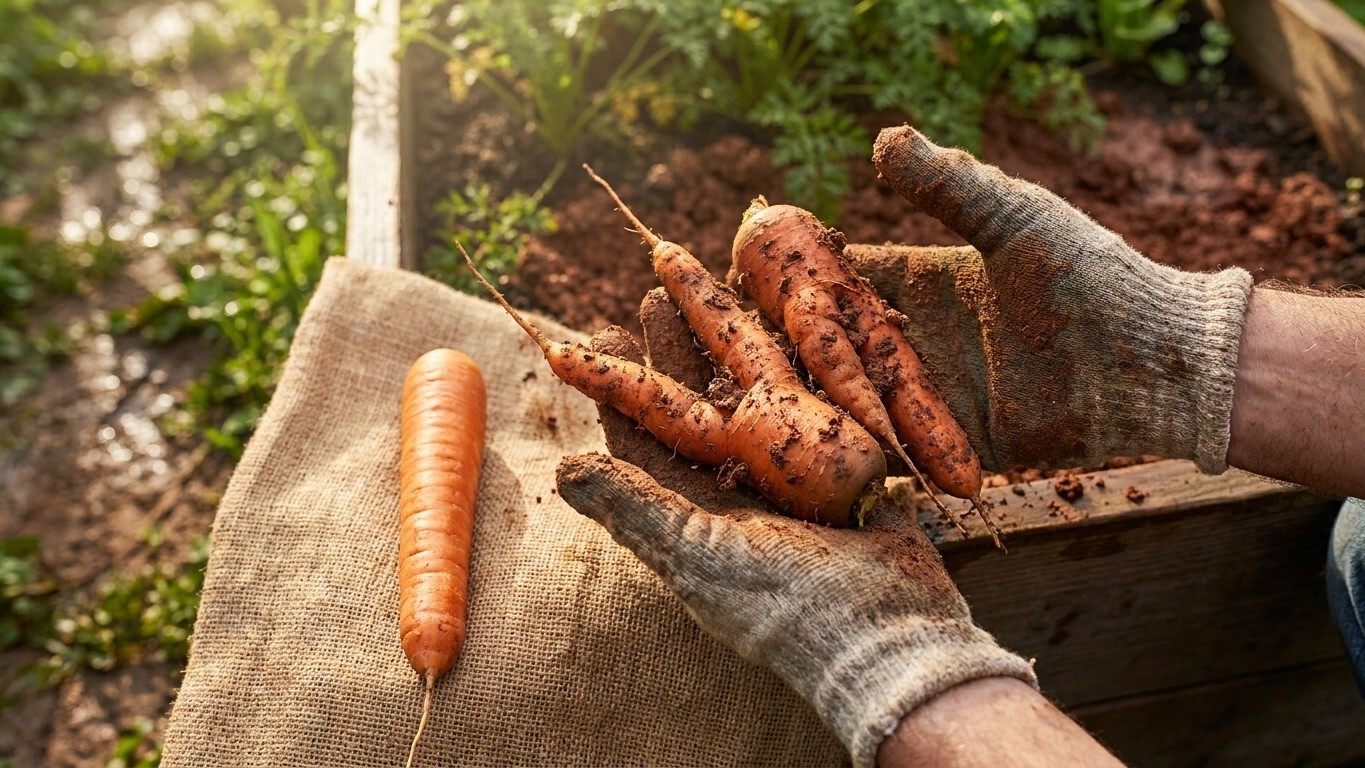

Arkansas gardeners sow carrots twice a year: a spring crop timed to slip into the ground as the last frost pulls back, and a fall crop counted backward from the first freeze of autumn. Both dates matter, but the calendar only gets you halfway there. The clay-heavy silt loam that covers much of the state does as much to decide whether that crop grows straight or forked as any date on a seed packet.
The short answer
Arkansas’s official state soil is the Stuttgart series, named by state law and studied by the USDA’s Natural Resources Conservation Service. It’s an Alfisol, the kind of forest soil that holds nutrients reasonably well but doesn’t drain especially fast. The surface layer runs 30 percent sand, 16 percent clay and 54 percent silt, with a surface pH around 5.6, slightly on the acid side, and organic matter sitting near 1.8 percent. The NRCS classifies it as somewhat poorly drained.
None of those numbers are good news for a carrot grown without amendment. Carrots want deep, sandy, well-drained soil rich in organic matter, according to Utah State University Extension. Heavy or rocky ground makes the root fork, splitting into two or three legs instead of growing down as one clean taproot. A silt loam with 16 percent clay and only somewhat poor drainage sits right in that danger zone. It’s not gravel-and-clay hardpan, but it’s dense enough, and wet enough in a rainy stretch, to push a carrot root sideways or split it around a compacted seam.
The fix isn’t a different carrot variety. Utah State’s extension office is blunt about it: heavy soil needs plenty of compost worked in, and it needs double digging, loosening the ground a full spade’s depth or more so roots meet no resistance going down. Gardeners who’d rather skip the digging build a raised bed instead, filling it with a loose, sandy, compost-rich mix that never touches the native clay underneath. Either approach solves the same problem, which is a root that can’t find a straight path down through dense ground.
One clarification before anyone grabs a shovel and assumes their yard matches this description. The Stuttgart series is the soil that represents Arkansas on paper, not the soil sitting under any one garden bed in it. The state maps hundreds of distinct soil series, and river bottoms, hill country, and any lot a builder graded or filled will read completely differently from these numbers. Treat this section as a starting point: it tells you what the region’s ground tends to do, hold water, run slightly acid, resist a taproot, and nothing more. The next step is finding out what’s actually under your own feet.
The test that settles it in your own garden
The Stuttgart figures describe a mapped average, not your raised bed or your side yard. Before picking a sowing date, spend twenty minutes finding out what you’re actually working with.
- Dig a hole at least a foot deep where you plan to sow. Carrots need loose ground for their full length, so a shallow test tells you nothing about what the root will hit six or eight inches down.
- Look at the depth of loose, dark topsoil before you hit a paler, denser layer or hardpan. A few inches of loose soil sitting on tight clay is exactly the setup that produces forked roots, no matter what the county’s official soil series says.
- Check for stones and buried debris as you dig. Roots that meet a rock or a chunk of old brick split around it the same way they split around compacted clay.
- Rub a handful of moist soil between your fingers. Sandy soil feels grainy and falls apart. Clay-heavy soil feels slick, sticky, and holds a shape when you squeeze it into a ball. Silt sits somewhere in between, smooth but not sticky.
- Fill the hole with water and time how long it takes to drain. Water that vanishes within a few hours points to fast-draining, sandy ground. Water that sits for the better part of a day signals the same somewhat-poor drainage the state soil survey records for Stuttgart, and it means raised beds or heavy compost aren’t optional extras, they’re the difference between a straight carrot and a forked one.
None of these steps require a lab, and none of them will hand you an exact pH number or a percentage breakdown the way a state soil survey does. What they will tell you, reliably, is whether your ground behaves like the state’s namesake soil or nothing like it at all, which is the only question that actually matters before seed goes in the ground.
What goes wrong here
- Forking in heavy, undug ground. A carrot root meeting compacted clay or a buried stone splits into two or three legs instead of growing straight down. The remedy is working in generous compost and double digging the bed a full spade’s depth before sowing, or skipping the native soil altogether and building a raised bed filled with a loose, sandy mix.
- Poor germination during a hot, dry stretch. Carrot seed is slow to sprout under the best conditions, and a crusted, dried-out surface layer, common on silt loam once it bakes in the sun, keeps seedlings from pushing through. Keeping the seedbed consistently moist until germination, with light, frequent watering rather than one heavy soak, gets seedlings up before the surface has a chance to crust over.
- Split roots from uneven watering later in the season. A dry spell followed by a heavy rain or a deep watering makes the root swell fast after weeks of slow growth, and the skin cracks under the sudden pressure. Watering on a steady schedule, rather than letting the bed dry out and then drenching it, keeps growth even and the root intact.
- Slow, stunted roots in soil low on organic matter. At around 1.8 percent organic matter, the state’s representative surface soil isn’t rich, and carrots grown in unamended ground often come up short and woody. Working compost into the bed before sowing, not after, addresses both the texture problem and the fertility problem in one step.
Common questions
Do I count the sowing date from seeding or from when I’d transplant carrot seedlings?
From seeding. Carrots are sown directly in the ground where they’ll grow; they aren’t started indoors and transplanted, because disturbing the taproot early causes exactly the forking and stunting a gardener is trying to avoid. The 70 to 100 days to maturity that Utah State University Extension cites run from the day seed goes into the soil, not from any later transplant date.
Does the state’s official soil mean my garden is automatically clay-heavy?
No. The Stuttgart series is a representative average drawn from surface soil across mapped components of that series, not a measurement of any individual garden. Arkansas holds hundreds of distinct soil series, and a home garden, especially one built on fill dirt, in a river bottom, or in hill country, can differ completely. Digging a test hole in your own bed tells you far more than the state figure does.
Is a raised bed always necessary, or does compost alone fix heavy soil?
It depends on how dense and how poorly drained the native ground is. Utah State University Extension lists both compost with double digging and raised beds as valid fixes for heavy soil that would otherwise fork a carrot root. If your drainage test shows water sitting for hours rather than draining within a couple of hours, a raised bed filled with a loose, sandy mix removes the guesswork; if drainage is only moderately slow, generous compost and thorough digging can be enough.
Why does organic matter around 1.8 percent matter for carrots specifically?
Carrots root deep and rely on loose, fertile soil the entire length of that root, so a soil that’s low in organic matter and heavier in clay resists the root at every inch rather than just at the surface. Utah State University Extension’s advice to work in plenty of compost addresses that fertility gap directly, loosening the structure while adding the nutrients thin, mineral-heavy silt loam doesn’t hold on its own.