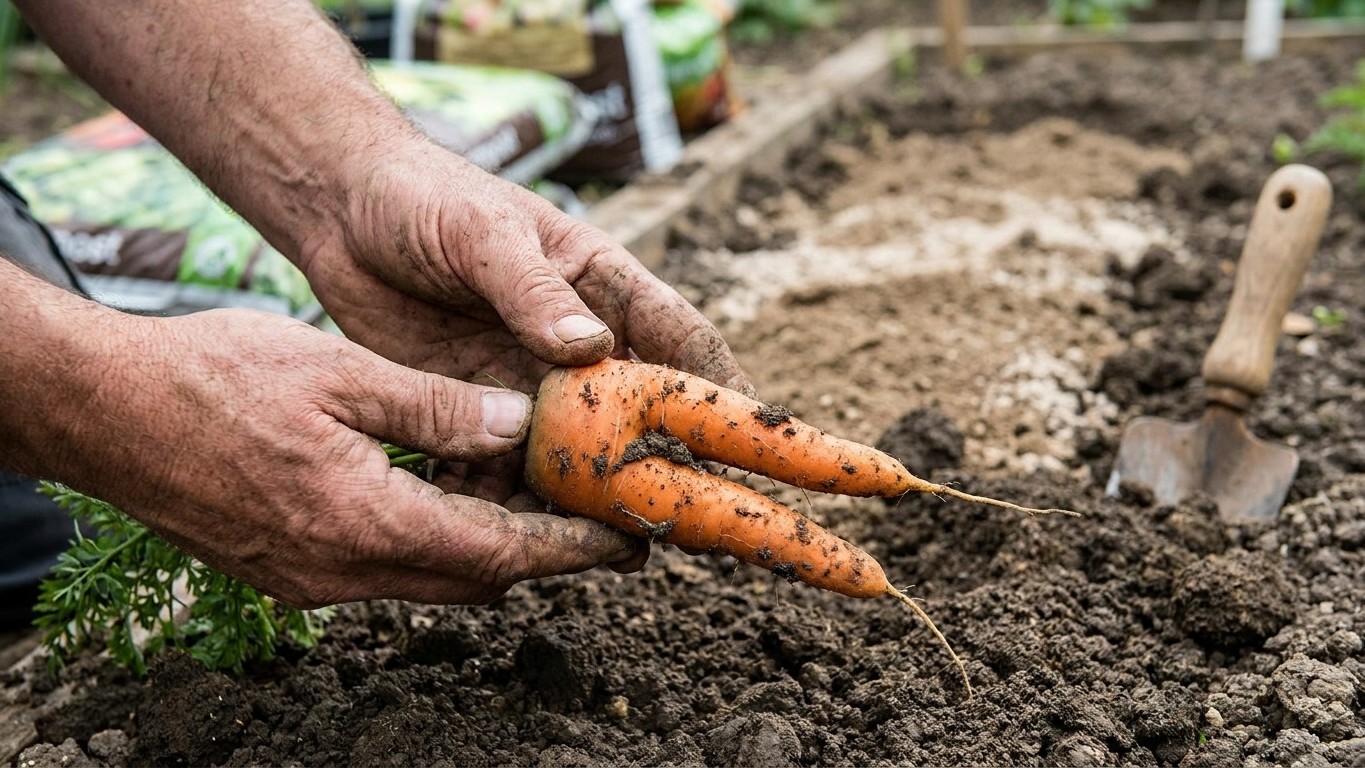

Arkansas’s official state soil, the Stuttgart series, is a slightly acid, silt-heavy ground that drains slowly, the kind of profile that pushes a carrot root sideways instead of straight down. The fix isn’t a different vegetable. It’s what you put under the seed row and how you water it once it’s up.
The short answer
The Stuttgart series, an Alfisol, is the soil Arkansas law named as its official state soil. Pulled straight from the surface horizon of its major components, the numbers read like this: 30 percent sand, 16 percent clay, 54 percent silt, a surface pH around 5.6, organic matter near 1.8 percent, and a drainage class described as somewhat poorly drained. That’s a loam-to-silt ground, forest-derived, that holds nutrients reasonably well but doesn’t let water move through it fast.
For a carrot, that combination is a mixed bag. The clay fraction at 16 percent isn’t extreme on its own, but paired with somewhat poorly drained conditions it means water sits longer than a taproot wants, and any compaction below the surface will turn a straight carrot into a forked one. Utah State University Extension is blunt about this mechanism: carrots want deep, sandy, well-drained soil rich in organic matter, and heavy or rocky ground makes the root fork. The question of Will Carrots Fork in Arkansas Soil? comes down to exactly this: where the Stuttgart-type profile runs heavier than that description, particularly in the tilled zone right under the seed, expect forking unless you change the bed before you sow.
The remedy Utah State names is direct: work in plenty of compost and double dig the bed, breaking up the compacted layer a foot or more down so the root has open ground to grow into. On a soil this silty, raising the bed 8 to 12 inches above grade does the same job faster, since it manufactures the depth and drainage the native ground doesn’t offer on its own. Either approach turns a soil that resists a straight taproot into one that will grow a decent carrot.
None of this is a diagnosis of your particular yard. The Stuttgart series is Arkansas’s representative soil, the one picked to stand for the state as a whole, but a state this size spans hundreds of mapped soil series, from river-bottom silt to hill-country clay to whatever a builder trucked in and graded flat before your house went up. Treat the numbers above as a starting point for what the region’s ground tends to do, not a reading of the dirt under your own tomato cage. Once your bed is prepped, pairing that soil work with When to Sow Carrots in Arkansas will round out your planting plan.
The test that settles it in your own garden
State soil data can’t tell you what’s six inches under your own raised bed or back forty. A short physical check will, and none of it requires a lab.
- Dig a hole a foot deep where you plan to sow. Note how far down you go before you hit a hard layer, a lens of clay, or a shelf of rock and gravel. Carrots need clear, loose ground to that depth or close to it; anything that stops a shovel cold at 6 or 8 inches is exactly the kind of obstruction that forks a root.
- Look at what comes out. Count visible stones and rock fragments in the spoil pile. A soil that’s mostly fine material with few stones gives a root nothing to deflect around. One full of gravel or broken rock will split or fork a taproot almost every time.
- Feel the texture. Take a moist handful and rub it between your fingers. Gritty and loose means sand. Sticky, slick, and able to roll into a ribbon means clay. Something silky in between, that won’t quite ribbon but isn’t gritty either, is closer to silt loam, the general family the Stuttgart series sits in.
- Watch how water drains. Fill the hole with water and time how long it takes to disappear. Water still standing after several hours points to a somewhat poorly drained profile working against you, the same trait recorded for the Stuttgart series. Water gone quickly points to a lighter, faster-draining soil that needs less amending, maybe just a compost topdressing.
Run all four checks before you commit a full row of carrot seed to a bed. It’s a fifteen-minute job that tells you more about your carrots’ odds than any state soil chart can.
When to sow here
Carrots go into the ground as seed. There’s no transplant date to count from and no seedling tray involved; every day of the 70 to 100 days most carrot varieties need to mature starts the moment the seed goes into the row, not later.
- Start with the last spring frost. NOAA NCEI’s 1991-2020 Climate Normals put Arkansas’s last spring freeze, using the 32 F threshold, somewhere between March 12 and March 28, depending on where in that window your particular spring falls.
- Count back two to three weeks. Carrot seed tolerates cool soil better than most root crops, which is why it goes in ahead of frost rather than after it. Two to three weeks before March 12 lands in the second half of February; two to three weeks before March 28 lands in early to mid-March. Together that gives a sowing window running roughly from late February through mid-March, depending on how early or late your spring is running.
- Check the soil temperature before you trust the calendar. Carrot seed needs the ground at 40 F at minimum to germinate at all. A cold snap after a warm stretch can push soil back below that line even inside the calendar window, so a simple soil thermometer pushed a couple of inches down is worth more than guessing from the date alone.
- Aim for the temperature range where germination actually performs best. That’s 55 to 65 F. Soil sitting in the low 40s will eventually sprout carrot seed, but slowly and unevenly; soil in the mid-50s to mid-60s gets you a faster, more uniform stand.
None of this hinges on a transplant date, because there isn’t one. Every week you sow late past that window is a week added directly onto the 70 to 100 days before harvest, pushing a spring crop uncomfortably close to summer heat.
What goes wrong here
- Forked roots in heavy or compacted ground. This is the failure the Stuttgart-type profile sets up directly: 16 percent clay and somewhat poorly drained conditions resist a straight taproot. Utah State University Extension’s answer is to work in compost and double dig the bed before sowing, or to build a raised bed that gives the root open, loose ground instead of a compacted native layer.
- Poor or patchy germination during a hot spell. Carrot seed’s best performance window is 55 to 65 F. A late-spring heat spike that pushes soil well above that range slows and thins germination even when the calendar date looked right. Watering the row lightly to keep the surface from crusting and drying out during a hot stretch helps seed that’s already down get through it.
- Splitting from uneven watering. Roots that grow through a dry stretch and then get a heavy soak swell fast and crack. The remedy is steady, even moisture through the whole growing period rather than an occasional deep watering after the bed has been allowed to dry out.
- Slow, stunted growth in poorly drained beds. Somewhat poorly drained ground holds water around the root longer than carrots want, which can stall growth even without outright forking. A raised bed or added organic matter that lightens the soil structure addresses this at the same time it addresses forking, since both problems trace back to the same underlying drainage issue.
Checking this against your own county
State-level soil data and climate normals describe the general pattern, not the bed you’re about to plant. For a reading specific to your county, whether that’s a river-bottom garden in the Delta or a hillside plot in the Ozarks, the University of Arkansas Division of Agriculture Cooperative Extension Service is the resource to contact directly at uaex.uada.edu. County extension offices can point you toward local soil testing and give guidance calibrated to your part of the state rather than the statewide average this page is built on.
Common questions
Does the Stuttgart series mean every Arkansas garden has clay problems?
No. It’s the soil chosen to represent Arkansas as a whole, drawn from surface data for its major mapped components. Your own garden could sit on a completely different series, especially near a river or on ground that’s been graded or filled.
Can I sow carrots before the soil check confirms good drainage?
You can, but on a soil that tests as somewhat poorly drained or slow to shed standing water, sowing without amending first raises the odds of forked or stunted roots. Doing the drainage check before committing seed to the ground is the cheaper fix.
Why does the sowing window matter more than a fixed calendar date?
Because the actual trigger is soil temperature, not the date on a calendar. The 40 F minimum and the 55 to 65 F best range are what carrot seed responds to, and a particular spring can run warmer or colder than the March 12 to March 28 frost normal in either direction.
Is a raised bed always necessary on heavy Arkansas soil?
Not always. Double digging with generous compost worked in can achieve the same loose, deep root zone that a raised bed provides. A raised bed is simply the faster route when the native ground is compacted or drains slowly across a wide area.