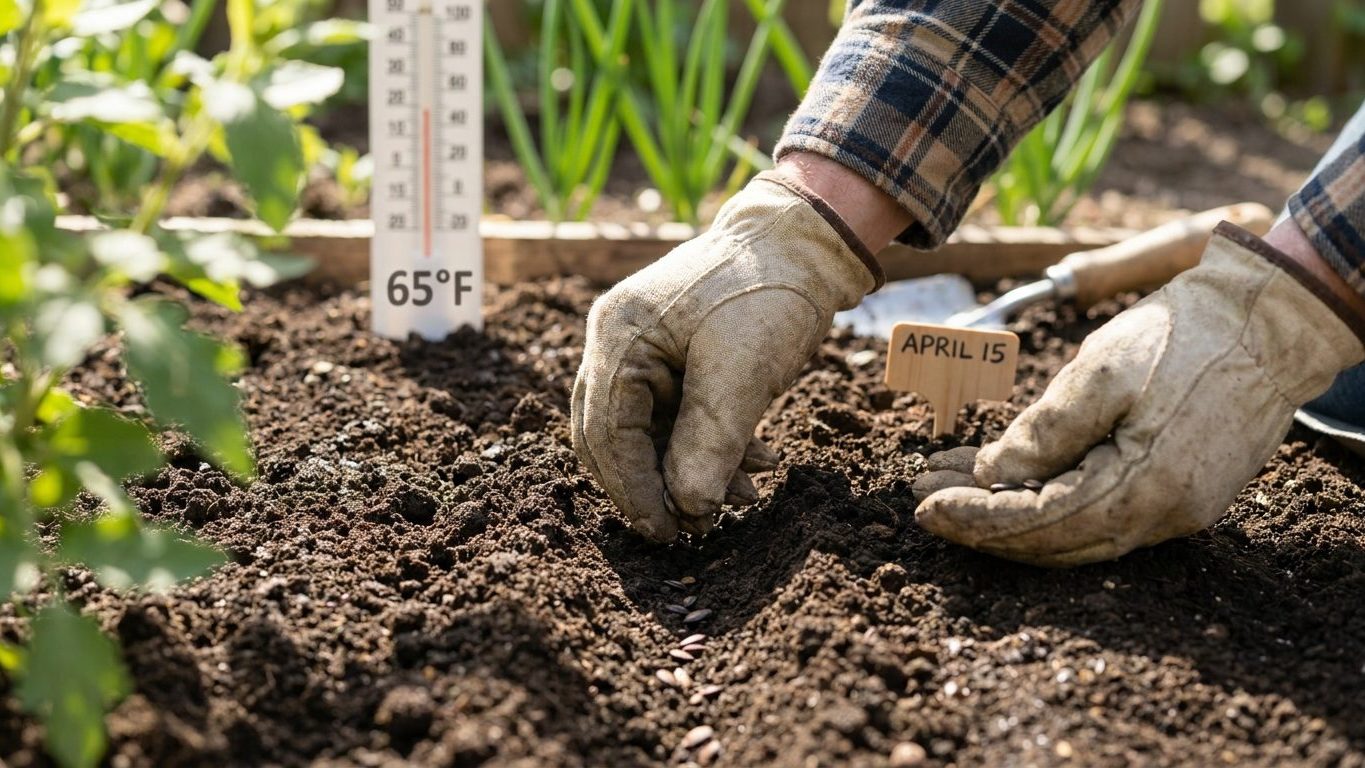

Arkansas melon growers get one direct answer: wait until April 3, the state’s average last light-frost date, before seeding or transplanting outdoors. That date comes from the National Weather Service’s 36-degree threshold for Little Rock, not the 32-degree freeze window sometimes quoted for spring. Melons stay frost-tender their whole life, so the lighter frost line is what actually protects them. Push earlier and a stray cold night can wipe out a bed overnight.
The short answer for Arkansas
Two different frost dates float around for Arkansas, and mixing them up is where most spring melon losses start. NOAA’s 1991-2020 climate normals put the 32-degree freeze probability window at March 12 to March 28, a band where the odds of hitting a hard freeze on any given day run between 30 and 70 percent. That number gets quoted often, but it describes a hard freeze, not the frost that kills a melon seedling. The National Weather Service office in Little Rock tracks a lighter, 36-degree threshold separately, and lands on April 3 for spring and October 31 for fall. Melons need the 36-degree dates, because a light frost well above the 32-degree mark still collapses their leaves.
That puts the safe outdoor window at roughly April 3 through October 31, about 211 days from first plant-safe date to first fall risk. No melon variety grown in home gardens needs anywhere close to that much time; even long-season watermelons typically mature in 80 to 100 days from seed. Season length is not the constraint in Arkansas. The state’s real advantage shows up in a different number: an average of 69.2 days a year reach 90 degrees or hotter, based on the Little Rock reference station’s 1991-2020 normals. Melons are heat-loving plants, and that many 90-degree days is exactly the kind of summer that pushes vines to set fruit fast and sugar up well.
So the short answer holds together as one calendar: seed or transplant after April 3, expect vigorous growth through a hot summer, and finish harvest well ahead of the October 31 light-frost mark. Gardeners who want a second, later planting for a fall crop still have room, since even a 70-day variety seeded in early July finishes by mid-September, more than a month before that fall threshold arrives.
What will not work here

The most common failure in Arkansas melon patches isn’t running out of season, it’s starting too early. Seeding into soil that’s still cold in late March, before the April 3 light-frost date has passed, either rots the seed outright or produces a weak seedling that a following cool night finishes off. The 32-degree band ending March 28 tempts people into thinking the frost risk is over a week earlier than it actually is for tender crops. It isn’t, at least not for something as frost-sensitive as a melon.
The second failure mode shows up in mid-summer, and it’s a watering mistake. With 69.2 days a year hitting 90 degrees or higher, evaporation demand on melon vines is steady and heavy from June through August. Summer rainfall averages about 10 inches across June, July and August combined, but August itself, the driest of the three at 3.16 inches, often leaves a multi-week gap between rain events right when fruit is sizing up. A weekly watering schedule built for a milder climate simply doesn’t keep pace; vines that dry out during fruit set produce smaller melons or drop fruit altogether.
Crowding and humidity
The third failure is spacing plants too close together. Arkansas summer rain doesn’t arrive as gentle, steady showers, it tends to come as thunderstorms, and a lot of that water runs off rather than soaking in, especially on compacted soil. What lingers instead is humidity on the leaf surface. Dense plantings that block airflow between vines trap that moisture, and powdery mildew and other fungal problems move fast through a humid, crowded melon patch during an Arkansas summer. Wider spacing than a seed packet from a drier state might suggest is not overcaution here, it’s a direct response to how the region’s rain actually falls.
What changes across Arkansas
Arkansas is not one climate, and the USDA Plant Hardiness Zone Map makes that clear: the state spans zone 6b in the highest parts of the Ozarks down to zone 8a in the southern lowlands. That’s the USDA system, built strictly on average annual extreme minimum winter temperature, and a spread of nearly two full zones inside one state’s borders means there is no single frost date that fits everywhere. The dates cited above, tied to the Little Rock reference station, describe the middle of that range reasonably well but understate how much earlier a southern Delta garden can often start, and how much later a highland garden in the north often needs to wait.
A gardener working land in the cooler, higher-elevation stretches of northern Arkansas should treat April 3 as an optimistic floor, not a guarantee, and lean toward the later side of any planting recommendation until local conditions confirm the soil has warmed. Someone gardening in the warmer southern part of the state, closer to zone 8a conditions, may find the ground workable and frost risk gone somewhat earlier than the state-wide date suggests. Neither adjustment is guesswork exactly, but neither is precise without knowing which zone applies to a specific piece of ground.
The right move is checking the current USDA Plant Hardiness Zone Map directly against a home address, rather than assuming which end of the 6b-8a range applies. Zone alone doesn’t set a planting date either, but it’s the first filter for deciding whether to trust the state average as written or shift it in either direction.
Where to check this for your own county
A state-wide frost date is a starting point, not a finish line, and county-level guidance from the University of Arkansas System Division of Agriculture’s Cooperative Extension Service consistently narrows things further. Their site publishes county-specific planting guidance built by agents who work with growers in that exact area, not a single average pulled from one reference station across the whole state.
Two things are worth searching for once there. First, the local vegetable planting calendar for the county, which typically adjusts spring planting windows based on that county’s own frost history rather than the statewide 32-degree or 36-degree normals cited here. Second, any list of melon varieties the local extension office has actually trialled in that county’s soil and climate. Variety performance varies with local disease pressure, especially fungal problems tied to humidity, and an extension agent who has watched several seasons of trial plots in a specific county knows which varieties held up and which struggled, in a way a state-wide page cannot.
None of this replaces the state-level picture built here. It sharpens it. A county recommendation, built from local frost records and local variety trials, will always outperform a state average for the simple reason that it’s describing a smaller, more specific piece of ground.
Checking this against your own garden
Every date above is a normal, an average built from three decades of weather records at one reference station. A reader’s own garden, on a specific slope, in specific soil, with its own drainage and sun exposure, can run a week or two ahead of or behind that average in either direction. Three direct observations settle the question better than any calendar.
- Soil warmth by feel: press a bare hand or knuckle into the planting bed a few inches down. Cold, clammy soil, even weeks after the calendar date has passed, means local conditions are running behind the regional average and seed will likely sit and rot rather than germinate.
- The first flush of male flowers: melon vines produce male flowers before female ones, often by a week or two. Their appearance signals the plant has moved past early establishment and into active growth, a sign the local season has genuinely warmed up around that particular vine.
- The first true leaves: the rounded seed leaves that emerge first aren’t the plant settling in, the first true leaf with the jagged melon-vine shape is. Seedlings that reach that stage without frost damage have cleared the riskiest early window for that specific spot in the yard.
Watching those three signs on one’s own ground does what no state or county calendar can: it reports on the microclimate actually growing the melons, not the one thirty years of station data describe.
Some gardeners also time melons by the Moon: when to plant watermelon and cantaloupe by the moon, as almanac tradition rather than fact.