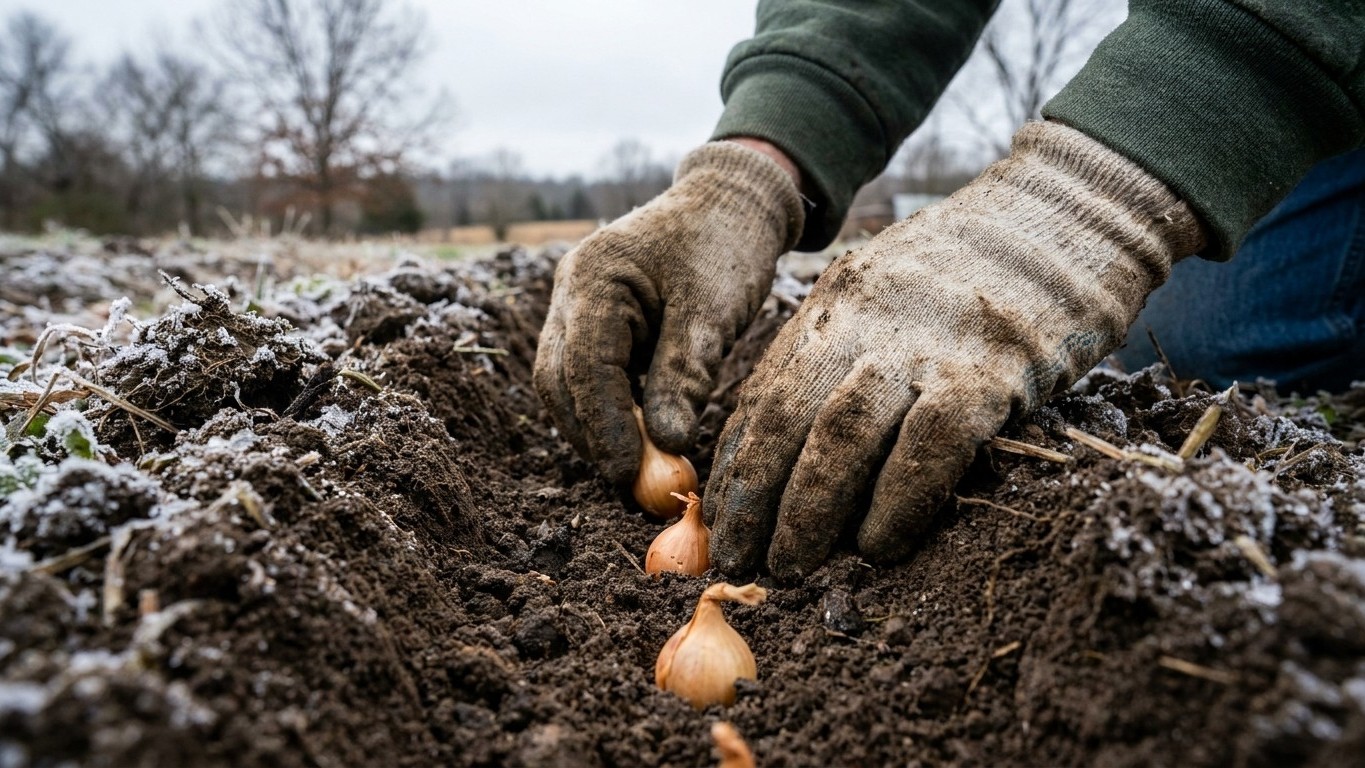

In most of Arkansas, onions go into the ground in late winter, from mid-January through March, and in the southern half of the state, fall planting works as well. That timing traces back to Little Rock’s 34.73 degrees north latitude and its 14 hours and 20 minutes of daylight on the longest day of the year, figures that place the whole state in short-day and intermediate-day onion territory rather than the long-day zone gardeners in the northern United States rely on.
The short answer for Arkansas

An onion doesn’t decide to bulb because the weather warms up. It bulbs when the day gets long enough to flip a switch inside the plant, and that threshold is different for every variety. Short-day types start bulbing once the day reaches about 12 hours, so they trigger early in the year almost anywhere. Long-day types wait for 14 to 16 hours of daylight, a length Arkansas’s 14 hours and 20 minutes only barely touches at the very top of the range, and never sustains. That’s why Arkansas gardens run on short-day and intermediate-day onions, planted early enough that the bulb has weeks of leaf growth behind it before the trigger hits.
In practice, that means sets or transplants going in from mid-January through March across most of the state, with the southern counties, closer to the Louisiana line, mild enough to plant in October and let the onions overwinter as small plants that resume growth in spring. Twelve varieties documented on this site have a published latitude range that covers Little Rock’s 34.73 degrees north, which makes them a reasonable starting point for Arkansas gardens:
- Candy (intermediate-day, 33-40N)
- Elsye (intermediate-day, 32-45N)
- Expression (intermediate-day, 32-45N)
- Gabriella (short-day, 20-35N)
- Madalyn (short-day, 20-35N)
- Red Rock (short-day, 30-36N)
- Red Sensation (short-day, 25-35N)
- Scout (intermediate-day, 32-46N)
- Sierra Blanca (intermediate-day, 32-45N)
- Texas Grano 1015Y (short-day, 25-35N)
- Vidora (short-day, 25-35N)
- White Castle (short-day, 30-38N)
None of these are exotic choices. They’re simply matched to a state where the sun never gives the plant more than about 14 hours and 20 minutes to work with, even at the summer solstice.
What will not work here
Planting a long-day onion in Arkansas isn’t a matter of getting a smaller bulb. It’s a matter of getting no bulb at all. These varieties need 14 to 16 hours of daylight to receive the signal that tells them to stop making leaves and start storing sugars underground. Arkansas’s longest day tops out at 14 hours and 20 minutes, and for a variety that needs the upper end of that range, the trigger simply never arrives. The plant keeps pushing out leaves through the whole season, then the cold arrives, and the bulb that never formed rots in the ground. Thirteen varieties documented on this site fall into that category for a garden at Little Rock’s latitude:
- Ailsa Craig (long-day, 38-60N): needs day length Arkansas summers never reach
- Barolo (long-day, 38-55N): same problem, no bulb trigger this far south
- Blush (long-day, 38-55N): leaves all season, no bulb
- Frontier (long-day, 40-50N): requires day length well above Arkansas’s maximum
- New York Early (long-day, 38-50N): bred for a day length this state doesn’t have
- Patterson (long-day, 38-55N): trigger threshold out of reach here
- Powell (long-day, 43-47N): a northern-belt variety, far outside this range
- Red Carpet (long-day, 40-45N): won’t bulb at this latitude
- Red Long of Florence (intermediate-day, 38-50N): its lower bound still sits above 34.73N
- Redwing (long-day, 43-65N): built for far-northern summers
- Rossa di Milano (long-day, 38-50N): no trigger, no bulb
- Safrane (long-day, 42-50N): well beyond Arkansas’s daylight ceiling
- Talon (long-day, 42-50N): same story, wrong latitude entirely
Timing makes a second, quieter mistake possible even with the right variety. Planting late doesn’t push the harvest back. It shrinks it. Whatever size the plant has reached when day length crosses its bulbing threshold is the size the bulb will be, permanently. A short-day onion set out in March instead of January doesn’t bulb three weeks later with the same result. It bulbs on schedule, dictated by the calendar and the sun, at whatever size it managed to reach. A late start means a small onion, not a delayed one.
What changes across Arkansas
Arkansas isn’t a single point on a map. The state runs roughly from the Louisiana border near 33 degrees north up to the Missouri line above 36 degrees north, a spread of more than three degrees of latitude. Little Rock, where the figures on this page come from, sits close to the middle at 34.73 degrees north, so most of the state tracks its numbers reasonably well. The far edges are a different story.
A gardener near the southern border gets a slightly shorter longest day than Little Rock and a milder winter, conditions that favor fall planting and lean the variety mix even further toward short-day types. A gardener near the northern border, closer to 36 degrees north, sees a bit more daylight at the solstice and a harsher winter, which nudges the picture toward the intermediate-day varieties and puts a handful of borderline choices into play.
| Location | Approximate latitude | What it changes |
|---|---|---|
| Southern Arkansas | ~33N | Milder winters, fall planting more reliable, short-day varieties favored |
| Little Rock (reference city) | 34.73N | Baseline for this page’s figures |
| Northern Arkansas | ~36.5N | Slightly longer summer days, colder winters, intermediate-day varieties safer bet |
Six varieties documented on this site sit within a degree and a half of their published range boundary at Little Rock’s latitude, which puts them in a genuine gray zone rather than a clear yes or no: Bridger (long-day, 35-50N), Cabernet (intermediate-day, 35-45N), Calibra (intermediate-day, 35-45N), Monastrell (intermediate-day, 35-46N), Red Long of Tropea (intermediate-day, 35-48N), and Walla Walla Sweet (long-day, 35-55N). A gardener in the northern counties, closer to that 35-degree line, is the one worth experimenting with these, not someone gardening near the state’s southern edge.
Sweet now, or onions that last
Arkansas gardens face a real trade-off, and it isn’t a matter of taste alone. It’s chemistry. The compounds that give an onion its sharp bite are volatile sulfur compounds, and those same compounds are what protect the bulb once it’s in storage. A variety bred to be sweet has fewer of them, which is exactly why it tastes mild raw and exactly why it won’t keep past a few weeks in the pantry. University of Missouri Extension puts it plainly: “As a rule, ‘sweet’ onions do not store as well as the more pungent types.”
This lines up with the day-length picture already laid out. Short-day varieties, the ones that dominate Arkansas gardens, tend to run sweet. Intermediate-day varieties like Candy, Scout, or Elsye sit a little further toward the pungent, longer-keeping end, without reaching the storage life of a true long-day onion grown in the northern states.
What that means for an Arkansas kitchen is straightforward. Onions harvested in late spring or early summer from short-day varieties are best eaten fresh, in salads and on the grill, within a month or two of harvest. If the goal is onions still good in March, the better bet among what actually bulbs here is one of the intermediate-day types, and even then, expect a shorter storage window than a gardener in Minnesota or Montana gets from a long-day variety. Arkansas gardens are built for eating onions soon, not stockpiling them.
Checking this against your own garden
Everything above is built on Little Rock’s numbers, and Little Rock is not every backyard in Arkansas. A few checks take the guesswork out before the sets go in the ground:
- Look up your own latitude if you garden well north of Little Rock or south toward the Louisiana line. A few degrees changes which variety group fits.
- Check your local frost dates before committing to a fall or a late-winter planting window. These vary by county and aren’t the same statewide figure everywhere in Arkansas.
- Contact your county extension office, part of the University of Arkansas System Division of Agriculture, for planting dates calibrated to your specific county rather than a statewide average.
- Note whether your garden sits in a low spot or a frost pocket, since local microclimates can shift effective planting windows by a week or two even within the same county.