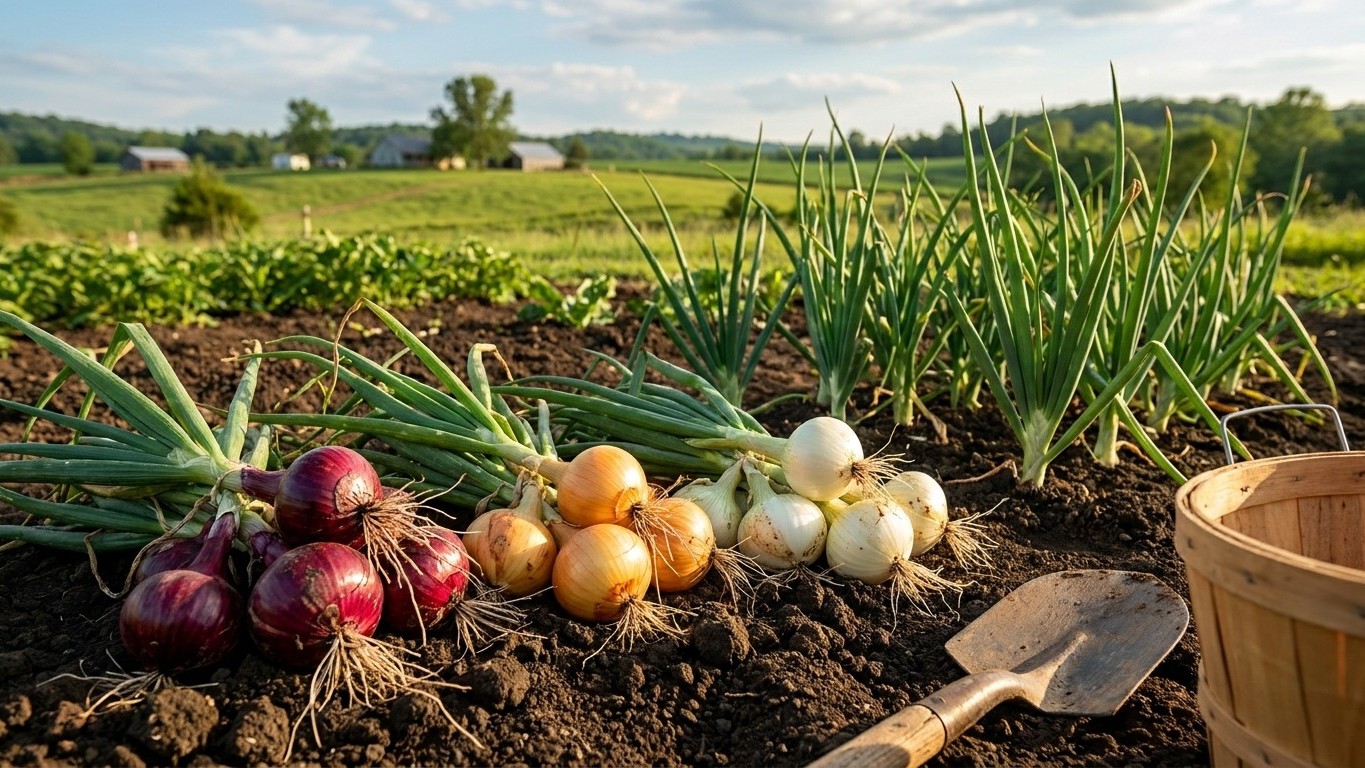

Arkansas sits almost exactly on the line where short-day onions stop being the only option and intermediate-day varieties start pulling their weight. At 34.73 degrees north, the reference city gets 14 hours and 20 minutes of daylight on the summer solstice, enough to trigger bulbing in both groups but nowhere near enough for the long-day onions sold for northern gardens. That single number is what decides which bag of onion sets belongs in your garden.
The short answer for Arkansas

Onions do not bulb because the weather warms up. They bulb because the day gets long enough, and the trigger is a fixed number of daylight hours written into each variety. Short-day types start switching from leaf growth to bulb growth at around 12 hours of daylight, according to Clemson Cooperative Extension. Long-day types wait for 14 to 16 hours before they even begin. At 34.73 degrees north, the reference city never gets past 14 hours and 20 minutes, even on the longest day of the year. That ceiling is what makes Arkansas a short-day and intermediate-day state, full stop.
Twelve documented varieties on this site have a published latitude range that actually covers 34.73 degrees north, which means they are built for exactly this kind of day length:
- Short-day: Gabriella, Madalyn, Red Rock, Red Sensation, Texas Grano 1015Y, Vidora, White Castle
- Intermediate-day: Candy, Elsye, Expression, Scout, Sierra Blanca
A few of those, Gabriella, Madalyn, Red Rock and White Castle among them, don’t have a dedicated page on this site yet, but their catalogue ranges place them squarely in Arkansas territory all the same. Either group will bulb reliably here. The short-day varieties tend to size up earlier and run sweeter; the intermediate-day ones take a bit longer and hold their shape better in storage. Which one to favor comes down to whether you want onions to eat this summer or onions to keep past Thanksgiving, a question the next two sections answer in more detail.
What will not work here
Long-day onions are bred for latitudes where summer days stretch well past what Arkansas ever sees. Plant one anyway and it does not sulk or “struggle.” It grows leaves all season long, because the day length it’s waiting for never arrives, and then it rots in the ground or in storage without ever forming a real bulb. Thirteen varieties documented on this site have published ranges that start above Arkansas’s latitude and have no business in an Arkansas garden:
- Ailsa Craig, a long-day type built for 38 to 60 degrees north, well past anything Arkansas’s daylight can trigger.
- Barolo, long-day, 38 to 55 degrees north.
- Blush, long-day, 38 to 55 degrees north.
- Frontier, long-day, 40 to 50 degrees north.
- New York Early, long-day, 38 to 50 degrees north.
- Patterson, long-day, 38 to 55 degrees north.
- Powell, long-day, 43 to 47 degrees north, a narrow window nowhere near Arkansas.
- Red Carpet, long-day, 40 to 45 degrees north.
- Red Long of Florence, an intermediate-day variety, but its 38 to 50 degree range still starts north of anything Arkansas offers.
- Redwing, long-day, 43 to 65 degrees north, essentially a northern-tier and Canadian-border variety.
- Rossa di Milano, long-day, 38 to 50 degrees north.
- Safrane, long-day, 42 to 50 degrees north.
- Talon, long-day, 42 to 50 degrees north.
None of these need to be on your seed order this year. If a catalog photo or a neighbor’s recommendation tempts you toward one, remember what you’re actually buying: a plant that will occupy garden space all summer and give you nothing but a rotten stub in September.
What changes across Arkansas
The 34.73 degree figure belongs to the reference city, not to the whole state. Arkansas stretches roughly from the Louisiana line near the 33rd parallel up to the Missouri border above the 36th, which means a gardener in the Delta and a gardener in the Ozarks are not gardening at the same latitude, even though both live in Arkansas.
| Location | Approx. latitude | What it changes |
|---|---|---|
| Southern Arkansas (near the Louisiana border) | ~33°N | Short-day varieties are the safer bet; intermediate-day types are still workable but closer to their own lower edge. |
| Reference city (station USW00013963) | 34.73°N | Both short-day and intermediate-day varieties bulb reliably, as described above. |
| Northern Arkansas (near the Missouri border) | ~36.5°N | The blurred zone opens up: some intermediate and even a couple of long-day varieties come into range, though at the edge of what they’re bred for. |
That northern edge is worth naming specifically. Six varieties documented on this site fall within a degree and a half of a published boundary, which puts them in a genuine gray zone rather than a flat yes or no: Cabernet, Calibra, Monastrell and Red Long of Tropea (all intermediate-day, 35 to 45 or 46 degrees north), plus Bridger and Walla Walla Sweet (long-day, starting at 35 degrees north). A gardener in Bentonville or Fayetteville sits close enough to that 35-degree line that these may bulb, especially in a season with an early, warm spring that lets the plant put on size before daylight peaks. A gardener in El Dorado, closer to 33 degrees, should treat those same six as off the table and stick with the short-day list instead.
Sweet now, or onions that last
The flavor of an onion and its shelf life are not two separate traits you can pick and choose. They come from the same chemistry. The volatile sulfur compounds that make an onion sting your eyes and bite your tongue are the same compounds that fight off rot in storage. University of Missouri Extension puts it plainly: “As a rule, ‘sweet’ onions do not store as well as the more pungent types.” Fewer sulfur compounds means a milder onion on the cutting board and a shorter life in the pantry.
This lines up with the day-length split already at work in Arkansas. Short-day varieties like Texas Grano 1015Y, Vidora and White Castle run sweet and mild, wonderful sliced raw in July, but they are not onions you tuck away for winter. Intermediate-day varieties like Candy, Scout and Sierra Blanca carry more of that sulfur bite and, as a direct result, hold up longer in a cool, dry spot.
Picture your pantry in March. A southern Arkansas garden built entirely on short-day sweets will likely have nothing left, those onions were eaten, given away or composted by midwinter. A garden that leaned on intermediate-day varieties instead still has onions on the shelf, sharper than they were in August but still usable. Neither approach is wrong. It’s a genuine trade, sweetness now against onions that last, and Arkansas’s spot on the map lets you plant for either one.
Checking this against your own garden
Every figure in this article traces back to one weather station and one city. If you garden near Little Rock, the numbers apply directly. If you garden near the state line in either direction, treat them as a starting point rather than a guarantee, and check the following before you commit a whole bed to one variety:
- Look up the latitude of your own town or county, not just “Arkansas” as a whole, especially if you’re within an hour of the Missouri or Louisiana border.
- Ask your county extension office for local frost dates; day length decides bulbing, but frost dates decide when you can safely get plants or sets in the ground.
- If you’re in the northern tier of the state, note whether your last few springs ran early or late, since a slow, cool spring gives blurred-zone varieties less time to size up before daylight peaks.
- Check the elevation of your specific site; the Ozark and Ouachita highlands can run measurably cooler than the Delta at the same latitude, which shifts your planting window even when day length stays identical.
- Contact the University of Arkansas System Division of Agriculture’s cooperative extension service for county-level onion recommendations built on soil and climate data from your area, not just a statewide average.