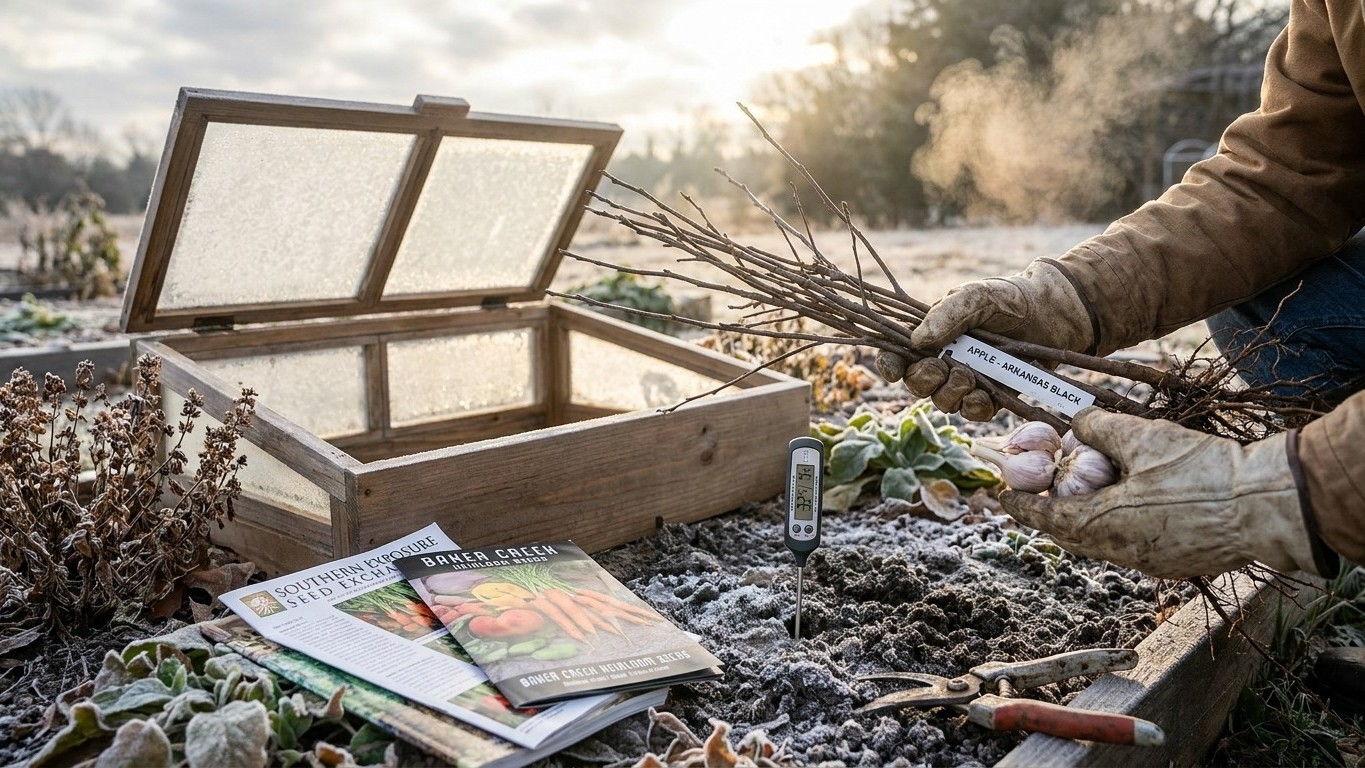

December in Arkansas sits deep inside the dormant season, weeks past the first fall frost and months short of the last one in spring. The direct answer: skip the open vegetable bed unless you’re finishing garlic or shallots, and put the month’s energy into cold frames, bare-root plantings, dormant pruning, and ordering seed before the good varieties disappear from catalogs.
What goes in the ground in December

Soil temperature, not the page on the calendar, decides what survives a December planting in Arkansas. The state’s last spring frost window runs from March 12 to March 28, and the first fall frost lands between November 7 and November 20, based on NOAA’s 1991-2020 climate normals for the 32°F freeze threshold at station USW00013963. December falls well after that fall date, in the coldest stretch before the ground even begins to warm toward spring. Air temperature can feel mild on a sunny afternoon, but the soil several inches down stays cold for weeks, and that’s what a seed or root actually feels.
Arkansas spans USDA hardiness zone 6b to 8a, a range that covers a lot of ground. The Ozark and Ouachita highlands in the northwest run colder and often have frozen or waterlogged soil by this point. The Delta and the southern part of the state stay workable more often, which matters because that single variable, the average annual extreme minimum temperature, is what the USDA zone system actually measures.
The honest answer is that open-ground planting is limited this month. But limited isn’t zero. Here’s what’s realistic:
- Garlic and shallots, if the ground hasn’t frozen solid and is still diggable with a trowel
- Bare-root fruit trees, roses, and cane fruits, planted while fully dormant so the roots settle before spring growth demands water
- Cold frames or low tunnels over hardy greens already in the ground, extending harvest rather than starting anything new
- Rhubarb crowns or chicory roots, dug and moved to a dark, cool spot indoors to force tender growth without any outdoor exposure at all
Everything else on the tender end of the spectrum, tomatoes, beans, squash, corn, has no business in Arkansas soil this month. That’s not a gap in the calendar. It’s the calendar working correctly.
What to start under cover
The right way to plan indoor seed starting isn’t to pick a date off a chart, it’s to count backward from the last frost window, March 12 to March 28, and work out how many weeks a given crop needs before it goes outside. That arithmetic changes crop by crop, and getting it wrong in either direction costs a season.
Onions and leeks grown from seed need roughly 10 to 12 weeks of indoor growth before transplanting, which places their start squarely in December for gardeners aiming at that March window. Peppers need something closer to 8 to 10 weeks, which puts them at the tail end of December into early January depending on the county. Early cabbage and broccoli, by contrast, only need about 6 to 8 weeks, which means starting them now would leave rootbound, leggy transplants sitting under grow lights for a month with nowhere to go. That’s the first failure mode: starting too early because a seed packet arrived and the itch to plant something took over.
| Crop | Weeks needed before transplant | Where that lands relative to December |
|---|---|---|
| Onions, leeks from seed | 10-12 weeks | Start now |
| Peppers | 8-10 weeks | Start late December into January |
| Cabbage, broccoli | 6-8 weeks | Wait, start in January |
The second failure mode runs the other way: waiting too long on the long-lead crops and running out of runway before the ground is ready to receive them. Onions started in February instead of December simply don’t reach transplant size on time, and the harvest shrinks accordingly. December is the month that keeps that particular clock from running out.
What is ready to pick
Outdoors, there’s little coming out of an Arkansas garden this month, and it’s worth saying so plainly rather than padding the list. What’s still there is what was tough enough to take the cold: kale and collards holding on under a layer of frost, leeks standing upright in the row because their structure resists freezing damage that would collapse a softer plant. Sweetness actually improves in these crops after a hard frost, since the plant converts starches to sugars as a kind of internal antifreeze.
A cold frame changes the math. Spinach, mâche, arugula, and mizuna will keep producing small harvests under glass or plastic even when the open beds are frozen solid, as long as the frame traps enough daytime heat to keep growth ticking over. Indoors, sprouts and microgreens fill the gap entirely, ready in one to two weeks from a jar or a tray on a windowsill, with no soil temperature to worry about at all.
The other job this month is checking what’s already in storage. Winter squash should feel firm with no soft spots, and any give under thumb pressure means it’s turning and needs to be used first. Potatoes go soft and sprout eyes when storage runs too warm or too humid, a sign to sort them out before the rot spreads to the rest of the bin. Onions that have started to feel mushy at the neck or show mold at the root end should come out immediately, since one bad onion in a mesh bag can take down its neighbors within days.
The jobs that matter this month
Dormant pruning is the headline task, and December is one of the better windows for it. Apple, pear, and peach trees, along with bramble canes, are leafless now, which makes the branch structure easy to see and easy to cut without stripping the plant of active growth it needs. Pruning during a hard freeze can stress the cuts, so pick a stretch of milder days within the month rather than the coldest snap.
Seed catalogs release their new lineups around this time, and popular varieties, the disease-resistant tomatoes, the heirloom beans people talk about, sell out weeks before spring planting season even starts. Ordering now beats scrambling in February for a variety that’s already gone.
Soil testing pays off precisely because it’s slow. Lab results take a couple of weeks to come back, and amendments like lime need months of contact with soil moisture to actually shift pH before spring planting. Skipping this step now means spring beds go in with whatever pH the soil happened to have, blind.
A few more jobs round out the list, each one with a real deadline attached:
- Turn the compost pile, insulating the outside with a layer of leaves to keep the interior working through the cold
- Clean and oil garden tools to prevent rust from setting in over a season of disuse
- Repair raised bed frames and fencing while the garden is empty and easy to access
- Check on next year’s crop rotation plan, since ordering seed is the moment to commit to what goes where
What not to do in December
The most common mistake is planting by the thermometer instead of the ground. A warm afternoon in the 60s can trick a gardener into putting tender seeds or transplants outside, but the soil several inches down is still cold from weeks of freezing nights, and seeds sitting in cold, wet soil rot before they ever germinate. Wait for the soil, not the air.
A close second: uncovering cold frames or pulling row cover off hardy greens after a few mild days, then getting caught when a hard freeze follows within the week. Arkansas winters swing, and a five-day thaw doesn’t mean winter is over. Leave protection in place through the season and only vent covers on the mildest days to prevent overheating.
Nitrogen fertilizer applied now does more harm than good. It pushes soft, tender new growth on whatever’s still active in the bed, and that new growth is exactly what a freeze kills first. Heavy winter rain also leaches nitrogen through the soil profile before spring roots are active enough to use it, so the nutrient is wasted twice over. Hold off until active spring growth resumes.
Pruning spring-flowering shrubs like azalea and forsythia this month is another trap. Those plants have already set next season’s flower buds, and a December pruning removes the very growth that would have bloomed. Save that pruning for right after flowering instead. Walking on wet or frozen garden soil is worth avoiding too, since compaction from footsteps can hurt root growth and drainage for a full growing season afterward.
Checking this against your own county
A state-wide answer is a starting point, not an instruction for a specific backyard. Elevation in the Ozark and Ouachita highlands, proximity to a large lake, and the general north-south split across Arkansas all shift frost dates and soil conditions by weeks in either direction. The USDA zone range of 6b to 8a for the state reflects exactly that spread, since it’s built on a single measure, average annual extreme minimum temperature, and one number can’t describe both the northern hills and the southern Delta.
For county-level guidance, the University of Arkansas Division of Agriculture’s Cooperative Extension Service is the reliable next step.
Common questions
Can you plant garlic in Arkansas in December?
Yes, as long as the ground isn’t frozen solid and can still be worked with a trowel. Garlic planted now has time to establish roots before the coldest stretch of winter sets in, then resumes top growth once the soil warms toward the March frost window.
What vegetables survive winter in Arkansas gardens?
Kale, collards, and leeks are the toughest, holding up under frost and often tasting sweeter afterward as the plant converts starches to sugar. Under a cold frame, spinach, mâche, and arugula keep producing in smaller quantities even through the coldest weeks.
Is it too late to start seeds in December in Arkansas?
Not for onions and leeks, which need 10 to 12 weeks indoors before transplanting near the March frost window. It is too early for cabbage and broccoli, which only need 6 to 8 weeks and would become leggy if started now.
When should Arkansas gardeners start pruning fruit trees?
December works well for apples, pears, and peaches, since the trees are fully dormant and the bare branch structure is easy to see. Avoid pruning during the very coldest snap and pick a milder stretch within the month instead.