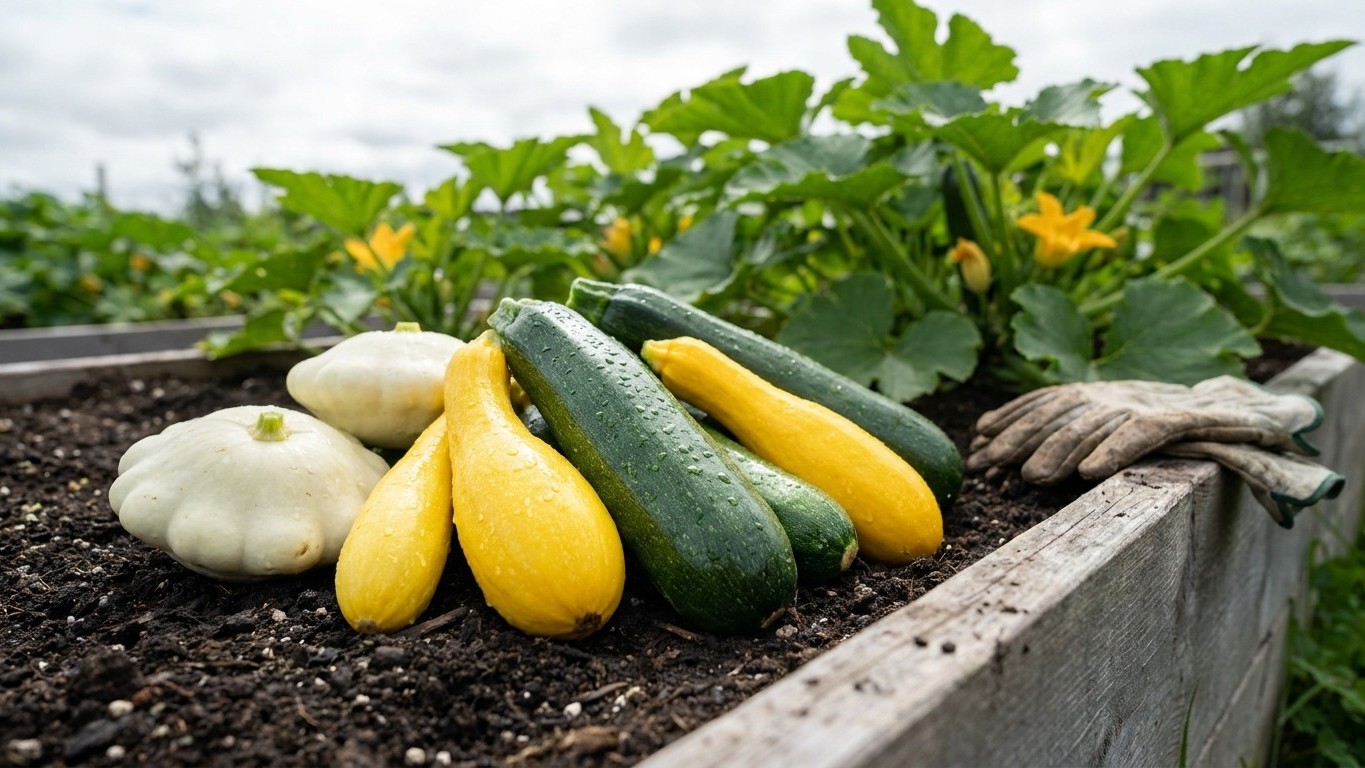

Arkansas gardeners can grow just about every type of summer squash there is, from zucchini to yellow crookneck to pattypan, because the state’s frost-free window is long enough to fit multiple plantings. The real decision isn’t which type survives the season here. It’s which type survives the heat and the pests that come with it.
The short answer for Arkansas
Arkansas’s growing season runs from roughly March 12 to November 20 at the 32F threshold, and the tighter 36F window that actually matters for a frost-tender crop like squash runs April 3 to October 31 at the Little Rock station. Either way, that’s well over 200 days of workable weather. No summer squash type, bush or vining, fast or slow to mature, is going to run out of season here. That’s not the constraint.
The constraint is heat load and humidity. The reference station logs an average of 69.2 days a year at 90F or above, and summer rainfall of about 10 inches across June, July and August arrives mostly as thunderstorms rather than a steady soak, with August running driest at 3.16 inches. That combination, heavy heat plus humid air plus irregular rain, is exactly what accelerates powdery mildew, invites squash vine borer, and stresses plants into early decline. So the type-by-type answer for Arkansas comes down to turnover speed, not season length.
Bush-type yellow squash (crookneck or straightneck) and bush zucchini make the most sense for most of the state. They mature quickly, they can be planted in succession every three to four weeks through the season, and a fading planting can simply be pulled and replaced rather than nursed through a pest infestation. Scallop or pattypan types work on the same logic, since they’re also typically bush habit and quick to bear. Vining, sprawling types that take longer to reach first harvest are a harder sell here, not because the season runs out, but because they spend more weeks exposed to the pest and disease pressure that builds through an Arkansas summer.
The practical version of the answer: plant fast, bush-habit Summer Squash in succession rather than committing to one long-season planting, and treat late April through early July as the window before disease and borer pressure typically peaks.
What will not work here
A single spring planting meant to carry the whole season is the most common mistake, and it’s a mistake built for Arkansas specifically. With 69.2 days a year above 90F, most summer squash plants here start declining by midsummer regardless of variety, whether from squash vine borer larvae tunneling into the stem or from powdery mildew moving through the humid canopy. A planting made in April is often finished by July. Gardeners who don’t plan a second or third sowing end up with a garden that produces heavily for a few weeks and then nothing, right when demand for fresh squash is highest.
Watering on a weekly schedule doesn’t hold up either. Summer rainfall averages about 10 inches over June through August, but that number is deceptive because it usually falls as isolated thunderstorms rather than gentle, evenly spaced rain. A storm that drops an inch in twenty minutes runs off more than it soaks in, especially once soil is already dry and crusted from the days above 90F that precede it. A weekly watering habit assumes rainfall fills the gaps consistently. In Arkansas, it often doesn’t, and squash, which is shallow-rooted and thirsty when fruiting, shows stress fast.
Tight spacing is the third failure point, and it’s a humidity problem, not a heat problem. Squash planted close together to save space traps moisture in the leaf canopy after rain or overhead watering, and that trapped humidity is what powdery mildew and other foliar diseases need to spread. In a drier, less humid state, tight spacing might just mean smaller plants. In Arkansas’s summer humidity, it more often means a mildew outbreak that spreads from plant to plant within days.
Finally, planting right at the earliest 32F-based date without accounting for the 36F caution is a real risk here. The 32F freeze probability window opens as early as March 12, but the light-frost threshold that actually matters for tender squash seedlings doesn’t clear until April 3 at the Little Rock reference station. A gardener who plants by the 32F date alone is planting three weeks into a window where light frost is still statistically likely.
What changes across Arkansas
Arkansas is not one climate, and the state’s USDA Plant Hardiness Zone range, 6b to 8a, makes that plain. That’s a two-zone spread across the state, built on average annual extreme minimum temperature, and it roughly tracks the state’s geography: the Ozark and Ouachita highlands in the north and west run cooler, closer to zone 6b, while the southern Delta and far south run warmer, closer to zone 8a.
That spread matters directly for summer squash timing. A gardener in the cooler highland zones should expect a later safe planting date and an earlier fall cutoff than the statewide averages suggest, since both frost dates shift with elevation and latitude. A gardener in the warmer southern zones can likely push planting earlier in spring and keep harvesting later into fall than someone gardening two hundred miles north. The frost-date ranges cited for Arkansas as a whole, March 12 to March 28 for last spring frost and November 7 to November 20 for first fall frost, already reflect this internal spread rather than a single fixed date, which is why they’re given as ranges and not one number.
There’s no single planting date that fits all of Arkansas, and no single answer to “how many successions can I fit in” either. A shorter effective season in the highlands means fewer succession plantings before fall frost risk returns; a longer one in the south means more room to stagger sowings and stretch harvest later. This page can’t tell an individual reader which zone applies to their yard, since hardiness zone depends on local terrain, elevation and even how close a garden sits to a valley or ridge. What it can say is that the difference between the state’s coolest and warmest zones is large enough that a planting calendar built for one end of Arkansas will be off by weeks at the other end.
Where to check this for your own county
The state-level answer above is a starting point, not a substitute for what applies to a specific county. The University of Arkansas Division of Agriculture Cooperative Extension Service publishes county-level guidance, and it’s the right next stop.
Two things are worth looking for there specifically. First, the local planting calendar for the reader’s own county, which will reflect the actual frost-date pattern for that spot rather than the statewide range used on this page. A county in the northern highlands and a county in the southern Delta can have real gaps in their safe planting windows, and the extension office’s county-specific dates account for that in a way a state-level page like this one cannot.
Second, look for variety trial results or recommended lists specific to that county or region. County extension agents and university trial programs test how different summer squash types perform under local pest pressure, local soil, and local disease history, which is a level of detail no state-wide article can responsibly claim. A recommendation backed by trials run in a reader’s own county, against that county’s actual squash vine borer and powdery mildew pressure, will outperform a general statewide guideline every time.
That’s the honest limit of this page: it works from statewide climate normals, frost probabilities, and heat and rainfall averages, all useful for understanding why Arkansas behaves the way it does, but not a replacement for county-specific field data. Treat this article as the reasoning, and the county extension office as the specifics.
Checking this against your own garden
Every date and average on this page is a statistical starting point, and a reader’s own garden will always outrank it. Soil temperature is the first check worth making, and it doesn’t require a thermometer to read approximately: soil that still feels cool and damp to the touch a few inches down, even on a warm afternoon, isn’t ready for squash seed regardless of what the calendar says. Squash seed sits and rots in cold soil rather than germinating, so a gardener who waits for soil that feels genuinely warm through midday is protecting against a false start no frost date can predict.
The second signal is the first flush of male flowers. Squash plants typically produce male blooms before female ones, and a garden that’s suddenly covered in yellow blooms with no small swelling squash forming behind them is just showing normal early growth, not a problem. What that first flush does confirm is that the plant has settled in and started reproductive growth, a useful check that the transplant or seedling handled the transition into the garden well.
Third, watch the first true leaves, the ones that emerge after the rounded seed leaves and actually look like squash foliage. Their size and color say a lot about the specific microclimate of that bed: pale, slow-growing true leaves often point to soil that’s still cooler or less fertile than the garden as a whole, while quick, dark-green true leaves suggest that spot is running warm and rich enough to support an earlier or heavier succession planting than the rest of the yard.