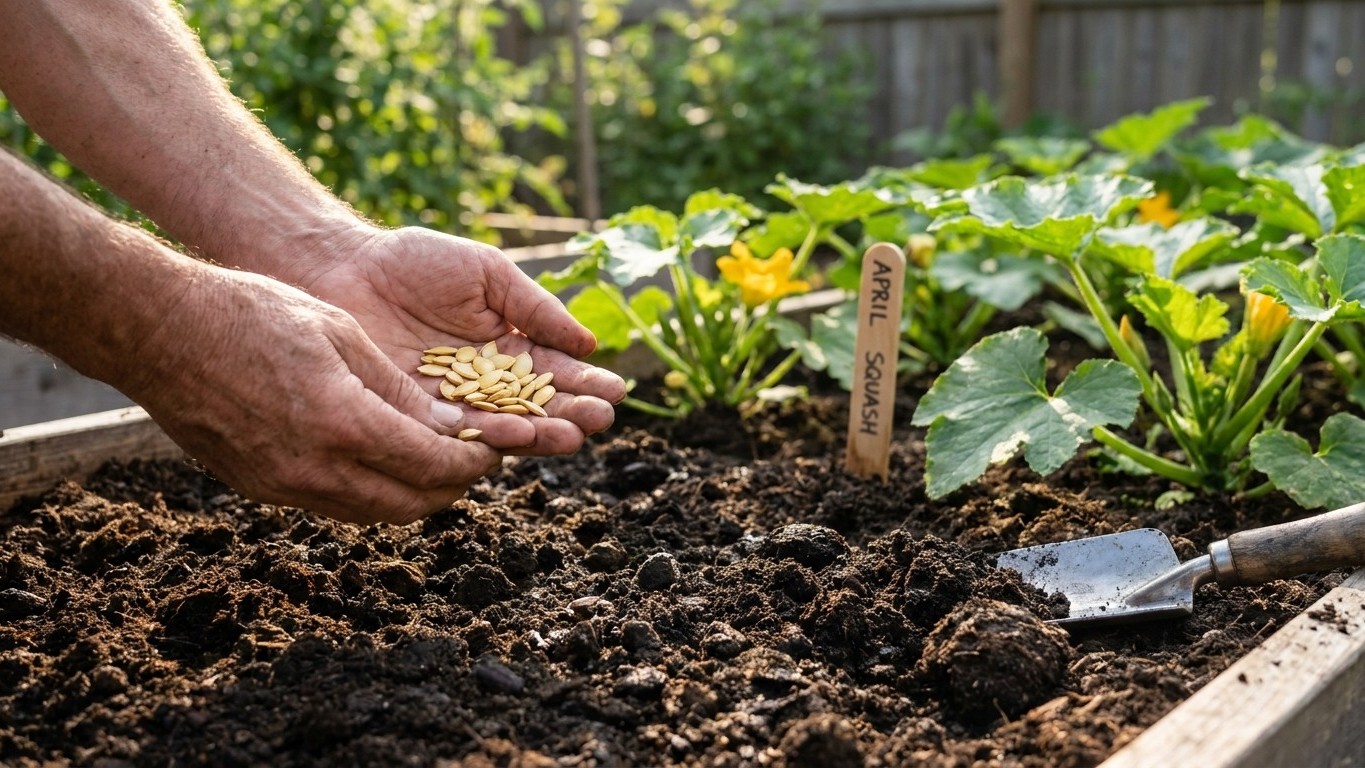

Summer squash goes into Arkansas gardens between April 3 and mid-May, once the risk of a damaging light frost has passed, and a second planting can go in as late as early August to beat the November frost line. That window comes from two different frost thresholds for the same region, and knowing which one applies changes the calendar.
The short answer for Arkansas
Arkansas gardeners work with two frost numbers, and they are not interchangeable. NOAA’s 32F freeze data for the reference station near Little Rock puts the last spring freeze in a band running from March 12 to March 28, and the first fall freeze from November 7 to November 20. Those are averages built on a 30 to 70 percent probability, meaning a freeze at 32F is about as likely as not to happen anywhere inside that window, not a guaranteed cutoff.
Summer squash does not care about 32F. It cares about 36F, the point at which a light frost damages young leaves and stops growth cold. The National Weather Service office in Little Rock puts that light-frost date at April 3 in spring and October 31 in fall. That is the calendar that actually governs squash: plant no earlier than April 3, and get a crop finished before October 31.
| Threshold | Last spring date | First fall date | What it means for squash |
|---|---|---|---|
| 32F freeze (NOAA 30-70% band) | March 12 to March 28 | November 7 to November 20 | General freeze risk, too aggressive a cutoff for tender plants |
| 36F light frost (NWS Little Rock) | April 3 | October 31 | The date that actually protects squash seedlings and fruit |
Between April 3 and October 31, Arkansas has roughly 211 frost-free days at the 36F threshold. Summer squash needs about 45 to 55 days from seed to first harvest, which leaves room for more than one planting cycle. Most Arkansas gardeners sow a first round in April, expect it to slow or decline by midsummer, then sow a second round in late July or early August timed to finish well before the October 31 cutoff.
What will not work here
Planting too early is the first way this fails. Squash seed sown before the soil has warmed, even if it technically lands after March 28, sits in cold, often waterlogged ground and rots before it germinates. The 36F date of April 3 is not a suggestion here; it is the point past which soil temperature in most Arkansas gardens has caught up enough for squash seed to sprout reliably.
The bigger failure mode is assuming one spring planting will carry a gardener through the whole season. Arkansas averages 69.2 days a year at or above 90F, concentrated exactly in the stretch when a spring-sown squash plant would be trying to set fruit. That much heat load stalls pollination, causes blossom drop, and stresses plants right when squash vine borer activity typically ramps up. A single April planting often peters out by midsummer for reasons that have nothing to do with disease or bad luck; the heat itself did the damage.
Watering on a weekly schedule and hoping is another mistake this climate punishes. Summer rainfall across June, July and August averages about 10.0 inches, but it is not evenly spread: June brings 3.55 inches, July 3.33, and August drops to just 3.16, the driest month of the growing season. Rain that does fall in Arkansas summers tends to arrive as thunderstorms rather than steady soakers, which means a lot of it runs off instead of reaching the root zone, especially once the 90-degree days start pulling moisture back out of the soil almost as fast as it lands. A garden that gets by on rainfall alone in June often runs short by August.
Tight spacing is the third trap. Combine Arkansas humidity with a wet spring and crowded squash plants develop powdery mildew and other foliar disease well before the plants have finished producing. Wider spacing than a seed packet suggests, and better airflow between rows, matters more in a state with this much summer humidity than it would somewhere drier.
What changes across Arkansas
Arkansas is not one climate. The USDA Plant Hardiness Zone Map puts the state across a 6b to 8a range, built on average annual extreme minimum winter temperature, and that spread alone signals a real difference in growing conditions between the cooler Ozark and Ouachita highlands in the north and west and the warmer Delta lowlands in the east and south.
The frost dates and heat-load figures above are drawn from a reference station near Little Rock, roughly in the middle of that range. A garden in the cooler northern highlands should expect the last spring frost to arrive later than April 3 and the first fall frost to arrive earlier than October 31, shortening the safe planting window on both ends. A garden in the warmer southern or eastern lowlands can typically push both dates in the other direction, planting a little earlier in spring and holding a late crop a little longer into fall.
Because the hardiness zone spans that much variation within one state, there is no single date that fits an Arkansas garden in the highlands the same way it fits one in the Delta. Rather than guess which end of the 6b to 8a range applies to a specific yard, use the USDA Plant Hardiness Zone Map to find the zone for the exact location, then adjust the dates on this page toward earlier (if the zone runs warmer than 7a) or later (if it runs cooler, closer to 6b).
Where to check this for your own county
The University of Arkansas System Division of Agriculture Cooperative Extension Service, at uaex.uada.edu, is the source that replaces state-wide estimates with numbers specific to a single county. This page has worked from a reference station near Little Rock because that is what NOAA’s climate normals provide at the state level, but a county extension office has data drawn from local weather stations and years of local trial plots.
Two things are worth looking for on that site. The first is a county or regional planting calendar, which will adjust the April 3 and October 31 dates used here to whatever the actual frost pattern looks like in that specific county, whether that is the Ozark highlands, the Arkansas River Valley, or the Delta. The second is a list of summer squash varieties the local extension office has actually trialed in Arkansas conditions, which accounts for regional pressure from squash vine borer, powdery mildew, and the heat load specific to that part of the state rather than a national seed catalog’s general description.
A county-level recommendation from Cooperative Extension will always beat a state-wide figure. This page draws on the best statewide climate data available, but it cannot know whether a given garden sits in a river-bottom frost pocket or on a south-facing slope that warms up two weeks ahead of the county average. The extension office, working from decades of local observation, can.
Checking this against your own garden
No date on this page beats what the soil and the plants themselves are showing on a given week. Three signs are worth checking before trusting a calendar over a garden.
Soil warmth by feel comes first. Squash seed wants soil that feels cool at most, not cold and clammy, when a handful is dug from two or three inches down. If the soil still feels damp and chilly against the skin well after April 3 has passed, that particular spot is running behind the regional average and seed will sit rather than sprout.
The first flush of male flowers is the second signal. Summer squash typically produces several male flowers before the first female flower opens, and a plant that throws male flowers quickly after emerging is telling a gardener the local conditions, heat and light both, are running ahead of schedule. A plant that takes noticeably longer to flower than a neighbor’s, planted the same week, is picking up on a cooler or shadier microclimate.
The first true leaves matter too, not just the seed leaves that appear first. Fast, sturdy true leaves within a week or so of germination point to warm, well-drained soil doing its job. Slow, pale true leaves, especially after a wet spell, usually mean the soil in that spot is holding water and cold longer than the general Arkansas averages would suggest, and the next planting should probably wait a few extra days or move to a raised bed with better drainage.