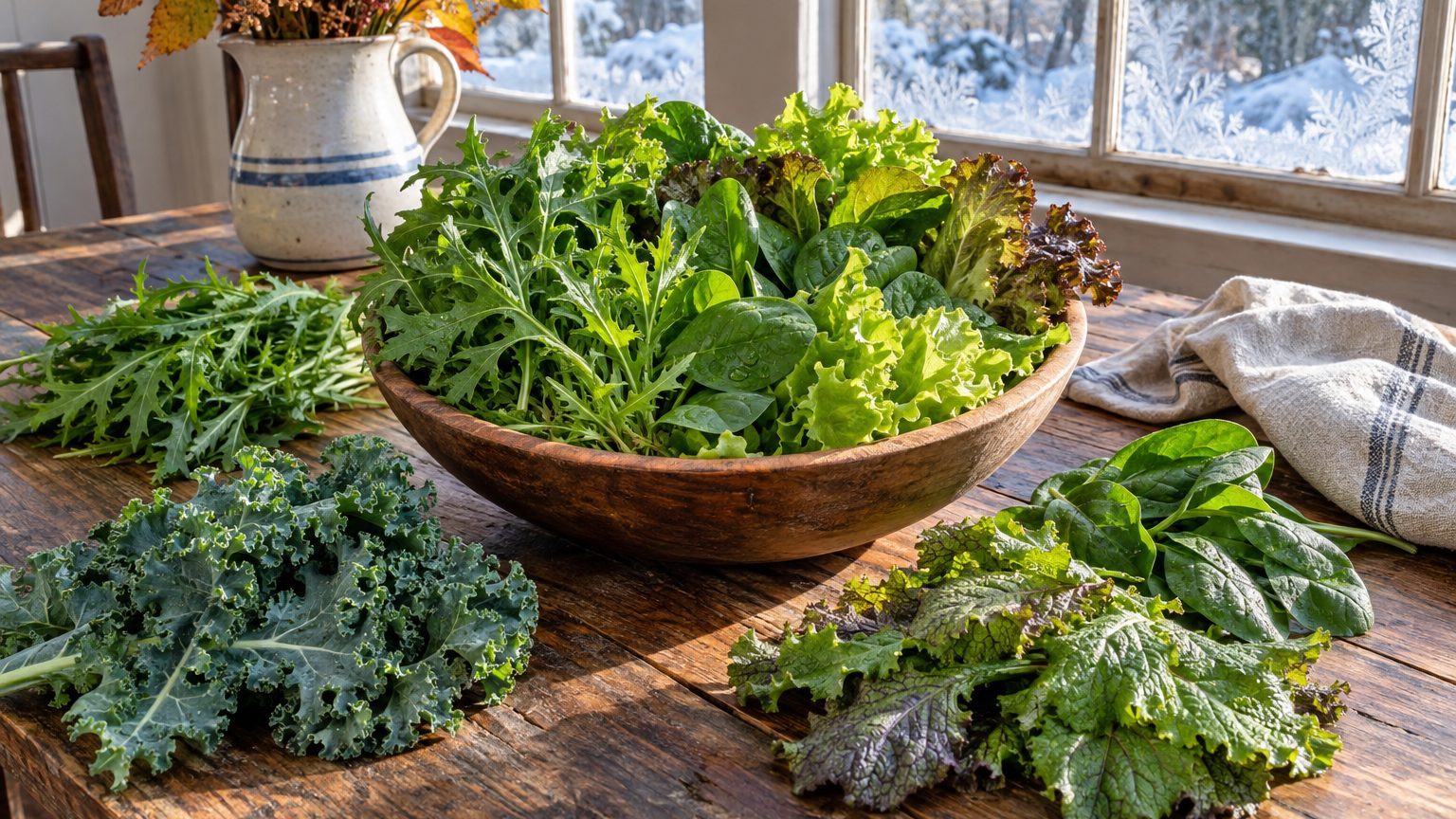

Cold-tolerant, low-growing greens do best in British Columbia: mâche, claytonia, spinach, kale, mizuna and arugula, with a few hardy lettuces and chicories as a second tier. Along the coast, wet and low light cause more losses than frost does. Choose varieties that shrug off damp and short days, and the cold takes care of itself.
The short answer for British Columbia
The only climate figures this page has come from the Vancouver International Airport station, using Environment and Climate Change Canada’s 1981-2010 normals. The average last spring frost there is March 18, and the average first fall frost is November 10. Both are mean dates, not safe ones. In one year out of two the frost lands later than the average, so treat each as the middle of a window. The coldest month has a mean daily minimum of 0.8 °C (33.5 °F, for anyone comparing with a US garden). That is barely below freezing, which is why a hard freeze is the exception on the coast and not the rule.
With a frost-free stretch of more than seven months and mild winter nights, the deciding factor is how a crop handles cool, damp, dim weather. Sort by type and the picture clears up.
| Type | Examples | Cold | Wet and low light | Verdict for the coast |
|---|---|---|---|---|
| Small rosette greens | Mâche, claytonia | Excellent | Good | First choice |
| Hardy leafy greens | Spinach, kale, mizuna, tatsoi | Very good | Good | Reliable in open ground |
| Peppery greens | Arugula | Good | Fair | Good with some cover |
| Chicories | Radicchio, endive, escarole | Good | Fair | Worth trying, fussier |
| Winter lettuces | Small, loose-leaf, cold-bred types | Fair | Poor to fair | Needs a cover |
Lettuce deserves a note, because it is what most people want. Loose-leaf types bred for winter, such as ‘Winter Density’, do far better than summer heading types, but they still sulk in a soggy bed. If lettuce is the goal, plan on a cold frame or low tunnel. For sowing dates by region, see When to Sow Winter Salads in British Columbia, and for the wider picture, Winter Salads for British Columbia Gardens.
What will not work here
Planting heading lettuces in an open bed and hoping for the best. On the coast, nights hover around the freezing mark without often dropping far below it, so the plants rarely die of cold. They die of rot. Butterhead and crisphead types hold water in their centers, and a month of drizzle turns them to mush. The same mild nights keep slugs active all winter, and a young seedling is a quick meal.
Sowing late is the second mistake, and the frost date is what misleads people. The average first fall frost of November 10 sounds like a deadline, but light is the real limit. By November the days are so short at this latitude that growth nearly stalls. A seedling that hasn’t reached size by then mostly sits in place until spring, and a crop that sits through a wet winter loses leaves to rot and slugs. Winter salads are mainly harvested, not grown, in the dark months. They have to be nearly full-sized before the light fades.
Tight spacing fails too. Crowded rows work fine in a dry California winter, but in damp coastal air they hold moisture against the leaves and invite gray mold. Wider spacing, a bed with good drainage, and picking off yellowing outer leaves matter more here than any variety choice. Raised beds help a lot where the soil is heavy clay.
Then there is trusting March 18. Because it is only the midpoint of the last-frost window, a seedling set out on that date has roughly even odds of meeting another frost. For hardy greens that is a nuisance. For tender seedlings started indoors it can wipe out a flat.
The last failure is borrowing Vancouver’s numbers for the rest of the province. A gardener in the Interior or the north who copies coastal advice will lose lettuce to hard freezes that the airport figures never show. The next section covers how far the picture shifts.
What changes across British Columbia
Natural Resources Canada puts Vancouver, the reference city for this page, in Canadian hardiness zone 9a, based on 1991-2020 normals. That is the Canadian system, built on seven climate variables, and it does not convert to a USDA zone. NRCan itself says there are no simple conversions between the two systems, so don’t read 9a as a US number.
It is also one city’s zone, not the province’s. British Columbia runs from rain-soaked coast to dry Interior valleys, high plateaus, mountain passes and the cold north. The page does not have a zone spread for the whole province, and it would be wrong to guess one. The honest answer is that there is no single answer. Your zone could sit well away from 9a, and the best way to find it is the Canada’s Plant Hardiness Site map, where you can look up your own municipality.
What should shift as you move away from the coast? Mostly three things. The sowing window moves earlier, by weeks in northern or upland districts, because the days shorten and the cold arrives sooner there. The crop list narrows toward the toughest types: mâche, claytonia, spinach and kale, with lettuce and chicories moved under cover. And cover itself goes from optional to expected. A cold frame or low tunnel that merely protects lettuce from rain on the coast can be what keeps any salad alive where nights drop well below freezing.
One more caution about the numbers. The Canadian normals here cover 1981-2010, while the US figures elsewhere on this site cover 1991-2020. Don’t set a British Columbia frost date beside an Oregon or Washington one as if they were measured the same way.
Where to check this for your own county
Start with the Government of British Columbia’s agriculture and seafood pages. Look for two things: a planting calendar written for your part of the province, and any record of which varieties have been trialled near you. A calendar for the Fraser Valley says little about the Okanagan or the Peace region, and the same goes for variety trials, since a cultivar that excels in one climate can fail in another.
British Columbia is divided into regional districts, not counties, but the idea is the same. The closer the source is to your own ground, the better. Local seed suppliers, community garden groups and regional growers often know which winter lettuce survived last January in your valley, and that knowledge rarely makes it into any provincial document.
A local recommendation beats a provincial one, every time. This page is the provincial one: it uses a single airport station and a single reference-city zone, and it can only describe the broad shape of the season. Where it conflicts with something written for your district, trust the district.
Checking this against your own garden
Your own observations outrank every date above. Three are worth watching, and none needs equipment.
- Soil warmth by feel. Push your hand into the bed in mid-afternoon. If the soil still feels cold after a few seconds, germination will be slow, and mâche and spinach will be your best bets. Soil that feels cool but not biting suggests a sheltered, well-drained spot.
- The first true leaves. The first pair are seed leaves; the true leaves come after. If seedlings reach that stage well before the days get short, they may reach harvest size. If they stall, your sowing was too late for your microclimate.
- Where frost lingers. Walk the yard on a cold morning. White ground on the lawn that melts first beside a wall and last in a low corner shows you the warm and cold pockets, and tells you where the tender crops belong.
Keep rough notes for one winter and your own calendar will be sharper than any average. A bed against a south-facing wall can behave like a garden a zone milder than the one beside the fence.
Common questions
Can I grow lettuce through winter in British Columbia?
On the coast, yes, with the right types and some cover. Small, loose-leaf, cold-bred lettuces cope better than heading types, and a cold frame or low tunnel keeps rain off them. Inland or at altitude, covered growing is close to a requirement.
Which winter salad is the most reliable?
Mâche and claytonia stand out for cold, and spinach and kale are the most forgiving in open ground. If you want one place to start, sow mâche and spinach and add the rest as you learn your site.
Is March 18 a safe date to plant out?
No. It is the average last spring frost at the Vancouver airport station, and in one year out of two the last frost comes later. Hardy greens can take a late frost, but tender seedlings should wait.
Does Canadian hardiness zone 9a match a USDA zone?
No. The Canadian system uses seven climate variables and the USDA system uses one, so the numbers don’t convert. Use the zone only to compare against other Canadian locations.