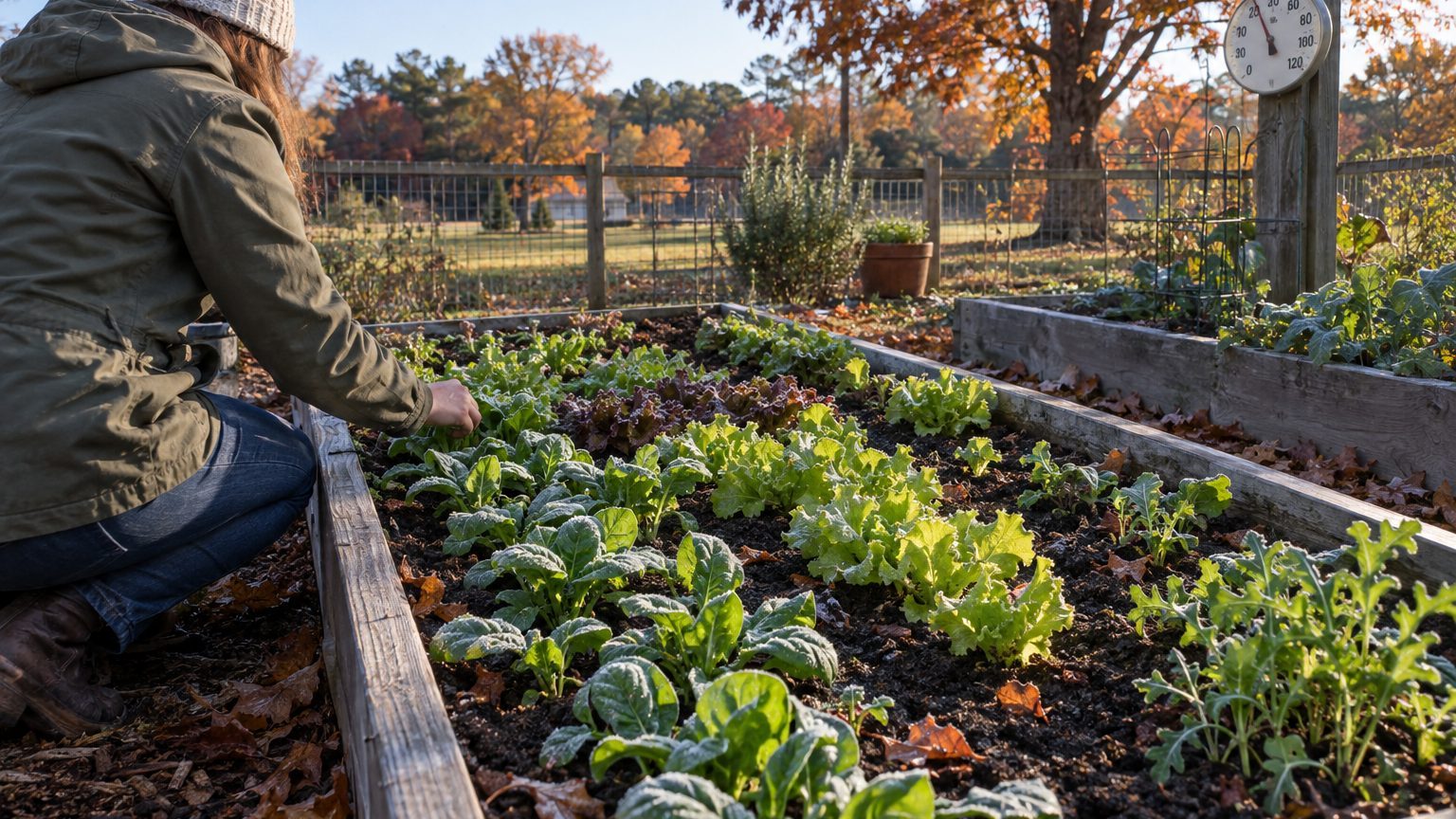

Sow winter salads in British Columbia from late summer into early autumn, so the plants are established before a first fall frost that averages November 10 at Vancouver’s airport station. A smaller spring window opens in late winter, with March 18 as the average last frost there. Both dates describe one coastal weather station, and the rest of the province shifts around them. Here is how to read them without being fooled.
The short answer for British Columbia
The main sowing window opens in late summer and closes in early autumn, counted back from a first fall frost that averages November 10 at the Vancouver Int’l A station. A smaller window opens in late winter, after the average last spring frost of March 18 (which passes on paper more reliably than in the garden).
Both dates come from Environment and Climate Change Canada’s 1981-2010 climate normals, and both are means. Each is the midpoint of a spread. In one year out of two, the last spring frost lands after March 18. In one year out of two, the first fall frost arrives before November 10. Treat them as the middle of a window, never as a safe date. The US figures elsewhere on this site cover 1991-2020, so the two sets don’t sit on the same footing.
The gap between the two mean dates is 237 days, a little under eight months. That is generous, and it explains why the coast is forgiving to winter salad growers. The usual failure here is not a hard freeze. It is sowing too late for plants to reach harvestable size before the light fades. A winter salad is mostly grown by December, then held in the cold and picked leaf by leaf. So count backward from November 10 and give the slower, hardier types the early end of the window and the quick leafy ones the later end.
Today is October 5, about five weeks ahead of that November 10 average. For fast cut-and-come-again greens, a sowing now may still work, ideally under cover. For anything that has to build a substantial plant, it is already late. Which type belongs where is sorted out in The Best Winter Salads for British Columbia, and the wider picture sits in Winter Salads for British Columbia Gardens.
One limit, stated plainly: this page does not have a British Columbia extension calendar giving sowing dates crop by crop. The window above is derived from frost dates at one airport station, not from local trials.
What will not work here
Slow types sown late. A heading lettuce or any salad crop that needs many weeks to size up will not get there from a sowing made in the last five weeks before November 10. The plants stall at seedling size, sit through the dark months, and either rot or bolt in spring. Cutting-type greens forgive far more.
Trusting March 18 as a safe date is the spring version of the same mistake. Since half of all years bring a frost after it, tender seedlings set out on that date are gambling on a coin flip. Sow under cover earlier if you like, but keep the cover within reach.
The coldest month here has a mean daily minimum of 0.8 °C, which is above freezing. That sounds like permission to skip protection, and it isn’t. It is an average of minimums, not a record low, so individual nights drop below zero even in a winter that averages out mild. Tender salad types left bare on those nights get burned.
The opposite error is just as common on a mild coast. Wrap a bed in a sealed cover for the whole winter and you trap moisture around leaves that never freeze hard enough to stay dry. Add close spacing and you have built a home for gray mold and slugs, both of which thrive when the nights hover just above freezing. Wider spacing than the seed packet suggests, and a cover that gets vented on mild days, will do more good than a thicker layer of fabric.
Finally, the Vancouver numbers do not travel well. The station’s own record notes that northern and upland districts run weeks behind it. A gardener in the interior or the north who sows on a Vancouver schedule will find the first frost arriving before the plants are ready. And advice written for USDA zones does not transfer either, since the Canadian zone system is built on a different set of measurements (more on that next).
What changes across British Columbia
The reference city for this page, Vancouver, sits in zone 9a in Canada’s plant hardiness system, using Natural Resources Canada’s 1991-2020 normals. That is the zone of one city, not of the province. British Columbia spans several zones, so there is no single answer for the whole territory. This page does not carry the full spread as a verified figure, and it won’t invent one. The direction is clear, though: zones get colder as you move north and uphill, sometimes within a short drive.
Please don’t read “9a” as a USDA zone. The Canadian system draws on seven climate variables, the USDA system on one, and Natural Resources Canada says there are no simple conversions between them. Its own example: Canadian zone 4a overlaps nine USDA zones, from 3a to 7a. To find where your own garden falls, use Natural Resources Canada’s plant hardiness map rather than guessing from a neighbor’s or from a US chart.
If the map puts you well below the coastal reference, shift three things:
- Sow earlier, counting back from a first frost that arrives weeks before November 10.
- Choose the hardiest types and skip the borderline ones.
- Plan on cover from the start, and expect less winter growth, so that most of your harvest comes from plants grown in fall.
At altitude the logic is the same, only steeper. A garden a few hundred feet above a valley floor can see its first frost earlier and its last one later, and cold air pooling in low spots makes the difference bigger on clear nights.
Where to check this for your own county
The provincial government’s agriculture pages, run through British Columbia’s agriculture and seafood section, are the place to start. British Columbia organizes by regional districts rather than counties, so look for material tied to your own region.
Look for two things there. The first is a local planting calendar, ideally one built for your region’s frost dates rather than the coast’s. The second is a list of varieties trialled where you live, since a type that shines on the lower mainland may sulk in the Okanagan or fail in the Cariboo. Local frost dates from the weather station nearest you, in Environment and Climate Change Canada’s climate normals, are a useful cross-check. They carry the same mean-date caveat as the Vancouver figures here.
A regional recommendation beats a provincial one, every time. This page is the provincial one: it is built on a single reference station and one hardiness zone, and its job is to give you a starting frame. If a local source disagrees with a date above, believe the local source.
Checking this against your own garden
Your own observations outrank every date on this page, and three of them cost nothing.
Soil warmth by feel. Push your hand into the bed in late summer. If the soil feels warm like a sun-heated stone, lettuce-type seed can germinate poorly, so sow in the evening, water the row, and shade it. Soil that already feels cool tells you the season is turning early in your spot.
The first true leaves. Seedlings first show rounded seed leaves, then the first true leaves with the shape of the adult plant. Note how many days that takes after sowing. If it takes much longer than the packet says, your site is cool or shaded, and growth will be slower than any calendar assumes.
The first frost damage. Watch a tender plant such as basil, dahlias, or squash. The morning its leaves blacken is your garden’s first frost, and comparing it with the November 10 average shows how far you sit from the airport. A low corner of the yard that blackens first is a frost pocket, and it deserves cover while the rest of the bed waits.
Common questions
Is it too late to sow winter salads on October 5?
For quick leafy greens under cover on the coast, possibly not. For slow types, yes, since only about five weeks remain before the November 10 average. Inland and northern gardens have less time still.
Can I treat March 18 as my last frost date?
No. It is a mean from one station, so in one year out of two the last frost falls later. Use it as the middle of a window.
Does Canadian zone 9a mean I can follow USDA zone 9a advice?
No. The Canadian system uses seven climate variables and the USDA system one, and Natural Resources Canada says there are no simple conversions between them.
Do winter salads need covering on the British Columbia coast?
Often, on the coldest nights. The coldest month averages a daily minimum of 0.8 °C, but that is an average, so some nights go lower. Cover on those nights and vent on mild days.