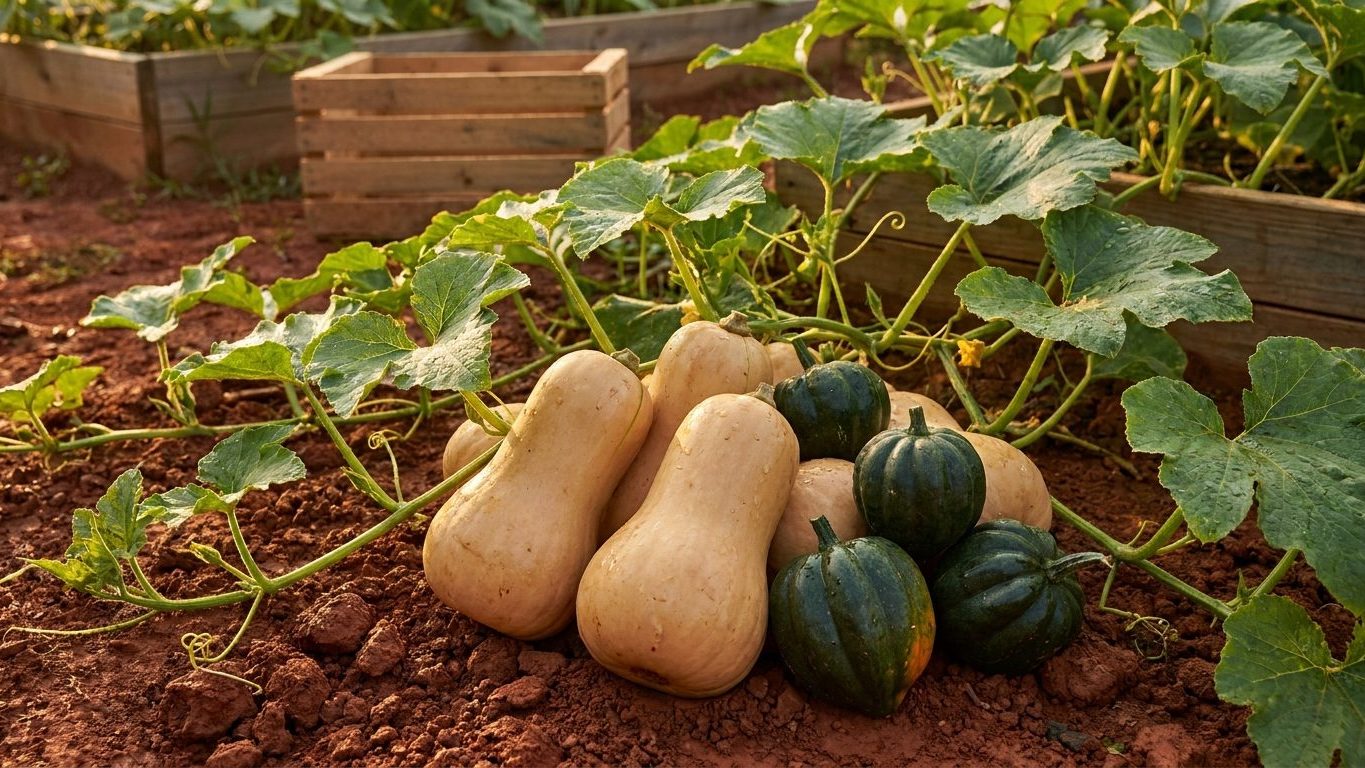

Acorn, delicata, and buttercup-type squash are the safe bets for most of British Columbia’s growing regions, while giant Hubbard, large maxima pumpkins, and many butternut hybrids struggle to fully mature. The reason comes down to one number: Vancouver’s climate normal shows zero days a year above 90°F, and winter squash sugar development depends on sustained heat, not just a long frost-free window.
The short answer for British Columbia
British Columbia’s reference station at Vancouver Int’l A averages a last spring frost around March 18 and a first fall frost around November 10, which on paper gives a season stretching close to 237 days. That sounds generous. But a long season and a hot season are two different things, and this is where the decision actually gets made. The same station records 0.0 days a year reaching 90°F, meaning the heat load that pushes sugars into a squash and hardens its rind before storage simply isn’t there in most summers.
That single fact reshapes the whole variety list. Squash types bred around cumulative heat units, like giant Hubbard or the classic long-vine butternut, are built for interior valleys or continental summers, not a coastal maritime pattern with cool nights and mild days. Types bred specifically for the Pacific coast, on the other hand, are built to size up and cure with modest heat, which is exactly what this territory offers.
| Squash type | Typical days to maturity | Heat requirement | Fit for this climate |
|---|---|---|---|
| Acorn | 80-100 | Low | Strong fit |
| Delicata | 100-110 | Low to moderate | Good fit |
| Buttercup / Kabocha | 95-110 | Moderate | Good fit, bred for maritime climates |
| Butternut | 100-120 | High | Marginal without season extension |
| Giant Hubbard / large maxima | 110-125+ | High | Poor fit |
The practical read: choose by heat requirement first, days to maturity second. A short-season variety planted in a summer with no real heat still beats a longer-season one waiting on 90°F afternoons that this station’s own normals say won’t arrive.
What will not work here

Giant Hubbard squash and most large Cucurbita maxima types are the clearest failures in this climate, and the mechanism is straightforward. These squash need sustained daytime heat, often into the mid-80s and above, to convert starches into the sugars that give winter squash its flavor and to fully harden the outer shell before frost. With zero days a year averaging above 90°F at the reference station, the heat accumulation these varieties expect simply doesn’t build. The result isn’t total crop failure so much as disappointment: thin-walled fruit, pale flesh, and squash that rot in storage within weeks instead of lasting through winter.
Many butternut varieties fall into the same trap, particularly the longer-season hybrids sold as 110- to 120-day types. Coastal gardeners in this territory sometimes push these under black plastic mulch or row cover specifically to trap extra heat around the root zone, because without that intervention the crop frequently doesn’t finish curing before the November 10 mean first frost. And that date itself deserves a second look: because it’s a mean drawn from Environment and Climate Change Canada’s 1981-2010 normals, frost arrives later than November 10 in half of all years, but it also arrives earlier in the other half. Betting a 120-day butternut against that averaged date, in a climate with no heat surplus, stacks two risks together.
Water and airflow matter too
Summer rainfall here averages about 5.0 inches across June, July, and August, with July running driest at just 1.4 inches. That’s not drought territory, but it’s dry enough that squash relying on rainfall alone through the fruit-set weeks of July will fall short, especially on the sandier soils found through the Fraser Valley. At the same time, the region’s overall maritime humidity means tight spacing, the kind printed on seed packets bred for drier interior gardens, invites powdery mildew on squash leaves faster here than it would inland. Wider spacing and morning watering at the root, rather than overhead, address that specific coastal pressure.
What changes across British Columbia
British Columbia is not one growing climate, and the hardiness zone figure makes that plain on its own. The reference city, Vancouver, sits in Canadian hardiness zone 9a, using the seven-variable Canadian system, which is not convertible to the USDA scale used elsewhere on this site. But zone 9a describes the mild, wet south coast. It says nothing about the Okanagan interior, the Kootenays, the Cariboo, or the northern half of the province, all of which fall into markedly colder and, in the Okanagan’s case, considerably hotter and drier zones during summer.
That spread matters directly for squash selection. Interior valleys with real summer heat can grow the butternut and large Hubbard types that struggle on the coast, because they actually accumulate the days above 90°F that Vancouver’s normals show at zero. Meanwhile a garden at higher elevation or further north than the coastal reference station faces a shorter frost-free window than the March 18 to November 10 span used here, which pushes the decision even harder toward the fastest acorn and delicata varieties, plus transplanting instead of direct seeding to buy back lost weeks.
There is no single BC answer, only a coastal one, an interior one, and a northern or upland one. A gardener needs to place their own plot on British Columbia’s official hardiness zone map before trusting any variety list drawn from a single coastal station.
Where to check this for your own county
British Columbia doesn’t organize agricultural extension by county the way many US states do, but the equivalent starting point is the provincial Ministry of Agriculture and Food. That’s the source for regional planting guidance and variety trials that actually reflect local growing conditions, rather than a single coastal station.
Look specifically for two things once there: a regional or district-level planting calendar, if one is published for your area, and any list of squash varieties that have been trialled by local agricultural offices or extension staff in your specific district. The Okanagan, the Kootenays, Vancouver Island, and the Fraser Valley all sit under different enough conditions that a variety recommendation tuned to one can mislead a gardener in another, even though both are technically “British Columbia.”
A district-level recommendation beats a province-level one every time. The provincial-scale answer covers the whole province at once. It’s a reasonable starting point for the reasoning behind variety choice, but it isn’t a substitute for whatever your own regional agricultural office has already tested against your local frost dates and summer heat.
Checking this against your own garden
Every date and average describes a mean condition at one weather station, not the soil in a particular backyard, and a gardener’s own observations settle questions that a climate normal can’t. Soil warmth is the first check: winter squash seed germinates poorly in cold soil regardless of the calendar date, so press a bare hand into the planting bed before sowing. If it still feels cold rather than merely cool, the soil hasn’t caught up to spring yet, no matter what March 18 suggests.
The second signal is the first flush of male flowers, which typically appear before the female flowers that actually set fruit. Their arrival marks the point where the plant has enough vine growth and warmth behind it to start reproducing, and it’s a more honest read of a given summer’s heat than any average recorded decades ago.
Third, watch how fast the first true leaves develop after the seedling stage. Quick, sturdy true-leaf growth signals a warm, well-lit microclimate that can likely support a longer-season variety like butternut. Slow, pale growth is the plant reporting cooler-than-average conditions on that specific plot, and it’s the clearest cue to lean toward the fastest acorn or delicata types rather than gamble on a squash bred for more heat than this particular garden, this particular year, is actually offering.