
In frost-free coastal and southern California, melon planting isn’t really bound by a calendar date at all: the growing window runs the full year, and the practical limits are heat accumulation and irrigation instead. Move north, into the Central Valley or the Sierra foothills, and real frost returns, putting the timing back on a familiar spring-to-fall track. Everything below explains why, station by station.
When the soil is warm enough in California
Ask when to plant melons in California and the honest first answer is: it depends which California you mean. At the reference station behind these figures, Los Angeles (NOAA station USW00023174), the 1991-2020 Climate Normals don’t even produce a computable freeze date. NOAA codes it -666, its internal flag for “there isn’t one.” Three decades of daily records show zero days at or below 32°F, and the dataset simply lists the frost-free season as the full 365 days of the year.
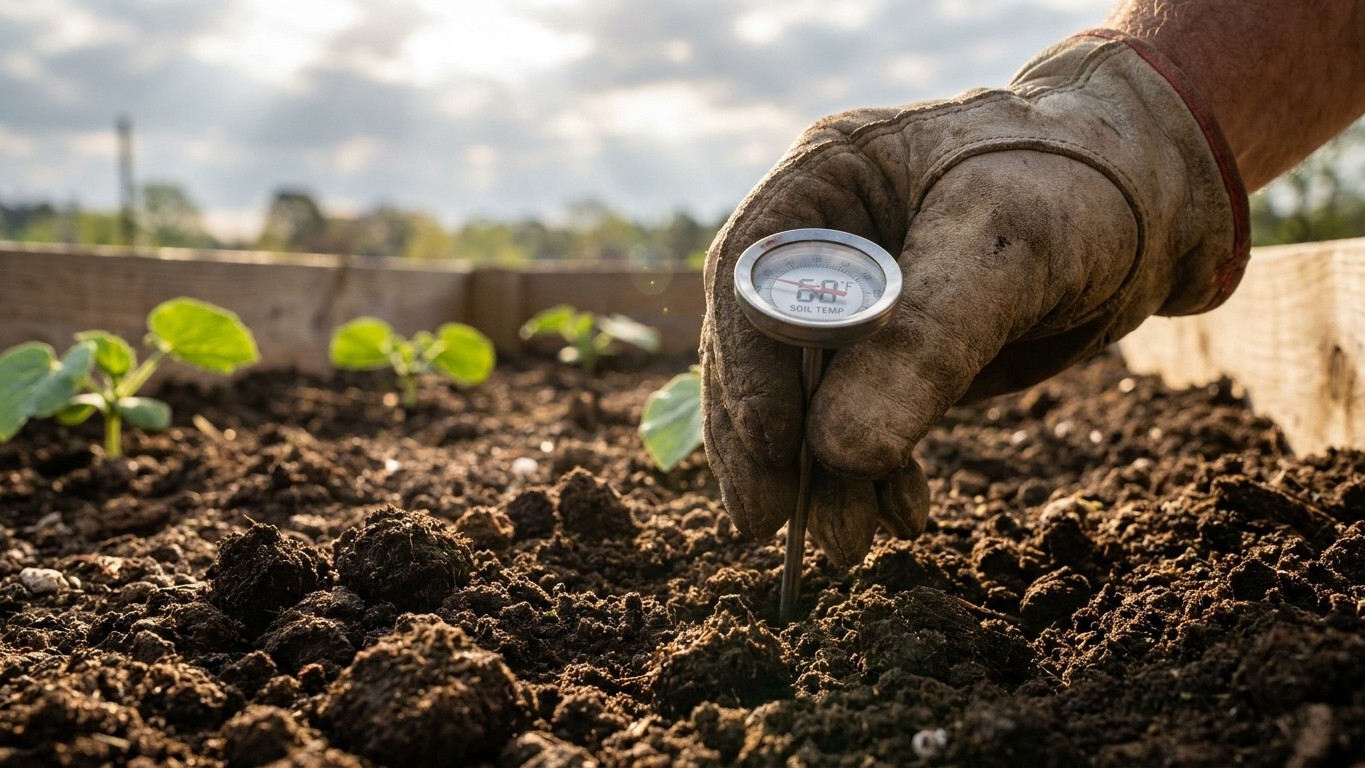
That’s the frost part of the story, but frost date is only ever a stand-in for the number that actually matters to a melon seed: soil temperature. Frost tells you when the air stops freezing overnight. Melons don’t care about that directly, they care about warm soil at seed depth, and soil keeps warming for weeks after the last frost risk has passed. So even in a territory with a real, calendar-based last-frost date, sowing right on that date usually means sowing into soil that’s still too cool for melon to germinate well. And it’s worth saying once, plainly: any frost date, where one exists, is a probability built from decades of records, not a promise for this particular year.
Coastal and southern California are a different case
Here, that whole calculation falls away. There’s effectively no frost date to wait out, which means soil temperature becomes the entire question, and it’s shaped far more by heat and water management (covered in the next two sections) than by any risk of a cold snap. The constraint in this part of the state isn’t frost. It’s drought, water restrictions, and how much afternoon heat a given spot actually collects.
That said, treating all of California this way would be a real mistake. Northern California, the Central Valley, and the Sierra foothills freeze in an ordinary year, sometimes hard. A gardener in Fresno or Redding or up toward Chico is working with a genuinely different climate than the one described by a Los Angeles-area station, and needs their own local last-frost data, not this one, before sowing. If that’s your territory, treat your planting date the way you would in any temperate zone: wait for your own local frost-free window, then let the soil finish warming before you commit seed. Your county’s extension office keeps that local data, and it’s worth a call before you trust a statewide generalization.
How long the season lasts here
Because both the last spring frost and the first fall frost come back the same way at the reference station, no computable freeze date and a listed 365-day frost-free season, the arithmetic that usually sets a growing window doesn’t apply along the coast and through the south. There’s no real subtraction to do. The window is, for practical purposes, the whole year.
What a window that long actually allows is the interesting part. It means a coastal or southern California grower isn’t locked into one sowing and one harvest. There’s room for a second sowing timed to ripen after the first planting is spent, stretching melon harvest across more of the year instead of concentrating it into a few weeks in late summer. That’s a genuine advantage this territory has that most of the country doesn’t, and it’s worth planning for rather than leaving on the table. The site’s succession sowing guide walks through how to stagger those plantings so the second round isn’t competing with the first for space and water at the wrong moment.
Inland and to the north, where real frost brackets the season, the math works the way it does almost everywhere else: a defined spring frost date, a defined fall frost date, and a growing window in between that’s finite. There, the first sowing tends to be the only sowing that matters, and because the window is tighter, the question of transplanting rather than direct-seeding becomes more relevant. Melons resent root disturbance, so a transplant only earns its place when the season is short enough that the head start outweighs the setback of a root check. In a 365-day window that trade-off barely exists; in a frost-bound one, it can decide whether a planting has time to finish at all.
Heat and water in California
Here’s a number that surprises a lot of people: at the Los Angeles reference station, the 1991-2020 normals show an average of just 2.4 days a year reaching 90°F or higher. That’s not a typo and it’s not a description of the whole state, it’s what the marine layer does to a coastal station specifically. Melons don’t actually need a pile of 90°F days so much as they need accumulated warmth over the whole season, so a territory that racks up very few of those days isn’t disqualified. It just means technique carries more of the weight than the calendar does: dark mulch to warm the root zone, siting against a south-facing wall or in the spot that holds afternoon sun longest, anything that captures heat the air isn’t reliably supplying on its own.
Water tells a starker story, and it doesn’t soften just because the heat numbers are modest. Summer rainfall at that same station averages about 0.1 inch across June, July, and August combined, with June at 0.08 inch, July at 0.04 inch, and August landing at a flat 0.0. There is, no meaningful natural rainfall to lean on during fruiting, regardless of how hot or mild the summer runs. Irrigation isn’t a supplement here, it’s the entire water budget for the crop, and the final two or three weeks before harvest are exactly when that irrigation decisions start affecting sugar concentration in the fruit rather than just fruit size.
Why this station isn’t the whole state
California’s USDA hardiness zones span an enormous range, 5a through 11a, and that spread alone tells you the coastal reference numbers above describe a floor, not a forecast for every yard in the state. A Central Valley garden sits under a heat load the marine layer never lets Los Angeles see, and a Sierra foothill garden deals with a cold season this frost-free station doesn’t have at all. Treat the days-above-90 and summer rainfall figures here as a starting point for the mild, dry coastal and southern strip, then check your own conditions, ideally with a rain gauge on your own plot, if you’re gardening anywhere else in the state.
Which melons suit California
None of this points to a single variety, and it shouldn’t. It points to a type, and the type follows directly from the three facts above. Along the frost-free coast and south, the long window removes the pressure to rush toward the earliest-maturing types, but the modest heat-day count at the reference station means growers there still benefit from choosing types suited to sustained, moderate warmth rather than counting on a run of 90°F days that mostly doesn’t come. Inland, where real heat shows up and frost brackets a shorter season, the priorities flip: earliness matters more because the window is finite, and once temperatures climb well past what the coast sees, airflow around the vine and some afternoon shade at the root become the difference between a plant that finishes and one that stalls under heat stress.
Coastal fog is also worth a mention here, because low rainfall doesn’t mean low humidity. Marine-layer moisture without actual rain can still favor powdery mildew on melon foliage, so disease resistance stays a relevant criterion even in a territory this dry on paper.
What this page won’t do is hand over a cultivar name, and that’s a deliberate choice, not an oversight. A state running from USDA zone 5a to 11a produces wildly different results from the same variety depending on where it’s planted, and the only recommendation that means anything comes from trials run in your actual region. The University of California’s cooperative extension service, UC ANR, keeps exactly that kind of regionally tested variety data, and it’s the resource worth checking before buying seed, rather than trusting a name that worked somewhere else in a state this size.