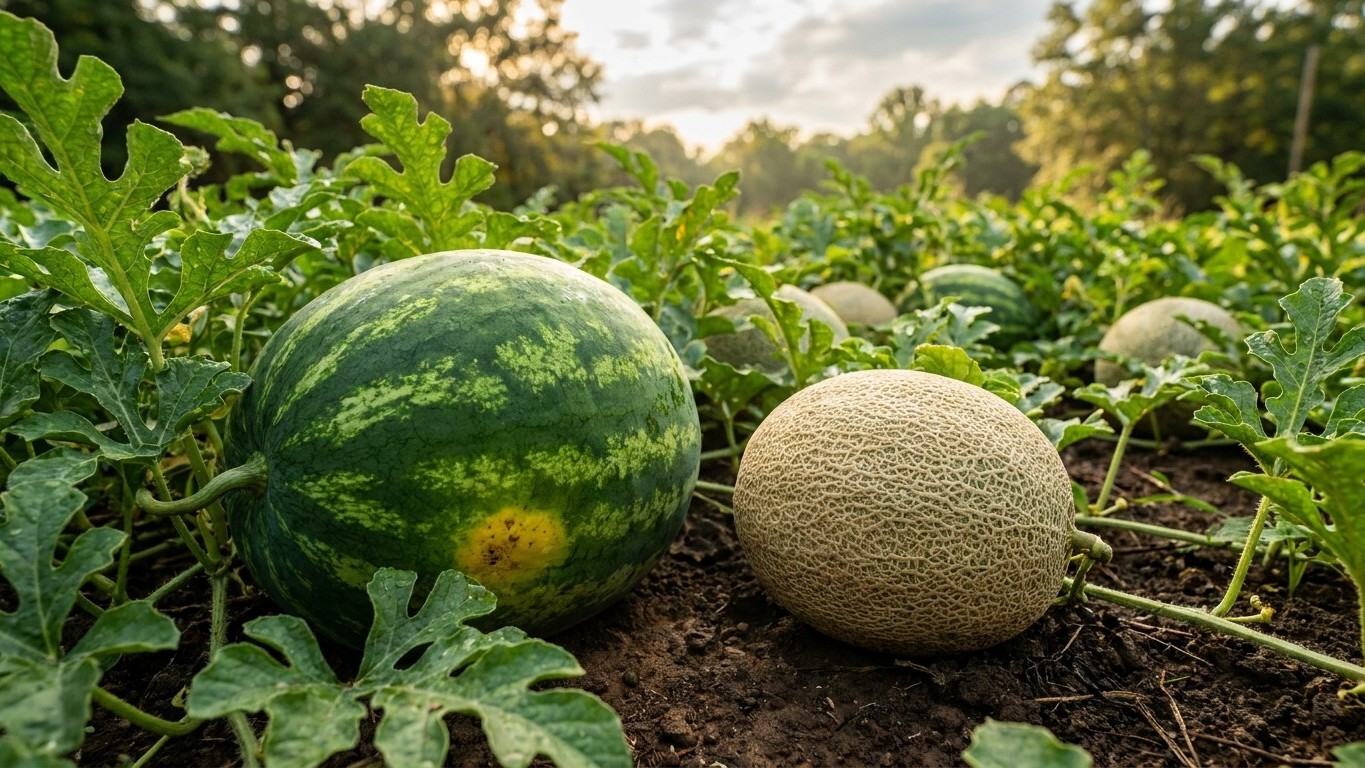

Short-season cantaloupes and muskmelons handle California‘s cooler coastal fog belts best, while big watermelons and honeydews reward the heat of the Central Valley and interior south. Which one wins in your yard depends less on frost than on how much summer heat and water you can actually deliver.
The short answer for California
Start with what California doesn’t have to worry about, at least along the coast and in the south: frost. NOAA’s 1991-2020 climate normals for the Los Angeles reference station show no computable freeze normal at all, code -666, and thirty years of daily records with zero days at or below 32°F. The frost-free season there is listed as 365 days. That single fact flips the usual melon-growing question on its head. In most states, the decision is “how many days-to-maturity can I fit before the first fall frost?” Along the California coast and through the southern basins, that question barely applies. The limit isn’t the calendar. It’s heat and water.
That reference station, though, sits near the coast, and its own numbers show only 2.4 days a year averaging 90°F or hotter. That’s a mild number, closer to what you’d expect from a marine climate than a desert. It matters because it means the coastal strip, even with its endless frost-free window, doesn’t necessarily deliver the intense, sustained heat that a big watermelon wants to build sugar. Inland, in the Central Valley and the interior south, the heat load runs considerably higher (this page’s facts don’t cover an inland station, so check your local extension for those specifics), and that’s where heat-hungry types finish stronger.
So the decision by type looks like this: where summers stay mild and foggy, lean on quicker, smaller-fruited cantaloupes and muskmelons that don’t need weeks of blistering heat to ripen. Where summers run hot and dry inland, watermelon and honeydew have the thermal runway to fully develop.
| Melon type | Typical days to maturity | Heat need | Best fit in California |
|---|---|---|---|
| Cantaloupe / muskmelon | 75-90 days | Moderate | Coastal fog belt, mild-summer zones |
| Watermelon (standard/large) | 80-100 days | High, sustained | Central Valley, interior south |
| Honeydew | 85-100 days | High, steady | Warm interior valleys |
| Specialty (Charentais, Galia, Crenshaw) | 75-90 days | Moderate to high | Varies; check local trial results |
The higher up you go, or the farther north, the more this shifts back toward a normal frost-limited calendar, which is exactly what the next section gets into.
What will not work here
The biggest failure mode in California melon patches isn’t frost. It’s water math. Summer rainfall at the reference station adds up to roughly 0.1 inch across June, July and August combined, with the driest month, August, sitting at a flat 0.0 inches. Month by month it runs 0.08 inch in June, 0.04 in July, nothing in August. That’s not a dry spell. That’s a summer with no meaningful rain at all. Any melon variety bred for or accustomed to steady natural moisture, the kind that does fine on weekly watering in a wetter state, will struggle here on that same schedule. Melons need deep, consistent soil moisture through fruit set and sizing, and in a summer this dry, “weekly” watering isn’t enough for anything but the most drought-tolerant types, and even those need supplemental irrigation, not rainfall, to get there.
A second failure comes from mismatching heat expectations to the wrong stretch of the state. A giant, late-maturing watermelon variety that wants a long run of consistently hot days will sit and sulk in a coastal garden where the reference station logs only 2.4 days a year at 90°F or above. It’s not that the plant dies. It just never sizes up or sweetens the way the seed packet promises, because the heat units simply aren’t there in a marine climate. That’s a variety-to-microclimate mismatch, not a growing mistake.
Where the freeze risk actually lives
The frost-free read applies to the coastal and southern reference station, not the whole state. Northern California, the Central Valley floor on cold winter nights, and anywhere in the Sierra foothills or higher does freeze in an average year. A gardener in those zones who plants a slow, 100-day watermelon expecting a Los-Angeles-style open season is gambling against a frost that the coastal numbers simply don’t have. In those colder pockets, the failure is the same one you’d see in any frost-bound state: a long-season variety planted too late, or started too late, runs out of warm days before it finishes.
Dense, closely spaced plantings are a third weak spot, though for a different reason than in humid states. California’s dry summer air keeps classic humidity-driven fungal disease pressure lower than in the Southeast, but tight spacing still restricts airflow and traps daytime heat around the fruit, which can scorch skin and stress vines that are already working hard against near-zero rainfall.
What changes across California
California’s USDA Plant Hardiness Zone spread runs from 5a to 11a, per the USDA’s 2023 map built on 1991-2020 normals. That is one of the widest ranges you’ll find inside a single state’s borders anywhere in the country, and it’s built on one variable only, the average annual extreme minimum temperature. A 5a-to-11a range means there is no single melon calendar for California. None. A garden at 11a is functionally frost-free with heat and drought as the only real constraints, the picture the reference station’s normals paint. A garden at 5a, likely up in elevation or far enough north, faces a genuinely short, frost-bound growing season much closer to what a mountain-state gardener deals with.
What should shift for a reader in the north or up in elevation isn’t guesswork, it’s a direct read on that zone number. Colder zones call for the shorter end of the days-to-maturity table above, started as transplants rather than direct-seeded, and often given black plastic mulch or row cover to bank extra soil heat early in the season since the frost-free window is real and finite there, unlike the coastal read. A reader at the warm end of the range, by contrast, can direct-seed on a relaxed timeline and instead needs to plan around water delivery for a summer that, per these normals, offers essentially none of its own.
This page can’t tell an individual reader which of those zones their own yard sits in, and it shouldn’t try. The USDA’s interactive Plant Hardiness Zone Map is built for exactly that lookup, using a home ZIP code to narrow a 5a-11a statewide spread down to one number. That number, not this page, is what should set the maturity-length side of a variety choice.
Where to check this for your own county
The University of California’s statewide extension arm, UC ANR, publishes county-level guidance at ucanr.edu, and that’s the address to bookmark before the next one is a state-level generality like this page. A state answer, even one grounded in real climate normals, is still an average across a 5a-to-11a spread and a coastline-to-desert range of summer heat. A county page, run through the local UC Cooperative Extension office or Master Gardener Program, has actually trialled varieties against that county’s own frost dates, heat load and soil conditions.
Two things are worth pulling from a county extension page specifically. First, the local planting calendar, which will translate the zone-level frost risk discussed above into an actual planting window for that county rather than a statewide range. Second, the list of varieties the local program has trialled or recommends, because those lists reflect real local performance against the specific dry-summer, high-heat pattern that county actually experiences, not a generic seed-catalog description written for a national audience.
A county recommendation beats a state one every time, for the same reason a tailor beats an off-the-rack suit. This page works at the scale of a whole state that spans six USDA zones and a coastline-to-Central-Valley heat gradient; a county office works at the scale of one set of local weather station records and one set of local trial plots. When the two disagree, defer to the county.
Checking this against your own garden
None of the numbers above, not the frost-free reading, not the 2.4 hot days, not the near-zero summer rain, replace what a gardener’s own hands and eyes can tell about one specific patch of ground. Three simple checks outrank every date on this page.
Soil warmth by feel is the first. Melon seed wants soil that feels genuinely warm to bare skin a few inches down, not just frost-free air above it. A coastal fog pocket can sit at a “frost-free” reading on paper while the soil itself stays cool and sluggish well into what looks like a warm month on the calendar, delaying germination regardless of what the zone map says.
The first flush of male flowers is the second signal. Melon vines typically throw male flowers before the female flowers that actually set fruit show up, and a strong early flush signals the plant has moved past establishment and into active growth, a decent read on whether the local heat and light have been sufficient so far.
The appearance of the first true leaves, the ones that look like the mature plant’s foliage rather than the rounded seed leaves, is the third. Slow, stunted true-leaf development on a plant that’s otherwise watered and warm often points to a microclimate running cooler or shadier than the surrounding neighborhood, useful information no zone map or extension calendar can capture for one particular yard.