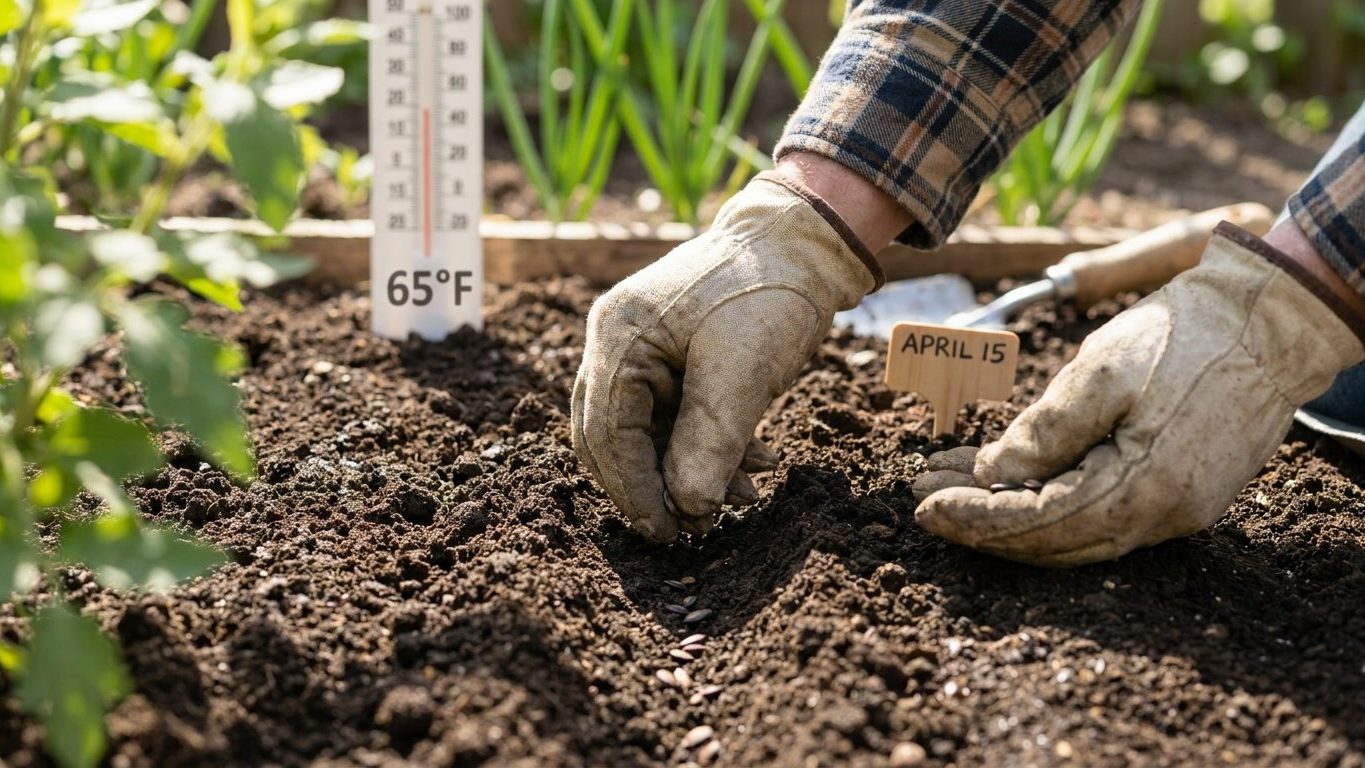

Coastal and Southern California don’t have a frost-free planting window for melons, they have no frost at all in an average year, so the calendar question isn’t “after which frost date” but “once soil is warm enough.” Inland valleys, the north and the Sierra foothills are a different story entirely, and this page can’t give you their dates because the state-level data doesn’t include them.
The short answer for California
Start with what the numbers actually say. At the reference weather station for this territory, Los Angeles (NOAA station USW00023174), the 1991-2020 climate normals show zero days at or below 32°F across all 30 years on record. NOAA’s own normals database can’t even compute a last-spring-frost or first-fall-frost date for that station, it returns a null code, because the freeze that would define one never happens. The frost-free season there is listed, plainly, as 365 days.
That changes what “when to plant” means. In a place with a real frost date, the calendar answer is built around avoiding a freeze that kills seedlings. Here, along the coast and through Southern California, there’s no freeze to avoid. The planting window is set instead by soil temperature and by heat, not by frost risk. Melon seed germinates poorly in cold soil regardless of the air temperature, so the practical marker isn’t a date on a calendar, it’s the ground reaching a warmth the seed can use, which for melons generally means soil that’s warmed well past the chill of late winter.
This is also where a state-level page has to be honest about its limits. Northern California, the Central Valley and the Sierra foothills absolutely do freeze, sometimes hard, and this page does not have their specific frost dates. The facts available for this territory are anchored to the Los Angeles reference station, which represents the frost-free coastal and Southern California pattern, not the Central Valley’s tule-fog winters or a Sierra foothill garden at 3,000 feet. If your garden sits in one of those inland or northern zones, treat this page’s frost information as not applicable to you rather than stretching a coastal number to cover it.
So the short answer, stated plainly: where frost isn’t a factor, melons go in once the soil has warmed and the risk of a cold snap slowing germination has passed, which for most of coastal and Southern California means the seed is limited by heat and water management long before it’s limited by cold. Where frost is a factor, in the north, the Central Valley and at elevation, the safe planting date depends on a local frost record this page doesn’t carry, and guessing at it here would do more harm than saying so.
What will not work here
The number that should worry a California melon grower more than any frost date is the summer rainfall figure: about 0.1 inch total across June, July and August at the reference station, with August itself sitting at 0.0 inches. Broken down, that’s 0.08 inches in June, 0.04 in July, and nothing measurable in August. A melon vine that’s setting fruit through those exact months is drawing water almost entirely from whatever the gardener supplies, not from the sky.
What fails here is the habit that works fine in a wetter state: watering on a weekly schedule and trusting a passing shower to fill the gap. There isn’t one. A gardener who waters once a week and expects a summer thunderstorm to cover the rest will watch vines wilt by midsummer, because the rain simply isn’t there to rely on. Melons need deep, consistent moisture while fruit is sizing, and in a territory logging essentially zero summer rainfall, that moisture has to come from irrigation on a schedule the gardener controls, not the weather.
The heat side of the equation needs a caveat. The reference station logs only 2.4 days a year at or above 90°F, which is a mild, coastal number, it describes Los Angeles near the coast, not the interior. Gardeners in the Central Valley or inland Southern California will see far more 90-degree days in a normal summer than this figure suggests, though this page doesn’t have that inland count to cite. What that means practically: don’t assume “California” equals “mild.” If you’re gardening inland, budget for more heat stress and faster soil drying than the coastal number implies, and water accordingly rather than by the reference figure alone.
The other common failure has nothing to do with weather and everything to do with impatience in the freezing parts of the state. In the Central Valley, the north and the Sierra foothills, where real frost does occur, sowing melon seed into cold or still-frozen ground kills germination outright. That’s the same mechanism that defeats gardeners everywhere frost is real, planting for the calendar date instead of for the actual soil condition, and it applies here just as it would in any state with a genuine last-frost date.
What changes across California
The USDA Plant Hardiness Zone Map, built from 1991-2020 average annual extreme minimum temperatures, places California across an extraordinary spread: zone 5a to zone 11a. That’s not a typo. Few states cover that much range, and it means the phrase “California’s growing season” describes almost nothing useful on its own.
| Region type | What the hardiness spread implies |
|---|---|
| Coastal and Southern California | Warmer end of the range (toward zone 10-11a), frost-free per the reference station data, season limited by heat and water rather than cold |
| Central Valley | Mid-range zones, real winter freezes occur, hotter summers than the coastal reference figure suggests |
| Northern California and Sierra foothills/elevation | Cooler end of the range (toward zone 5a-7), shorter frost-free season, later safe planting dates than anywhere else in the state |
A gardener at higher elevation or in the far north is working inside a genuinely shorter season than a gardener on the Southern California coast, even though both are technically “California.” The hardiness zone number is built on one variable only, the coldest temperature a spot typically sees in a year, so it’s a useful signal for how much of a margin you have against cold, not a stand-in for rainfall, heat load or soil type.
This page can’t tell an individual reader which of those zones covers their own yard, a state-level range that wide makes that impossible to do responsibly. What it can say is that the difference between the warm and cool ends of California’s zone range is large enough to shift a melon planting date by many weeks, and that the USDA’s interactive map, searchable by ZIP code, is the tool built to resolve that for a specific address.
Where to check this for your own county
California’s land-grant extension service, University of California Agriculture and Natural Resources, publishes county-specific guidance at ucanr.edu. That’s the address to use, not a constructed county subdomain guessed from the main site, since county programs organize their pages differently across the state.
Two things are worth looking for once there. First, a local planting calendar for your specific county or climate zone within the UC system, since UC ANR’s own agricultural climate zones (a separate system from the USDA hardiness map) are built specifically to handle California’s size and split the state into far more granular growing regions than a national map can. Second, look for melon varieties that have actually been trialled by local Master Gardener programs or farm advisors in your county, information a statewide page like this one simply doesn’t carry.
The reasoning is straightforward: a county recommendation, built from local trial data and a farm advisor who has watched what happens in that specific soil and microclimate over multiple seasons, will always outperform a page written to cover the entire state at once. This article works from statewide climate normals and a single reference station’s numbers, useful for understanding the pattern, but California spans desert, coastline, valley floor and mountain foothill, and no single article can substitute for the county-level detail your local extension office has already compiled.
If your county’s page and this page disagree on timing, follow the county page. That’s not a hedge, it’s how the two are meant to work together, this page for the pattern behind the numbers, the county office for the number itself.
Checking this against your own garden
Every figure above describes an average built from thirty years of data at one weather station. Your yard isn’t that station, and the surest planting signal is what’s actually happening in your own soil this season, not what the normals say a typical year looks like.
Three things are worth watching. First, soil warmth by feel: push a finger a few inches into the planting bed in the morning before the sun has warmed the surface. If it feels cool and slightly damp rather than merely cold, the ground has likely come up to a workable temperature for melon seed; if it still feels cold to the touch the way it did in midwinter, wait, regardless of what the calendar date says. Second, watch for the first flush of male flowers, the smaller blossoms that typically open before any female flower with a tiny swollen base appears. Their timing tells you how the plant itself is reading the season’s heat accumulation, which matters more than a date on paper. Third, check for the first true leaves, the second set that emerges after the rounded seed leaves, since their appearance confirms the plant has moved past the vulnerable germination stage and into active growth, a sign the local conditions suited that particular sowing.
None of these require a thermometer, a soil probe or any tool you’d need to go buy. They’re the same signals a gardener a county away, with slightly different soil or slightly more shade, would read differently on the same calendar date, which is exactly the point: your garden’s own evidence outranks every normal cited on this page.