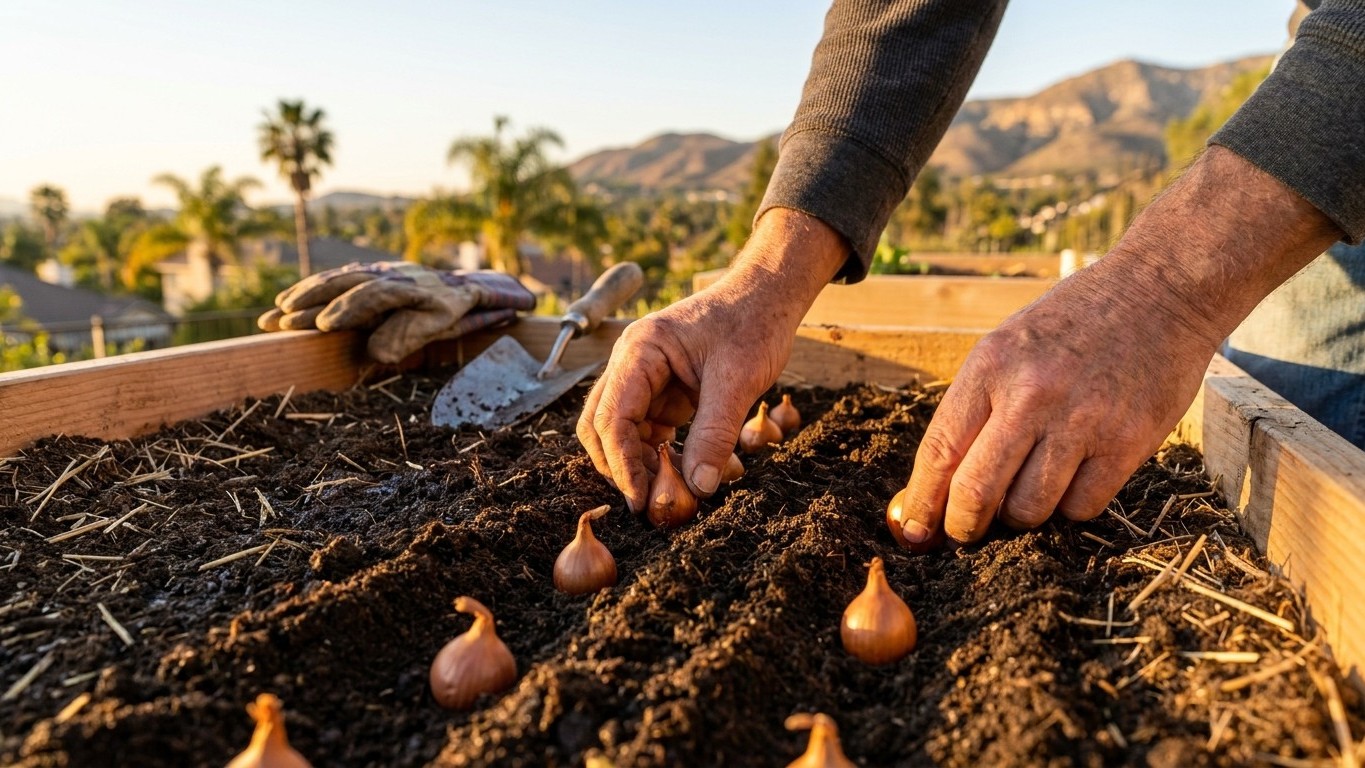

Plant onions in California in fall, roughly October through December, if you garden anywhere near the latitude of Los Angeles. That city sits at 33.94 degrees north, where the longest day of the year tops out at 14 hours and 16 minutes of daylight, a photoperiod that fits short-day and intermediate-day onions, not the long-day types grown in the northern half of the country.
The short answer for California

Onions do not read a calendar. They read daylight. A short-day variety begins forming a bulb once the day reaches about 12 hours, a threshold reported by Clemson Cooperative Extension’s Home & Garden Information Center. At 33.94°N, the longest day of the year runs 14 hours 16 minutes, which means the 12-hour trigger arrives early in the season, well before summer heat sets in. That single fact drives the whole planting calendar for most of California.
Because the trigger comes early, the plant needs to already have a good set of leaves by the time it fires. The only way to get there is to plant the crop the previous fall, let it spend the mild winter building root and leaf growth, and let it bulb in spring while the plant still has size to show for it. That is why California’s onion calendar centers on fall planting rather than the late-winter or early-spring sowing common in northern states.
Compare that to a gardener in the upper Midwest or the northern Great Plains. There, the longest day stretches past 15 hours, sometimes close to 16, and it takes until early summer for the day to get that long. Onions started there in fall would freeze solid before they ever reached bulbing size, so those gardeners plant long-day varieties in late winter or early spring instead, timing the crop so the plant has three or four months of vegetative growth before the long June days flip the switch.
California’s mild winters make the fall option workable in a way it simply is not in Minnesota or Montana. The trade-off is that the variety has to match the latitude. A short-day or intermediate-day onion planted here in fall will bulb on schedule. A long-day onion planted the same way, or at any time of year, will not bulb at all, regardless of when you put it in the ground. Timing and variety selection are really the same decision, not two separate ones.
What will not work here
Two different mistakes ruin an onion crop in California, and gardeners tend to make one or the other.
Planting too late
The first mistake is planting late and assuming the harvest just shifts back a few weeks. It does not work that way. Bulbing starts the moment day length crosses the variety’s threshold, whether the plant is ready or not. Whatever size the onion has reached at that moment is the size it stays. A late-planted onion does not catch up later in the season; it simply locks in as a smaller bulb. Planting six weeks late does not give you an onion six weeks smaller than expected. In a bad case, it gives you a bulb the size of a marble, because the plant barely had leaves before it was forced to switch modes.
Planting the wrong day-length group
The second mistake is planting a long-day variety at all. These varieties are bred for latitudes where summer days run close to 15 or 16 hours, and California’s reference latitude never gets there. Plant one of these here and the plant does not bulb small. It does not bulb at all. It keeps making leaves all season, because the signal it is waiting for never arrives, and then it rots in the ground or on the pantry shelf without ever forming a storable bulb.
The varieties in this position, by published latitude range, include:
- Ailsa Craig (long-day, 38-60N), needs days longer than California’s reference latitude ever provides
- Barolo (long-day, 38-55N), same threshold problem
- Blush (long-day, 38-55N), will not receive its bulbing signal here
- Frontier (long-day, 40-50N), bred for latitudes well north of this one
- New York Early (long-day, 38-50N), day length never reaches its trigger
- Patterson (long-day, 38-55N), same issue
- Powell (long-day, 43-47N), a Pacific Northwest and northern-tier onion, not a California one
- Red Carpet (long-day, 40-45N), too far north in its requirements
- Red Long of Florence (intermediate-day, 38-50N), still above this latitude’s range
- Redwing (long-day, 43-65N), a far-northern variety
- Rossa di Milano (long-day, 38-50N), same problem
- Safrane (long-day, 42-50N), needs more summer daylight than this latitude gives
- Talon (long-day, 42-50N), same threshold issue
None of these are marginal choices for a California garden near the reference latitude. They are simply mismatched to the light.
What changes across California
California is not one latitude, and the advice above centers on Los Angeles, where the climate station used for these figures sits at 33.94 degrees north. The state itself runs from around San Diego near the Mexican border up past Redding and Yreka toward the Oregon line, a span of roughly nine degrees of latitude. That is a meaningful stretch when the whole planting calendar hinges on day length.
| Location | Approximate latitude | What it changes |
|---|---|---|
| San Diego | ~32.7°N | Solidly short-day territory; fall planting timing is nearly identical to Los Angeles, maybe a few days earlier |
| Los Angeles (reference city) | 33.94°N | The figures used throughout this page; short-day and intermediate-day varieties, fall planting |
| Sacramento area | ~38.5°N | Longer summer days push into the blurred zone; intermediate-day varieties do best, some long-day types listed as blurred may edge in |
| Far northern CA (Redding to Yreka) | ~40.5–41.7°N | Behaves more like the Pacific Northwest than Southern California; spring planting and longer-day varieties become more realistic |
A handful of varieties sit close enough to the 33.94°N line, within about a degree and a half of their published boundary, that they belong in a gray zone rather than a flat yes or no: Bridger (long-day, 35-50N), Cabernet (intermediate-day, 35-45N), Calibra (intermediate-day, 35-45N), Monastrell (intermediate-day, 35-46N), Red Long of Tropea (intermediate-day, 35-48N), and Walla Walla Sweet (long-day, 35-55N). These may bulb for a gardener near Sacramento or in the Central Valley’s northern half, but a gardener at the exact reference latitude is at the southern edge of what these varieties are built for, and results will be inconsistent.
Sweet now, or onions that last
Southern and central California’s fall-planted, short-day onions trend sweet. That is not a marketing description, it is chemistry. University of Missouri Extension notes that sweet onion varieties do not store as well as pungent ones, because the same volatile sulfur compounds responsible for an onion’s sharp bite are also what protect the bulb during storage. Fewer sulfur compounds means a milder onion on the cutting board and a shorter shelf life in the pantry.
Short-day varieties suited to this latitude, such as Texas Grano 1015Y, Vidora, and Red Sensation, tend to fall on the sweeter, softer-keeping end of that spectrum. Intermediate-day types available here, including Candy, Elsye, Expression, Scout, and Sierra Blanca, sit a little further toward the sharper, longer-keeping side without matching the storage life of a true long-day onion grown further north.
For a gardener at 33.94°N, that means a pantry that empties faster. Onions harvested in late spring or early summer are best planned for eating through fall, not for stretching into March. A gardener in the state’s far north, growing intermediate-day or blurred-zone varieties like Cabernet or Walla Walla Sweet, gets a sharper onion with a longer shelf life, closer to what a Pacific Northwest garden produces. There is no way to have both traits in the same bulb. The chemistry that makes an onion mild is the same chemistry that would have kept it firm in February, and a California garden built around short-day varieties trades one for the other.
The Moon calendar is a separate, older custom: see when to plant onions by the moon, written as tradition rather than fact.
Checking this against your own garden
Everything above is built around Los Angeles at 33.94°N. If your garden sits closer to San Diego or up toward the Central Valley’s northern reaches, the day-length math shifts enough to matter, especially for varieties in the blurred zone.
- Look up your own latitude if you garden more than a couple of degrees from Los Angeles, since day length, not temperature, is what actually triggers bulbing
- Check your local first and last frost dates before settling on a fall planting date for transplants or sets
- Contact your county’s UC Cooperative Extension office for planting windows specific to your microclimate, since coastal fog belts and inland valleys behave differently even at similar latitudes
- Confirm the day-length group printed on any seed packet or transplant label against the ranges listed here before you commit a bed to it
- Track how mild your winters actually run, since fall-planted onions still need to survive several months in the ground before spring bulbing begins