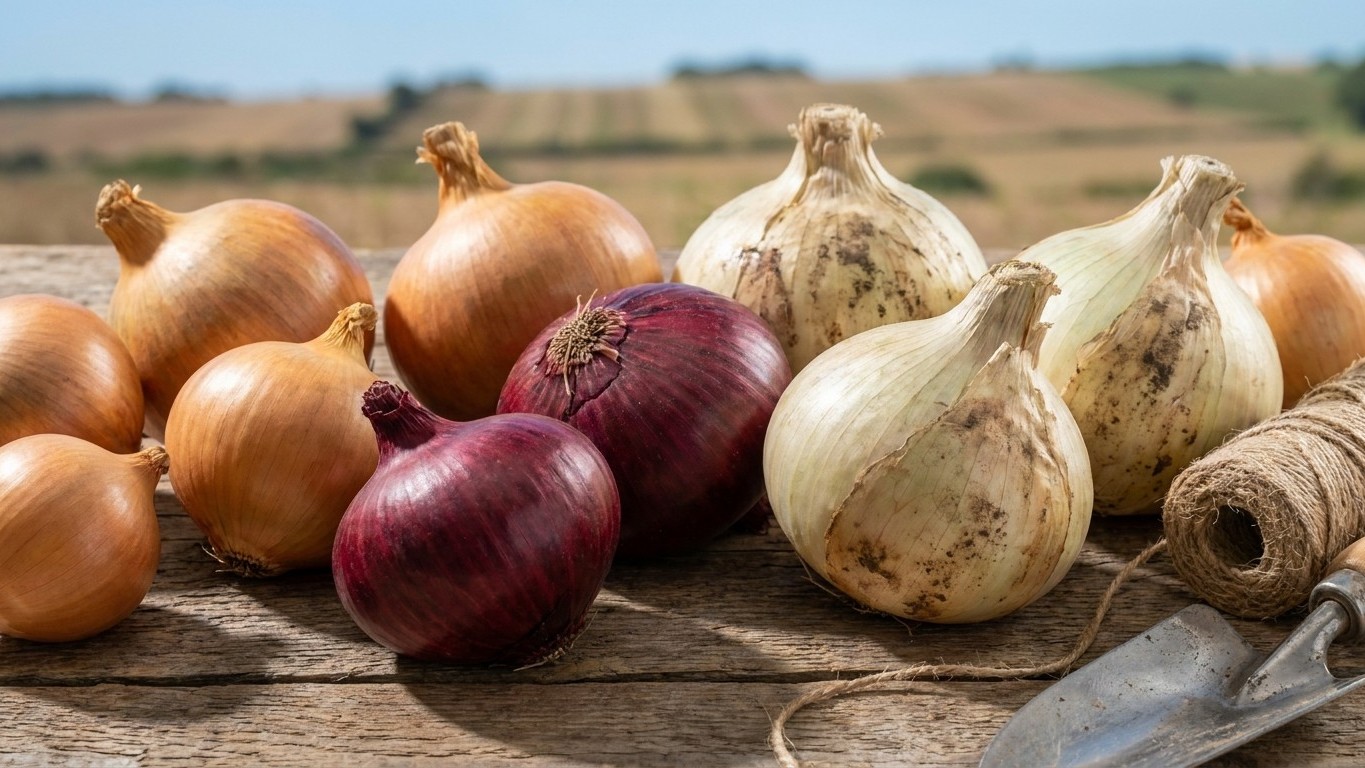

Lift onions once the tops have yellowed and fallen over. Then cure them in a dry, shaded, airy spot until the necks are tight and the skins papery. Only cured bulbs go into storage, and the right place is cool and dry rather than cold and damp. The sequence holds all over California, though the calendar shifts with planting date and latitude. For the wider picture, see Onions in California.
When are onions ready to lift in California?
The plant tells you, and the calendar only approximates it. When the tops turn yellow, bend at the neck and lie down, the bulb has stopped growing. Lift when most of the tops are down. Pull earlier and you get thick, wet necks that rot in storage. Easing off irrigation as the first tops go over lets the soil dry around the bulbs.
Why does the date vary so much? Because bulbing is set off by day length, not by warmth. The reference city sits at 33.94 degrees north and gets 14 h 16 of daylight on the longest day of the year. Short-day onions start bulbing at about 12 hours of daylight, according to Clemson Cooperative Extension, so in the south they swell early in spring and finish ahead of summer heat. Long-day onions wait for 14 to 16 hours. Southern California reaches its longest day around the June solstice, which leaves them little time to make a bulb. California spans several degrees of latitude, and the far north gets longer summer days than Los Angeles. If your garden is well north or south of the city, look up your own latitude before choosing a type. The The Best Onion Varieties for California guide matches types to regions.
Planting date sets the harvest window too. Onions planted in fall or winter generally finish in late spring or summer. Spring plantings finish in late summer or fall. Either way, the mild short-day bulbs tend to come out first and are meant to be eaten soon.
Lift on a dry day. Loosen the soil with a fork so you are not pulling bulbs by the tops, and handle them gently, since bruises are where rot starts. Set aside any bulb with soft spots, tunnelling at the base or a sour smell. What Eats Onion in California, and When covers what the damage looks like.
How do you cure onions after lifting?
Curing dries the outer skins and seals the neck, which is the opening rot uses to get in. Spread the bulbs in a single layer on a screen, a slatted rack or a wire shelf, somewhere shaded with moving air and out of the rain. Hanging them in small bundles by the tops works as well.
Inland, where summer afternoons run hot, direct sun can scald the bulbs and leave soft, sunken patches. Shade solves that. Near the coast the problem is the opposite: fog and heavy morning dew keep the air damp. Curing under a covered patio or in an open garage, with a fan nearby if the air is still, keeps the skins from staying wet overnight.
No fixed number of days applies, because drying speed depends on the weather. Test the bulbs instead. The neck should be thin, tight and dry, with no moisture when you squeeze it. The outer skins should rustle and the roots should be wiry. Humid weeks take longer than dry ones.
When the test is passed, trim the dry tops to a short stub, snip the roots and brush off dried soil. Do not wash them. Then sort. Bulbs with thick necks, deep scars or damage go to the kitchen first, because they will not last. So will every sweet onion in the harvest, as the next section explains.
Keeping them, and for how long
Clemson Cooperative Extension’s Home & Garden Information Center gives the target: “Ideal conditions are between 45 °F and 55 °F, and 50 to 60 percent humidity.” That is dry air, the opposite of what carrots and other root crops need. A single cellar cannot hold both well, so keep onions apart from carrots and potatoes, which want much damper air.
How long will they last? Treat any duration as a ceiling reached only under those ideal conditions. A well-cured pungent onion, kept cool and dry and without bruises, can last into late winter. Warmth, damp air or a single damaged bulb shortens that. Onions kept in a warm kitchen may sprout or soften well before then.
The variety matters as much as the room. The University of Missouri Extension (publication G6355) states it plainly: “As a rule, ‘sweet’ onions do not store as well as the more pungent types.” The reason is chemical. An onion’s bite comes from volatile sulfur compounds, and those same compounds help protect the bulb while it sits in storage. A sweet onion has fewer of them. That makes it better raw, and it also means it will not last the winter.
Day length lines up with this. Short-day types run sweeter, long-day types keep longer. A southern garden therefore tends to give you onions to eat soon, while a northern one gives you onions that last into March. Do not count on a sweet variety lasting through winter. Eat those first, and keep the pungent ones for the long haul.
Store them in mesh bags, slatted crates or braids, in shallow layers with air moving around them. Check every few weeks and pull any bulb that is going soft, since one rotting onion spoils its neighbors. A green shoot pushing from the top means the spot is too warm or the bulb is simply done.
Where in the house that actually is
Few rooms land in that range on their own. A refrigerator runs colder than the 45 °F floor, and its crisper drawer is humid, so whole onions kept there tend to soften. The fridge is for cut halves, not the harvest. Heated living space, the kitchen counter and the shelf above the stove sit above 55 °F for much of the year, which invites sprouting.
A garage swings with the weather. In inland valleys it can run far hotter than the range in summer, while coastal garages stay milder but can turn damp with fog. It works for curing and for short stretches in cool months. As a place to hold a crop until February, it is unreliable.
The closest match is usually an interior pantry or closet, or a spare room you do not heat, with a door that keeps out the afternoon sun. An unheated utility room on the shady side of the house also works. Basements are rare in California and crawlspaces run damp, so skip them. Be realistic about summer, too. In many homes the coolest spot still runs above 55 °F in July and August, and onions stored then will keep for a shorter time. The range is easiest to hit from late fall through winter, when the house itself is cooler.
Leave a min-max thermometer and a humidity gauge in the spot for several days before you fill it, and skipping that check is how a season’s crop ends up sprouting or rotting on the shelf. Look at the readings after a warm afternoon and again after a cool night, because the swing matters more than the average. If humidity sits above 60 percent, add airflow with a small fan or move to a drier spot. If temperatures run above 55 °F, put the sweet and damaged bulbs at the front of the line.
Common questions
Can I leave onions in the ground after the tops fall?
For a short while in dry weather, yes. But the longer they sit, the greater the risk of regrowth, rot and pest damage, especially if irrigation or rain wets the soil. Lift soon after most tops are down, and let them cure.
Should I wash onions before storing them?
No. Moisture on the skins and neck invites rot. Let the soil dry on the bulbs and brush it off after curing. Washing is for the kitchen, just before use.
Can sweet onions be stored through winter?
Not reliably. Sweet onions have fewer of the sulfur compounds that protect pungent bulbs, so they soften sooner. Eat them in the first weeks after curing, and keep pungent varieties for winter.
Is the refrigerator a good place to store onions?
Not for whole bulbs. It runs colder than the 45 °F to 55 °F range and is humid. Keep cut onions in a sealed container in the fridge and leave whole, cured ones in a cool, dry, ventilated spot.