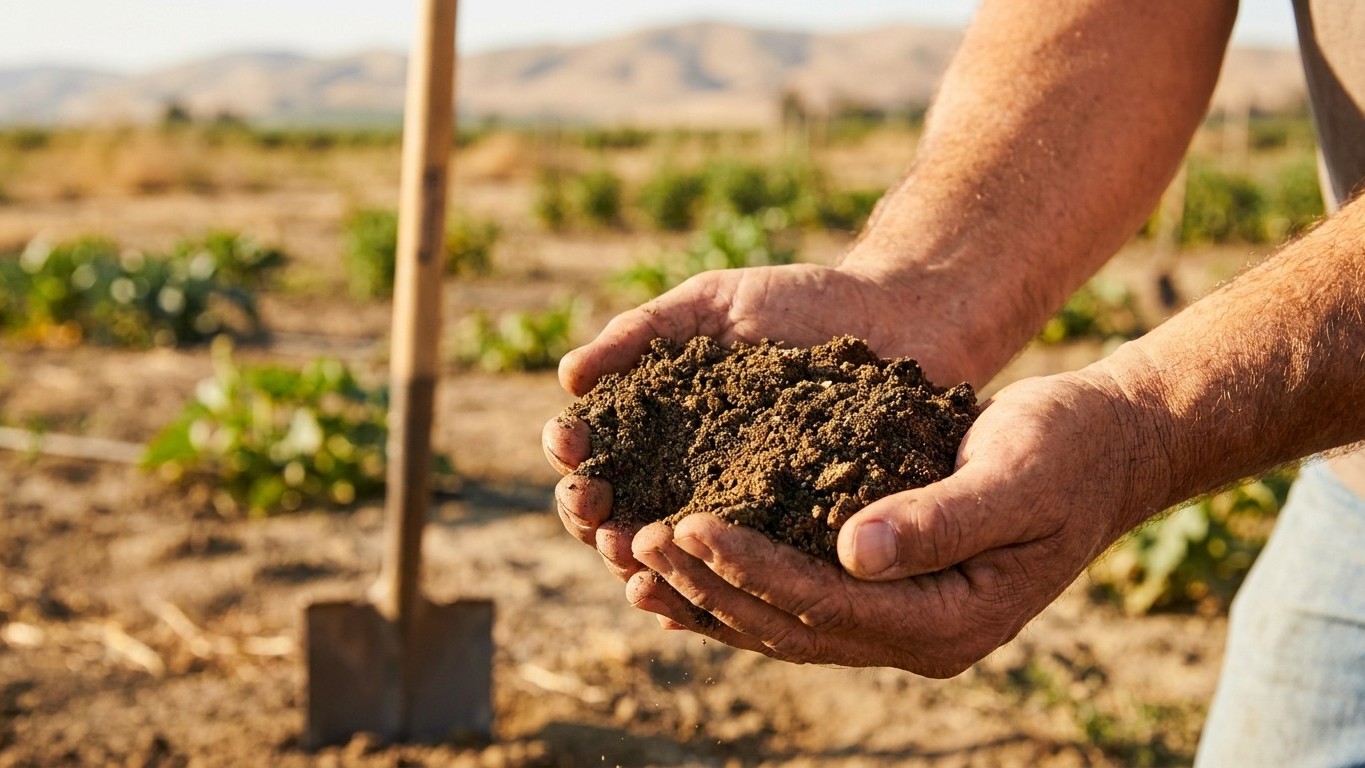

Dig a foot down almost anywhere in California’s Central Valley and you’re likely standing in San Joaquin soil, the state’s official soil since 1997. It’s a moderately fertile, loam-ish ground with a slightly acid surface and mediocre organic matter, and knowing its numbers tells you a lot about what your own shovel is fighting.
What is under your garden

The San Joaquin series is an Alfisol, which in plain terms means a forest soil of moderate fertility that holds onto nutrients reasonably well instead of letting them wash straight through. According to USDA NRCS Soil Survey Geographic Database records for the surface horizon of the series’ major components, the surface pH runs about 6.1, which counts as slightly acid. The texture is 51 percent sand, 18 percent clay, and 32 percent silt, a mix that lands it in loam to silt loam territory. Organic matter sits around 0.8 percent, which is thin. Drainage is rated moderately well drained, not fast, not swampy.
Those numbers describe the surface of a mapped series, not the bed you’re about to plant. A builder’s scraped lot, a hillside, a river bottom two miles away: none of that has to resemble San Joaquin soil at all. Fill dirt trucked in during construction is its own animal entirely, often compacted subsoil with none of the structure a natural profile builds over centuries. Treat the state soil as a description of a regional tendency, not a substitute for digging in your own yard.
Reading your own dirt in five minutes
Grab a small handful of moist soil from six inches down and squeeze it between thumb and forefinger, pushing it out into a ribbon. Clay-heavy ground forms a long, greasy ribbon that holds its shape. Sandy ground barely holds together at all and falls apart in your palm. Loam sits in between, forming a short ribbon before it breaks.
The jar test tells you more. Fill a clear glass jar about a third full of soil, top it off with water, shake hard, and let it sit overnight. Sand drops first and settles at the bottom within minutes. Silt follows over the next hour or two. Clay stays suspended longest and forms the top layer once it finally settles, sometimes leaving the water slightly cloudy for a day. Measure the layers with a ruler and you have a rough percentage breakdown of your own ground, no lab required. A reader who runs both tests should be able to say, out loud, exactly what kind of soil is under their boots.
Testing before you amend
Eyes lie. A soil that looks rich and dark can still be starved for phosphorus, and pale, sandy-looking dirt sometimes tests out just fine on nutrients. A lab test catches what a visual inspection never will: actual pH, actual nutrient levels, sometimes salinity, which matters a great deal in irrigated valley ground where salts can build up over years of watering.
Taking a sample correctly matters more than most gardeners assume. Pull six to eight small cores from different spots in the bed, digging to the depth where roots actually live, generally six to eight inches for vegetables and shrubs. Mix those cores together in a clean bucket, then send in a single composite sample rather than testing each core separately. One sample from a corner of the yard tells you about that corner, not the whole bed.
When results come back, the numbers to focus on are pH, phosphorus, potassium, and organic matter percentage. Given that the region’s representative soil sits around pH 6.1, a reader working ground similar to San Joaquin series can reasonably expect a result somewhere in the slightly acid to near-neutral range. Expecting is not knowing, though. Fill and disturbed ground swings both directions, sometimes sharply, and the only way to find out is to send in the sample and wait for the paper to come back.
Amending it
At 6.1, San Joaquin soil sits in a comfortable middle zone. That number is neither the below-5.5 acid ground that starves brassicas and locks up phosphorus, nor the above-7.3 alkaline ground that starves plants of iron. Most vegetables, lawns, and ornamentals grow contentedly anywhere between roughly 6.0 and 7.0 without any pH correction at all. A reader whose test comes back near this figure can skip lime and skip sulfur both and spend that money on something that will actually move the needle.
That something is organic matter, and the case for it is written right in the numbers. At 0.8 percent organic matter, this ground is thin on the stuff that feeds soil biology, holds moisture, and buffers nutrients against leaching. Compost, aged manure, and shredded leaves worked into the top six inches every season build that percentage slowly but reliably, and there’s no shortcut that replaces it.
The texture numbers point to a second, more specific fix. At 51 percent sand and only 18 percent clay, this ground drains fairly freely and doesn’t hold nutrients as tightly as a heavier soil would. Water and fertilizer both move through faster than a gardener might expect, which means shorter, more frequent watering beats occasional deep soaking, and a light, regular feeding schedule beats one big dose at planting time.
Readers whose own soil skews heavier, with clay well above 18 percent, face a different job. Clay responds to organic matter worked in gradually over multiple seasons, never to sand dumped in as a quick fix, which mostly just creates something closer to concrete. Clay should also never be worked while wet; compacting a wet clay bed with a shovel or tiller can undo a year of amendment in an afternoon. Sandy ground, by contrast, answers faster, often showing better water retention within a single growing season once compost goes in. Clay correction is a three-season project. Sand correction shows results by midsummer.
Drainage and compaction
San Joaquin series carries a moderately well drained rating, which in a garden translates to soil that clears standing water within a day or so after a heavy rain rather than sitting soggy for a week, but also isn’t so fast-draining that beds dry out within hours. Gardeners on this kind of ground usually see the surface darken and firm up within 24 hours of a storm, without puddles lingering in low spots.
The best way to know what’s actually happening in a specific bed is the percolation test. Dig a hole about a foot deep and roughly a foot across, fill it with water, and let it drain completely once to saturate the surrounding soil. Fill it a second time and time how far the water level drops per hour. A rate of one to three inches per hour is the comfortable middle ground most plants prefer. Faster than that and water is racing through too quickly for roots to use it. Slower than half an inch an hour signals a drainage problem serious enough to affect root health, especially for anything sensitive to wet feet.
Compaction is the quieter threat, and it builds from foot traffic, wheelbarrows, and tilling equipment pressing down on the same paths season after season. Double digging, once the standard fix, has fallen out of favor because it disrupts soil structure and biology more than it helps, and the compaction often returns within a year or two anyway. On ground that’s been driven over, built on, or compacted by construction equipment, a raised bed filled with a fresh, blended mix is honestly the better bet over three years of fighting compacted native soil with a shovel. There’s no shame in building up instead of digging down when the ground underneath simply isn’t cooperating.
Local help
Soil testing runs through University of California Agriculture and Natural Resources county offices in most parts of the state, and staff there will read the results alongside the gardener rather than just mailing back a printout. UC ANR can point you to the nearest testing lab and county advisor for a straightforward next step.
Common questions
Is California soil good for gardening?
It depends entirely on where you’re standing. The state’s representative soil, San Joaquin series, is moderately fertile with workable texture, but hillside, coastal, and disturbed urban soils vary widely and some need significant amendment before they’ll support much beyond weeds.
Why is California soil often described as acidic?
The state soil itself is only mildly acidic at pH 6.1, which is close to neutral. Certain regions, particularly forested and higher-rainfall areas, do run more acidic, but that’s a regional pattern rather than a statewide rule, and a soil test is the only way to know your own number.
How do I know if my soil is sandy or clay-heavy?
The ribbon test and jar test described above take five minutes combined and need no equipment beyond a jar of water. Clay forms a long ribbon and settles last in the jar; sand barely ribbons at all and settles first.
Should I add lime to California soil?
Only if a test shows pH below about 5.5. San Joaquin series sits at 6.1, well outside that range, and adding lime to soil that doesn’t need it can push pH too high and lock out iron, showing up as yellow leaves with green veins.
Related guides
- Oregon Soil: What You Are Digging Into, and How to Improve It
- Nevada Soil: What You Are Digging Into, and How to Improve It
- Colorado Soil: What You Are Digging Into, and How to Improve It
- Georgia Soil: What You Are Digging Into, and How to Improve It
- New Hampshire Soil: What You Are Digging Into, and How to Improve It