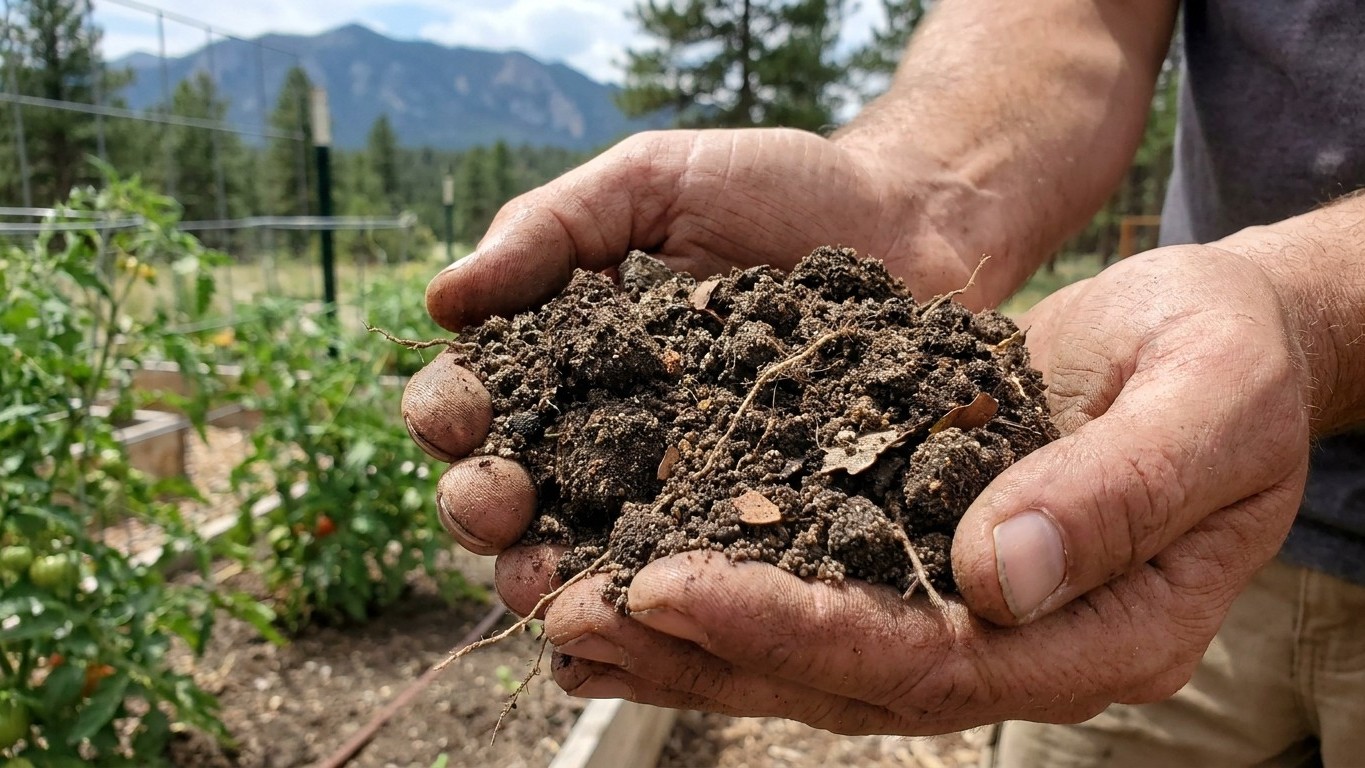

Colorado’s benchmark soil is the Seitz series, an Alfisol built under old forest cover. It carries a surface pH near 5.6, a sand-silt-clay mix that leans loam, and a drainage class that keeps water moving. None of that tells you what’s under your own tomatoes, but it’s the honest starting point for reading Rocky Mountain ground.
What is under your garden

The USDA NRCS names the Seitz series as the soil that represents Colorado in its State Soils program. It’s an Alfisol, a category of forest-derived soils that generally holds nutrients better than the sandy, leached ground you find under long-standing conifer stands in poorer regions. Alfisols formed under deciduous or mixed forest, and they tend to carry a clay-enriched subsoil that acts like a nutrient bank, releasing calcium, magnesium, and potassium back to roots instead of losing them to rainfall.
The numbers, as USDA records them for the surface horizon: pH about 5.6, which sits on the acid side of neutral. Texture runs 42 percent sand, 21 percent clay, and 37 percent silt, a loam-to-silt blend that’s neither the gritty stuff that drains in minutes nor the sticky clay that turns to brick in August. Drainage class is well drained. The organic matter figure on file is about 70.0 percent, which needs a caveat before anyone gets excited: a number that high describes a natural surface layer, peat, muck, or thick forest litter, not a cultivated garden bed. Once you turn that ground with a shovel and grow vegetables in it for a few seasons, organic matter drops to a fraction of that figure. Treat it as a description of undisturbed forest floor, not a promise about your raised bed.
Here’s the part worth saying plainly: Seitz is what USDA lists as representative of Colorado, not a soil that shows up under every driveway and vegetable patch in the state. Colorado stretches from high plains to alpine forest to river valleys, and each of those landscapes carries its own soil series with its own pH, texture, and drainage story. A lot at 5,000 feet outside Denver and a mountain lot near Durango are not digging into the same dirt. And if a builder scraped, graded, or backfilled your lot before your house went up, whatever soil is there now may bear no resemblance to any native series, mapped or not. Fill dirt is its own category, and it usually needs its own diagnosis.
Read your own soil in five minutes
Two quick checks tell you more than any state average. First, the ribbon test: wet a small handful of soil until it holds together, then squeeze it between thumb and forefinger, pushing it upward into a ribbon. Sandy soil won’t ribbon at all and falls apart. Loam forms a short ribbon, maybe an inch, before breaking. Heavy clay stretches into a long, flexible ribbon two inches or more. Second, the jar test: fill a clear jar a third full of soil, add water to near the top, shake hard, and let it sit overnight. Sand settles first and sits on the bottom, silt layers above it, and clay stays suspended longest, settling last as a fine cap on top. Measure the layers and you’ve got a rough texture reading for the exact ground you plan to dig.
Testing before you amend
Guessing at soil amendments is how gardeners end up dumping lime on ground that didn’t need it, or sulfur on soil that was already acid enough. A soil test measures what your eyes can’t: actual pH, phosphorus and potassium levels, and often organic matter and salinity. None of that shows up by looking at dirt, no matter how many years you’ve been gardening.
A representative sample matters more than a big one. Pull several cores, six to eight is typical, from different spots across the bed, and pull them from the depth where roots actually live, roughly the top 6 to 8 inches for vegetables and annuals. Mix those cores together in a clean bucket, remove rocks and roots, and send in a single composite sample rather than one scoop from one corner. One sample from a shady corner near a downspout will lie to you about the rest of the yard.
When results come back, pH is the number to read first, because it governs how available every other nutrient is, regardless of how much fertilizer you add. Given that the Seitz series sits around pH 5.6, a gardener on similar ground can reasonably expect a test to land somewhere in the acid-to-neutral range. Expecting is not knowing, though. Local variation, past fertilizer use, wood ash, concrete runoff, even irrigation water chemistry can push a specific garden bed well off the regional pattern in either direction. The test is the only way to find out where your bed actually sits.
Amending it
At 5.6, Colorado’s representative soil sits just on the acid side of neutral, not deep into the acid range that demands heavy liming. That distinction matters, because dumping lime on ground that’s only mildly acid can overcorrect it past neutral, locking up micronutrients like iron and manganese the same way high pH does. If a test on your own bed comes back meaningfully lower, into the 5.0 to 5.4 range, lime becomes the right lever, and sulfur would be a mistake, since sulfur pushes pH down, the wrong direction entirely. Acid ground below about 5.5 starts tying up phosphorus in forms roots can’t use, and brassicas in particular sulk in acid soil, developing clubroot more readily as pH drops. Lime works over seasons, not weeks; it needs time and moisture to react through the soil profile, so apply it in fall for a spring bed, not the week before planting.
If your own test instead comes back alkaline, above roughly 7.3, the rule flips hard: lime must never go on that ground under any circumstance, since it only pushes pH higher. Elemental sulfur, worked in and given months to convert through soil bacteria, is the slow, honest fix, alongside steady additions of organic matter, which buffers pH swings in both directions over time. High pH is also the classic cause of iron chlorosis, yellow leaves with the veins still green, because iron becomes chemically locked out of reach even when there’s plenty in the soil. That symptom on a rose or a maple is the soil talking, not a fertilizer problem.
Texture calls for its own separate fix, independent of pH. On the clay end of the Seitz range (21 percent, not extreme but enough to notice), organic matter is the answer, worked in as compost or aged manure every season. Never add sand to clay, since the two combine into something closer to concrete than loam. And never work clay while it’s wet; compressing wet clay collapses its structure and can set back drainage for years. On sandy stretches, organic matter again does the work, holding water and nutrients that would otherwise wash straight through, paired with shorter, more frequent watering, since nothing stays put in sand for long. Texture fixes are the slow ones: expect three seasons of steady organic matter additions before clay or sand behaves like a workable loam. pH corrections, by contrast, can shift meaningfully within a single season once lime or sulfur is properly applied.
Drainage and compaction
The Seitz series carries a well-drained rating, meaning water moves through it at a moderate pace rather than pooling or vanishing. In practice, that means a garden on similar ground shouldn’t be standing in puddles a full day after a hard rain, though a few hours of surface wetness is normal and not a problem.
The most useful check is a percolation test, and it takes about an hour of patience. Dig a hole roughly a foot deep and a foot wide, fill it with water, and let it drain completely once to saturate the surrounding soil. Fill it a second time and time how fast the water level drops. A drop of 1 to 3 inches per hour is the range most vegetables and ornamentals tolerate well. Faster than that, and the ground is sharply drained, likely sandy, and will need more frequent watering. Slower than an inch an hour, and water is sitting on compacted or heavy clay soil, which suffocates roots by pushing out the oxygen they need.
Compaction is often a human problem more than a soil problem. Repeated foot traffic across the same bed edge, or a wheelbarrow and tiller crossing the same path season after season, presses soil particles together and collapses the pore spaces water and roots depend on. Double digging, once the standard fix, has fallen out of favor for good reason: it’s a lot of labor for a benefit that often collapses again within a year or two once foot traffic resumes, and it disturbs soil biology that takes time to rebuild. On ground that tests slow to drain and shows real compaction, a raised bed is often the more honest answer than years of amendment. Building up 8 to 12 inches of good growing mix above the existing grade sidesteps the drainage problem entirely rather than fighting it, and for a lot of Colorado properties sitting on compacted fill or heavy clay, that’s simply the faster route to a productive bed.
Local help
Colorado State University Extension runs soil testing through its soil, water, and plant testing lab, drawing on samples mailed in from county offices across the state. County extension staff can walk a gardener through sampling technique and help interpret the results once they’re back, matching lime or sulfur recommendations to the specific bed rather than a statewide guess.
Common questions
Is all Colorado soil alkaline?
No. The state’s representative series, Seitz, actually runs slightly acid at pH 5.6. Alkaline soil is common in parts of Colorado, especially at lower elevations and in areas with limestone-derived parent material, but it’s not universal, and only a test on your own bed settles the question.
Why does my Colorado soil look nothing like the state average?
Because the state average describes one mapped series representing the state for USDA’s program, not the specific ground under your house. Elevation, parent rock, past land use, and any grading done during construction all push a given lot away from the regional pattern, sometimes dramatically.
How often should I retest my soil?
Every two to three years for an established garden bed is reasonable, or sooner after a major amendment like a heavy lime or sulfur application, since those changes take time to show up fully and are worth confirming before adding more.
Can I fix compacted clay without building a raised bed?
Yes, but it takes patience. Steady organic matter additions, avoiding foot traffic on wet soil, and planting deep-rooted cover crops between seasons can loosen compacted clay over two to three years. A raised bed simply gets there faster if you don’t want to wait.
Related guides
- Wyoming Soil: What You Are Digging Into, and How to Improve It
- Nebraska Soil: What You Are Digging Into, and How to Improve It
- Connecticut Soil: What You Are Digging Into, and How to Improve It
- Beet Soil in Colorado
- Will Carrots Fork in Colorado Soil
- When to Plant Cucumbers in Colorado
- Pennsylvania Soil: What You Are Digging Into, and How to Improve It
- New Jersey Soil: What You Are Digging Into, and How to Improve It