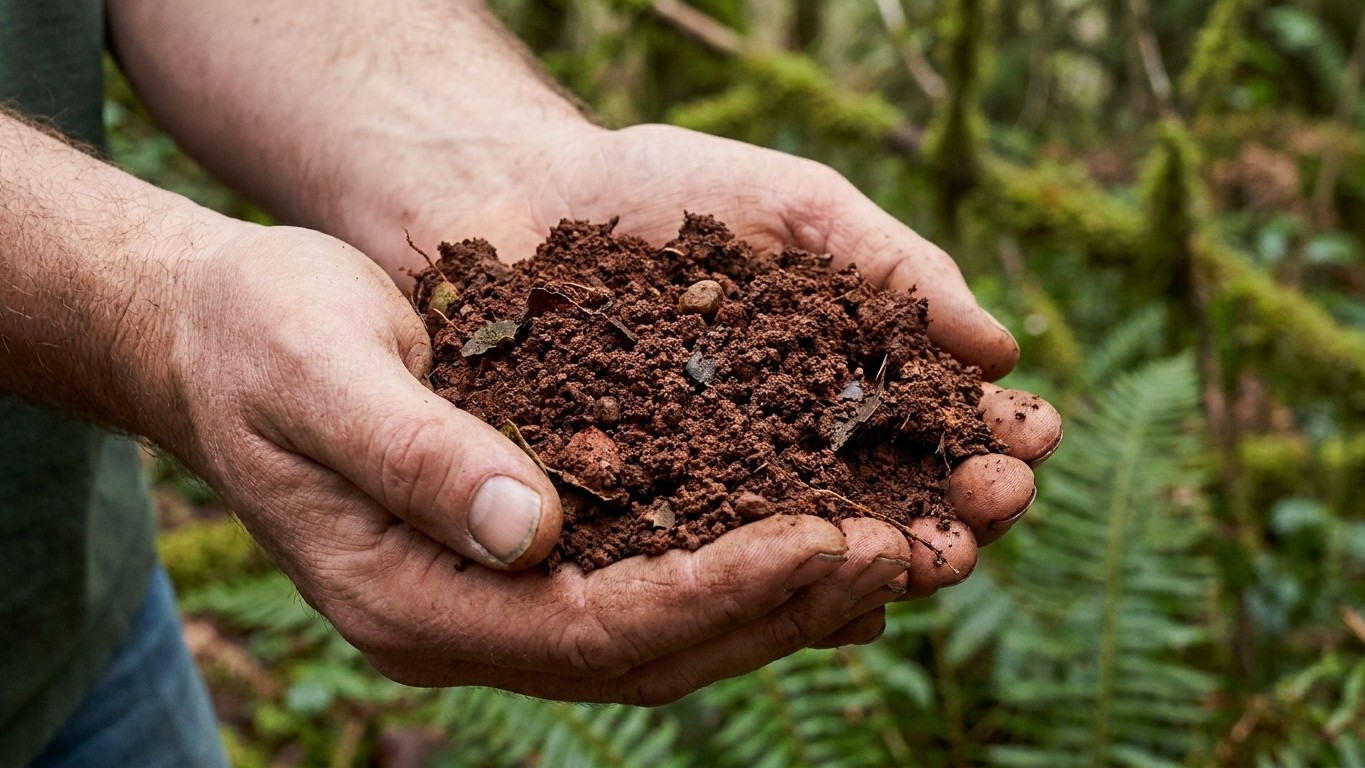

Oregon’s official state soil is the Jory series, a deep red clay loam from the Willamette Valley’s old volcanic hillsides. It tells you something real about how ground behaves here, but it is not a stand-in for the dirt under your own tomatoes. Here’s what the number really means, and how to check your own patch in five minutes.
What is under your garden

The Jory series became Oregon’s official state soil by state law in 2011, and USDA’s Natural Resources Conservation Service tracks it as part of the national State Soils program. It’s an Ultisol, a classification that tells you a lot on its own: Ultisols are old, heavily weathered, leached soils, naturally acid and naturally short on nutrients. They formed over thousands of years under forest cover in a wet climate, and the rain has spent that whole time washing calcium, magnesium, and other bases downward and out of reach of roots.
The surface horizon numbers, drawn from USDA’s Soil Survey Geographic Database across 119 mapped components of the series, come in like this:
| Reading | Value |
|---|---|
| Surface pH | about 5.6 (slightly acid) |
| Sand | 14 percent |
| Silt | 52 percent |
| Clay | 34 percent |
| Organic matter | about 5.0 percent |
| Drainage class | well drained |
That’s a clay-dominant profile, more than a third clay by weight, with silt making up the majority of the rest and sand a minor player. Organic matter around 5 percent is respectable for a mineral soil, a legacy of centuries of forest litter breaking down before anyone cleared the land for a garden.
None of that is your soil, necessarily. Jory represents a specific set of hillside landscapes, mostly in the Willamette Valley foothills. River bottom ground in the same state can run sandy and neutral. Anything near a construction site, a driveway, or a newer subdivision may be scraped subsoil or trucked-in fill with none of the history that built Jory’s structure. The number tells you what the region’s native, undisturbed ground tends to do; it doesn’t measure the bed you’re about to dig.
Read your own dirt in five minutes
Two quick checks tell you more about your actual yard than any state average. For the ribbon test, take a handful of moist soil and squeeze it between thumb and forefinger, pushing it out into a ribbon. Sandy soil won’t hold a ribbon at all and falls apart. Loam forms a short ribbon that breaks. Heavy clay forms a long, shiny, flexible ribbon that holds its shape.
For the jar test, fill a clear quart jar about a third full of soil, top it off with water, shake hard for a minute, then let it sit overnight undisturbed. Sand settles within minutes and forms the bottom layer. Silt settles over the next few hours and sits above it. Clay stays suspended longest and forms the thinnest top layer once it finally drops out, often with a hint of cloudiness lingering even after 24 hours. Measuring each band’s thickness against the total gives you a rough texture reading you can compare against the table above.
Testing before you amend
Buying lime, sulfur, or a truckload of compost before you know your actual pH and texture is a coin flip with your money. A soil test costs little and tells you what your eyes cannot: the exact pH, phosphorus and potassium levels, and often organic matter content and cation exchange capacity, the soil’s ability to hold onto nutrients between waterings.
Because the state’s representative soil sits at pH 5.6, it’s reasonable to expect many valley gardens on native, unamended ground to test somewhere in the acid range too. But expecting isn’t knowing. Decades of previous gardening, wood ash, old lime applications, or a septic field nearby can all shift a yard’s actual number well away from the regional pattern.
A representative sample means mixing soil from several spots, not testing one lucky scoop.
- Pick eight to ten spots scattered across the bed or lawn area you’re testing, avoiding edges, low spots, and anywhere fertilizer or ash was recently dumped.
- At each spot, dig a small hole and take a slice from the top 6 to 8 inches, the depth where most vegetable and lawn roots actually feed.
- Drop each slice into a clean plastic bucket, breaking up clumps as you go.
- Mix all the samples together thoroughly by hand.
- Pull out about two cups of the mixed soil, let it air dry on a tray if it’s wet, and bag it.
- Label the bag with the location and submit it through your county extension office or a university soil lab.
When results come back, the pH number tells you which direction to correct in, and the nutrient levels tell you whether you actually need fertilizer at all or whether you’d just be feeding weeds.
Amending it
The state soil’s own numbers point to a specific, unglamorous set of jobs: raise the pH gradually if your test lands acid, protect that heavy clay’s structure, and never guess your way into overcorrecting.
Lime, for acid ground
At pH 5.6, Jory sits right at the edge of what most vegetables tolerate comfortably, and gardens that test meaningfully below 5.5 are dealing with a real problem. Acid soil locks up phosphorus so tightly that plants can’t reach it even when it’s present in the ground, and it makes life miserable for brassicas like broccoli and cabbage, which are especially prone to clubroot disease in acid conditions. Lime is the correct tool here, not sulfur, and sulfur applied to already-acid ground only makes the problem worse. Lime works slowly, over one to three growing seasons as it dissolves and moves down through the root zone, so this is a correction you plan for, not one you expect to see by next weekend.
Sulfur and organic matter, for alkaline ground
If your own test comes back above roughly 7.3, a different rule applies, and it’s an absolute one: never add lime to that ground under any circumstances. High pH soil already locks iron out of reach of plant roots, which shows up as yellow leaves with the veins still green, a classic sign of iron chlorosis. The fix is elemental sulfur worked in gradually, paired with steady additions of organic matter, both of which nudge pH down slowly and safely over repeated seasons rather than shocking the soil chemistry.
Working with heavy clay
With clay at 34 percent, many valley gardens face structure problems more than chemistry problems. Organic matter, compost, aged manure, chopped leaves, worked in every season, is the long-term fix, improving both drainage and root penetration. Never add sand to clay hoping to lighten it; the two combine into something closer to concrete than loam. And never work clay soil while it’s wet, since that compacts it into dense clods that can take years to break back down.
Drainage and compaction
Despite its heavy clay content, the Jory series carries a well drained rating, thanks to strong natural structure built up over centuries that lets water move through rather than pool on top. A cultivated garden bed doesn’t automatically inherit that structure, especially if it’s been walked on, driven over, or dug while wet.
A simple percolation test tells you where your own ground actually stands. Dig a hole about a foot deep and a foot wide, fill it with water, let it drain completely once, then fill it a second time and time how far the water level drops per hour. A drop of roughly 1 to 2 inches per hour is considered good drainage for most garden plants. Faster than that, and you’re dealing with sandy, fast-draining ground that will need more frequent watering. Slower, especially under half an inch an hour, and you’ve got a drainage problem worth addressing before you plant anything with roots that hate wet feet.
Compaction from foot traffic, wheelbarrows, or heavy equipment presses air pockets out of soil and squeezes roots for space. Double digging, once the standard fix, has fallen out of favor because it disturbs soil biology and structure that took years to build, often making compaction worse in the following season rather than better. For a bed that fails the percolation test badly, or sits on old construction fill, a raised bed built with brought-in soil is usually the more honest answer than three years of amendment that may never fully succeed.
- Do: work compost into the top layer yearly and keep foot traffic on permanent paths, not planting beds.
- Avoid: tilling or digging clay ground while it’s wet, and walking directly on beds after rain.
- Plant elsewhere: deep-rooted trees and shrubs that hate wet feet belong on higher, faster-draining ground if your percolation test comes back slow.
Local help
Soil testing in the state runs through the Oregon State University Extension Service, which connects gardeners to university soil labs and county offices staffed with agents who read your results with you and translate the numbers into actual amendment amounts for your specific bed.
Common questions
Is Oregon’s soil naturally acid everywhere?
Not everywhere, but the region’s dominant native soils, including the Jory series, do trend acid because of the wet climate and forest history. Valley bottoms and disturbed or filled ground can differ sharply, which is exactly why a test matters more than a regional assumption.
Can I use the state soil pH as my own garden’s pH?
No. The 5.6 figure reflects the surface horizon of undisturbed Jory series ground as mapped by USDA, not any cultivated bed. Amendments, age, and prior land use can shift a real garden’s pH well away from that number in either direction.
How often should I retest my soil?
Every two to three years is typical for an actively gardened bed, since amendments, mulching, and fertilizer use all shift pH and nutrient levels gradually over time.
Why is my clay soil well drained on paper but soggy in my yard?
The mapped drainage class describes intact, structured native ground. Compaction from construction, foot traffic, or tilling when wet destroys that structure, which is why a percolation test on your actual bed matters more than the regional classification.