
Colorado carrots don’t wait for a date on the calendar. The plant tells you when it’s ready, and the storage clock starts the moment you trim the tops, not before. Here’s the signal to watch for, the numbers behind safe storage, and where in an actual house those numbers hold up.
When carrots are ready in Colorado
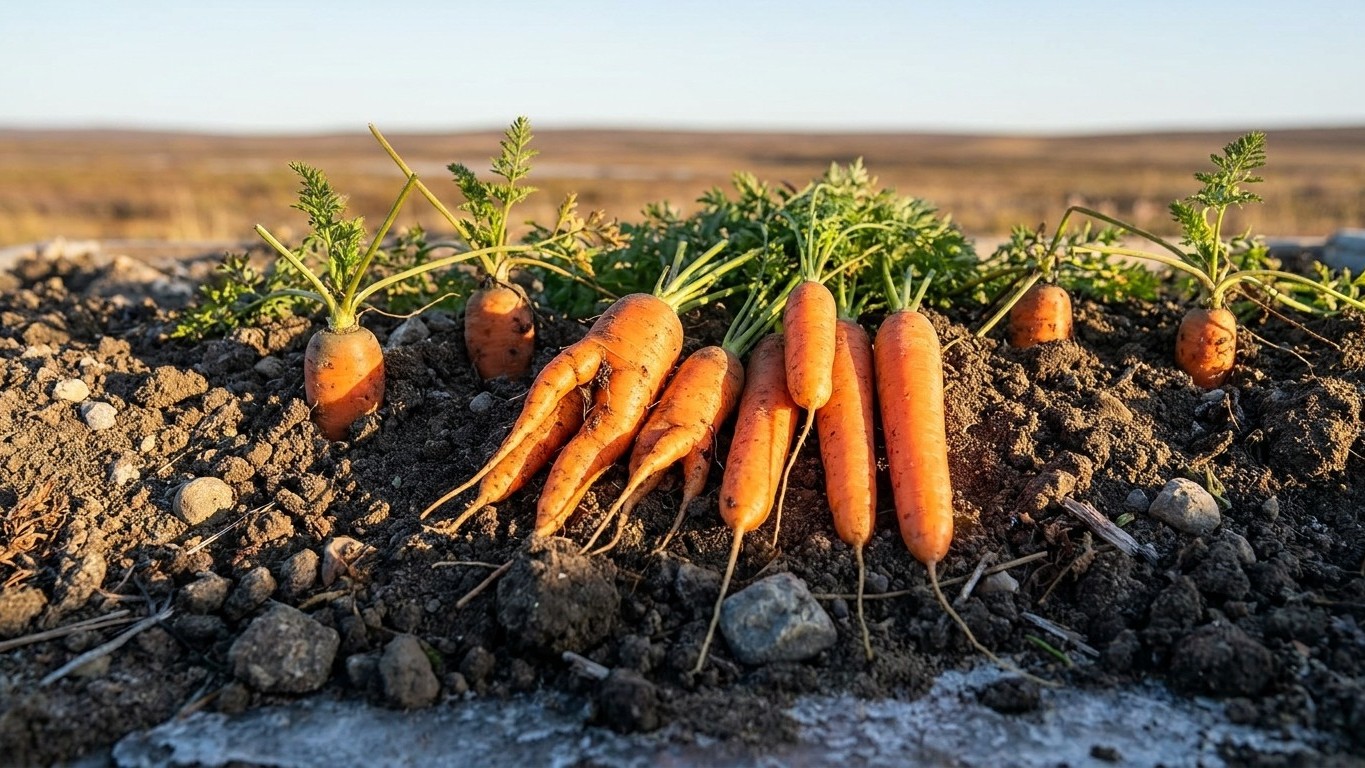
Forget counting days on a phone app and look at the shoulder of the root instead. As the carrot fattens, the very top of it pushes up level with, or just above, the soil line. Once that shoulder measures roughly three-quarters of an inch across and has gone fully orange rather than pale or greenish, the root underneath is at full size. The foliage backs this up: older leaves at the base start to yellow and the whole top loses some of its dark green vigor once the root has stopped putting on much new growth.
Carrots are sown directly in the ground, there’s no transplant step to reset the clock, so every day counted toward maturity runs from the seeding date itself. Clemson Cooperative Extension puts harvest at about 65 to 75 days after planting, and that window is a reasonable one to carry into a Colorado garden as well, since it’s tied to the plant’s own biology rather than to any one region’s weather. What changes from state to state is how much that window drifts. At Colorado’s elevation, a stretch of cool, cloudy weather can slow root sizing without damaging the crop at all, which is exactly why the shoulder-and-color check matters more than the day count. No specific first or last frost date for Colorado is published in the sourcing behind this article, so treat the 65-to-75-day figure as the anchor and let the plant’s own appearance settle the exact week.
Soil texture also nudges that window. Utah State University Extension notes that carrots want deep, sandy, well-drained ground rich in organic matter, and that heavy or rocky soil makes the root fork instead of growing straight. Colorado’s representative surface soil, the Seitz series tracked by USDA NRCS, runs to loam and silt (42 percent sand, 21 percent clay, 37 percent silt) with a slightly acid surface pH around 5.6 and good drainage, which is closer to what a carrot wants than many heavy clay soils. That said, this is a statewide reference point built from soil survey data, not a reading from any particular backyard. A raised bed two counties over, or a lot where a builder scraped and refilled the topsoil, can behave completely differently. A basic soil test is the only way to know what’s actually under your row.
Keeping them, and for how long
Once the roots are out of the ground, the tops become the enemy. Clemson Cooperative Extension is specific on this: carrots should be stored at 33°F and high humidity to prevent wilting, and the difference between bunched carrots (tops still attached) and trimmed carrots is dramatic. Bunched carrots, according to the same source, hold for about 10 to 14 days. That’s it. The leaves keep pulling moisture out of the root the entire time they’re attached, which is why cutting the tops off immediately after harvest, right at the crown, is the single step that separates a two-week carrot from one that lasts months.
That 33°F figure deserves a second look, because it sits just barely above freezing. It is not a rough approximation of “cold” or “cool.” It is a specific number, and it is a maximum-condition figure, meaning it describes the best possible outcome under ideal storage, not a guarantee. Store carrots at 40°F instead of 33°F and the difference isn’t marginal, sprouting and softening show up in a fraction of the time the source describes. High humidity matters just as much as the temperature: carrots stored cold but dry will go rubbery and limp well before they rot, because the same moisture loss that ruins bunched carrots in two weeks will eventually catch up to trimmed ones stored somewhere dry.
None of this is a promise. Clemson’s figures describe storage under conditions that hold steady, meaning a temperature that doesn’t creep up on a warm afternoon and humidity that doesn’t dry out over a few weeks. A real house rarely offers that kind of stability without some effort, which is exactly why the next section matters as much as the numbers themselves.
Where in the house that actually is
A kitchen refrigerator is the obvious first guess, but most home units run in the high 30s to low 40s, warmer than the 33°F the research describes, and the air inside is dry rather than humid. That’s workable for a bag of carrots meant to be eaten within a couple of weeks, especially in the crisper drawer with a damp towel or a perforated bag to hold some moisture in, but it isn’t the same as long-term cold storage.
A heated living space is worse, not better. Any room kept comfortable for people, meaning somewhere in the 60s or warmer, will push carrots toward sprouting and softening far faster than the 33°F benchmark allows. An attached garage swings the other direction: it tracks the outdoor temperature closely, which in a Colorado winter means it can plunge well below freezing on the coldest nights, and a hard freeze ruins stored carrots outright by rupturing the cell walls.
What tends to come closest, in most homes, is an unheated basement, root cellar, or an interior closet against an exterior wall that stays cool but doesn’t freeze. These spaces sit in a middle zone that’s harder to hit exactly than a kitchen thermometer would suggest. Checking the actual temperature with a simple thermometer left in the storage spot for a few days is worth doing before trusting a full harvest to it, since “it feels cool down there” and “it holds at 33 to 40°F” are two very different claims. Layering trimmed carrots in slightly damp sand or sawdust inside a bin, in whichever spot tests closest to that range, does more for humidity than any container placement decision alone.
| Location | Typical conditions | Fit for storage |
|---|---|---|
| Refrigerator crisper | Cold, dry air, upper 30s to low 40s°F | Good for short-term, 2 to 3 weeks with humidity added |
| Unheated basement or cellar | Cool and stable, humidity variable | Best option if it tests near freezing without dropping below it |
| Attached garage | Tracks outdoor swings, can freeze hard | Risky in winter without insulation |
| Heated living space | 60s°F or warmer, dry | Poor, accelerates sprouting and softening |
What goes wrong here
The most common failure in Colorado isn’t a pest at all, it’s a storage spot that freezes. A garage or an outbuilding that seems cold enough in October can drop well below 33°F on a hard winter night, and frozen carrots turn mushy the moment they thaw. The fix is testing the space with a thermometer through at least one cold snap before committing a whole harvest to it, and moving stored bins to an interior wall or a basement if the numbers swing too far.
Forked or stunted roots trace back to soil, not weather. Where a garden bed leans heavier and more compacted than the state’s representative Seitz series, which runs to loam and silt with decent drainage, carrots hit resistance and split into two or three legs instead of growing as one straight root. Utah State University Extension’s fix is working in plenty of compost and double digging the bed before seeding, rather than switching crops or blaming the season.
Colorado State University Extension documents several pests likely to show up on garden vegetables in the state, including flea beetles, cutworms and seedcorn maggots, grasshoppers, slugs, and spider mites, among others on its list. Cutworms and seedcorn maggots target young seedlings right at emergence, which is the point where a carrot row is most vulnerable, since a damaged stand at that stage can’t be transplanted to fill gaps. Flea beetles and grasshoppers chew foliage later in the season; enough leaf loss slows the root’s sizing even if it doesn’t kill the plant outright. Checking rows in the first few weeks after seeding, rather than waiting until roots are already sizing up, catches these problems while there’s still time to act.
A glut at harvest is its own kind of failure, just a slower one. Carrots pulled all at once and left to sit at room temperature soften within days, long before anyone gets through a full bed. Staggering harvest, or pulling only what fits the cold storage space actually available, prevents more loss than any pest ever will.
Common questions
Can I leave carrots in the ground over winter in Colorado?
Sourcing for this article doesn’t cover in-ground overwintering specifics for the state. Given how hard the ground can freeze here, and how carrots need consistent cold rather than a hard freeze, digging and moving roots to a tested cold storage spot is the safer approach based on the storage figures above.
Do I need to wash carrots before storing them?
The sourcing here focuses on temperature, humidity, and trimming the tops rather than washing steps. Brushing off loose soil and trimming the tops right at harvest are the two actions the source ties directly to storage life.
Why do my carrots taste bitter after storage?
That’s usually a sign of temperature swings or too much warmth over time rather than a variety issue, though this isn’t something the sourcing behind this article addresses directly.
Is 10 to 14 days really the limit for carrots with tops on?
That’s the figure Clemson Cooperative Extension gives for bunched carrots specifically, tops still attached. Trimming the tops off at harvest is what extends storage well beyond that two-week window.